Not so happy hunting
Guest writer Johnny Nguyen offers his tuppence worth on the dreaded house hunt in Hanoi
You might think looking for a house in Hanoi would be an exciting time, as you dream of that perfect lakeside mansion with the mild mannered and non-interfering landlord and a swimming pool in a hither-to undiscovered neighbourhood where everyone sleeps in on Sunday morning and no construction ever happens.
But let’s face it, moving house is a drag. Finding that dream house is worth celebrating, for sure, but until then, you’ll have to search the length and breadth of the city, traipse up a thousand steps while feigning interest in houses you know you don’t want as soon as you step inside.
After years of wild goose chases into areas I had already said I didn’t want to live in, I believe it’s best to be strict with a lot of local agents. Send an email, prior to meeting up, stating your preferences or shall we say demands, particularly the price and the areas you’re happy to live in.
For those of you who are new to town and don’t know the difference between Bach Khoa quarter and Truc Bach village, try to ask a colleague for some helpful parameters to work within. Otherwise you’ll end up with the worst kind of city tour, one dominated by traffic jams in the suburbs as you’re dragged from one ‘villa’ to another.
You’ll be doing well to score the perfect combination of a great area, great price and great landlord. So don’t set your hopes too high as two out of those three is not bad.
Landlords and agents may also very well tell you what you want to hear – concerned about security? Why this area is as safe as ... houses! Can’t stand construction, why nothing is going to built near here ever again! (Apart from that about-to-be-built multi-story abomination across the road, of course.)
My advice, come back after the guided visit and ask the neighbours these questions yourself. Have a look out for hidden karaoke bars or late night pho stalls that might end up hacking into your precious sleeping time, or the infernal loudspeaker, which is used for community announcements, generally at 6-million-am on certain streets. Any one of the above can ruin a perfectly good house.
For those with initiative, or time on their hands, you can go solo. You can try and drive around town and again, ask locals if they know of any houses for rent, or look for ‘house for rent’ signs, which are common enough in areas where a lot of foreigners live already, such as Nghi Tam village, Van Ho or around West Lake.
You can even look up the classifieds in Vietnamese papers (Mua Ban) or online papers (www.vnexpress.net), though you’ll need a helpful translator for this. (For English language listings check out www.newhanoian.com)
Finding a house by yourself means you have more chance of getting a better price by cutting out the middleman. In general as well, don’t be afraid to ask for household items to be included in the rental price – chairs, tables or even a TV – to be provided. Most landlords, or landladies, will be happy to negotiate the terms of the lease.
In terms of signing contracts and the small print, don’t be afraid to assert any quasi-legal deals you might think of (admittedly you learn what these might be the hard way, once bitten, twice shy). A close friend recently had the nasty experience of finding that “dream house” then quickly losing it. She moved in after shipping everything she owned over, then one week later the landlord told her that he’d sold the house and she had to move out by the end of the month. Moving had been a complete waste of time, energy and money and, as you might have guessed, there’s little chance of compensation.
Finally, for those of you who are fortunate enough to have people to look for houses for you and companies or embassies to pay for the rent, please do us little people a favour and encourage your staff to haggle on your behalf – it helps keep prices down all over town!
Monday, October 09, 2006


Saturday, October 07, 2006
Pittstop's H'ors d'oeuvre
1 - Rua Tay Di ! (And no, I don't mean "go wash a westerner")
2 - He flew through the air with the greatest of ease!
1 - Rua Tay Di ! (And no, I don't mean "go wash a westerner")
2 - He flew through the air with the greatest of ease!
Monday, October 02, 2006
Misguided in Hanoi
Got sent this link and it's a shocker to be sure, in every sense, right from the misspelling in the headline: "Thing to do", though that could work quite nicely for a satirical - short but sweet - guide to Hanoi... The One Thing To Do in Hanoi
So what is it for you - that one thing that outdoes all the others?
Answers on a postcard please.
Got sent this link and it's a shocker to be sure, in every sense, right from the misspelling in the headline: "Thing to do", though that could work quite nicely for a satirical - short but sweet - guide to Hanoi... The One Thing To Do in Hanoi
So what is it for you - that one thing that outdoes all the others?
Answers on a postcard please.
Friday, September 29, 2006
Tiger Land
A brewer turned breeder on why he bred a tiger in captivity: "I wanted to send out a message to other nature lovers that I am doing my best to save the tigers because there are reports that there are only 150 left in Vietnam."
A brewer turned breeder on why he bred a tiger in captivity: "I wanted to send out a message to other nature lovers that I am doing my best to save the tigers because there are reports that there are only 150 left in Vietnam."
Surf's up in Da Nang
The typhoon which has just thrashed the phillipines is bee-lining for central Vietnam.
The typhoon which has just thrashed the phillipines is bee-lining for central Vietnam.
Tuesday, September 26, 2006
Goedemorgen Hanoi
Here's a new book on Vietnam to keep your eyes out for. Written by a couple of volunteers involved with Voice of Vietnam. For those of you in Hanoi, book launch this Friday in Goethe Institute.
Here's a new book on Vietnam to keep your eyes out for. Written by a couple of volunteers involved with Voice of Vietnam. For those of you in Hanoi, book launch this Friday in Goethe Institute.
Monday, September 25, 2006
Spies like him
An in-depth Newyorker article on Pham Xuan An, the spy who loved them (the US), though not as much as they thought. Well worth a read.
An in-depth Newyorker article on Pham Xuan An, the spy who loved them (the US), though not as much as they thought. Well worth a read.
Friday, September 22, 2006
No ticket to ride...
I have a mantra that goes something along the lines of "back right pocket, back right pocket, just remember back right pocket". Or perhaps, it's more like self-hypnosis. Either way, the desired effect is to drum it into my thick-befuddled head that the only way not to lose my parking ticket or, at least, give myself the best possible chance of not losing it, or waste time looking for it, is to always put it in the same place – you guessed it, my back right pocket. Yes, I see you ladies with your enormous purse-bags at Hanoi Towers staring hopefully inside, hoping that the piece of paper that is known as your parking ticket might suddenly be as large and colourful as a flag. I feel your pain. I have a man-bag of my own with a dozen or so pockets I never normally use, though for some reason these infernal tickets always found their way in, before crumpling themselves and playing hide and seek. I've seen you drunken boyos, too, realising you've lost it and deciding there's no point arguing with the stony faced bao ve (parking attendant), so instead you rev up and accelerate through the gate like the Lone Ranger taking off with a "Hi-Ho Silver!" But I've also seen you caught by the scrawny bao ve (you didn't notice those rau muong powered Popeye-muscles on him did you?), de-saddled and berated. I myself have embarrassed myself in parking lots all across the city, shouting that I didn't get a ticket (believing I hadn't) until they "released me". Of course, when I return home and empty my pockets, I come face to face with the elusive, laminated rapscallion of a card and feel more than a tad guilty. Foreigners are the lucky ones, as they probably end up getting away with losing the tickets (either through sweet talk or ranting in incomprehensible Vietnamese), and driving home, albeit a little sheepishly. Vietnamese people would be forced to wait until all the other motorbikes are gone, until the bao ve can finally survey the desolate car park and decide with a fair degree of authority that the 16-year old doe-eyed girl claiming to be the owner of the sole remaining motorbike, who even has the matching pink T-shirt (with I Love U written on it) and the right key to prove it, is not a bare-faced teenage bandit, before allowing her to take the bike home. My simple advice, choose a pocket and stick to it.
I have a mantra that goes something along the lines of "back right pocket, back right pocket, just remember back right pocket". Or perhaps, it's more like self-hypnosis. Either way, the desired effect is to drum it into my thick-befuddled head that the only way not to lose my parking ticket or, at least, give myself the best possible chance of not losing it, or waste time looking for it, is to always put it in the same place – you guessed it, my back right pocket. Yes, I see you ladies with your enormous purse-bags at Hanoi Towers staring hopefully inside, hoping that the piece of paper that is known as your parking ticket might suddenly be as large and colourful as a flag. I feel your pain. I have a man-bag of my own with a dozen or so pockets I never normally use, though for some reason these infernal tickets always found their way in, before crumpling themselves and playing hide and seek. I've seen you drunken boyos, too, realising you've lost it and deciding there's no point arguing with the stony faced bao ve (parking attendant), so instead you rev up and accelerate through the gate like the Lone Ranger taking off with a "Hi-Ho Silver!" But I've also seen you caught by the scrawny bao ve (you didn't notice those rau muong powered Popeye-muscles on him did you?), de-saddled and berated. I myself have embarrassed myself in parking lots all across the city, shouting that I didn't get a ticket (believing I hadn't) until they "released me". Of course, when I return home and empty my pockets, I come face to face with the elusive, laminated rapscallion of a card and feel more than a tad guilty. Foreigners are the lucky ones, as they probably end up getting away with losing the tickets (either through sweet talk or ranting in incomprehensible Vietnamese), and driving home, albeit a little sheepishly. Vietnamese people would be forced to wait until all the other motorbikes are gone, until the bao ve can finally survey the desolate car park and decide with a fair degree of authority that the 16-year old doe-eyed girl claiming to be the owner of the sole remaining motorbike, who even has the matching pink T-shirt (with I Love U written on it) and the right key to prove it, is not a bare-faced teenage bandit, before allowing her to take the bike home. My simple advice, choose a pocket and stick to it.
By Teddy de Burca Jnr
Wednesday, September 13, 2006
Obituary
Oh dear – "Hung Electric" electrocuted (and dies). Vietnamese version here (Nguoi khong bi dien giat chet vi dien).
Oh dear – "Hung Electric" electrocuted (and dies). Vietnamese version here (Nguoi khong bi dien giat chet vi dien).
Tuesday, September 12, 2006
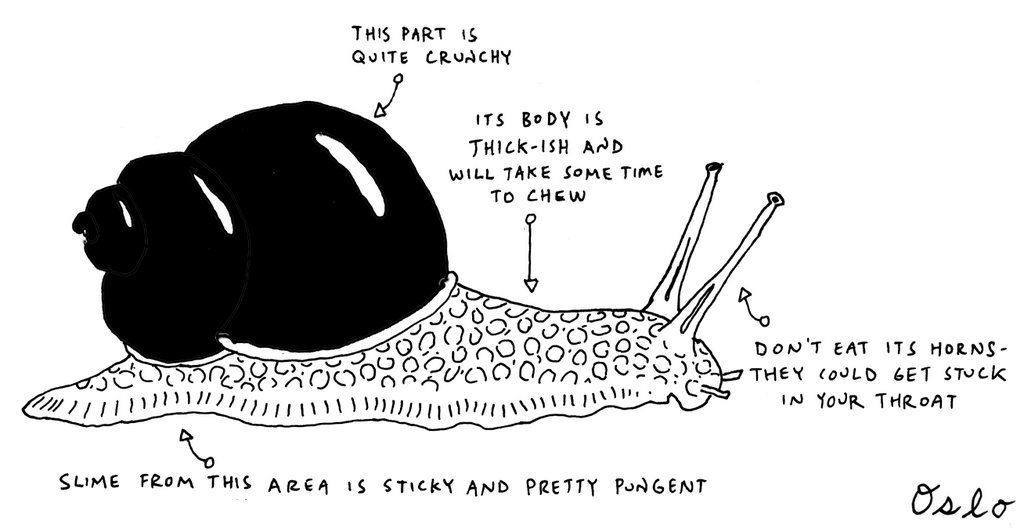
The Snail - My gastronomical nemesis
Over the last six years in
By Teddy de Burca Jnr.
***************************************************************************
This piece originally appeared in Raised Eyebrows - Melbourne's
favourite A3 magazine created by illustrator Paul Oslo Davis
It's his picture of a snail at the top, click on it for a BIG version
***************************************************************************
This piece originally appeared in Raised Eyebrows - Melbourne's
favourite A3 magazine created by illustrator Paul Oslo Davis
It's his picture of a snail at the top, click on it for a BIG version
Thursday, September 07, 2006
Beep-beep beep-beep - yeah!
To beep or not to beep, that is the question. Personally, I beep at young couples with babies squashed in between their bodies, because if we crashed I'd probably be held responsible for the baby's injuries, even though it wouldn't have been my idea for them to take their baby out for a devil-may-care spin on a motorbike. I also beep at enormous articulated lorries even though I know it's utterly pointless. Old men beep when no one's in front of them, just in case someone might suddenly pop out of the asphalt, perhaps. Better safe than sorry. My next door neighbour beeps rather than press her doorbell; her dutiful country cousin-maid scuttles out to open the gate. Why my neighbour hasn't got a key or, if she has, why she refuses to use it herself is anyone's guess. The buses that barrel down the roads beep indiscriminately at anything that moves, flinches, breathes, exists – as long as it's in their way – even though we were here first. Sometimes I wonder do they beep at other buses. Middle aged dads teach their kids perched in between their thighs how to make the bike go beep; a valuable lesson for the future. The young teenagers with bony limbs, spiky hair and dressed in football shirts beep with extra loud horns they've installed to scare the bejesus out of anyone in front of them. It is highly effective but should be punishable by enforced exile to Mu Cang Chai*. Young corporate women beep outside bakeries while shouting "em oi!" A hot banh bao or bread roll is then delivered to them all of five feet away on the street (time is money). Everyone beeps when the lights turn green, a few people even beep when the lights are red. My friend from New Zealand beeps with orange plugs rammed in his ears – if you can't beat them, join them (or beep back) is his philosophy. Everyone beeps at once when Vietnam wins a football game. Cars and vans flash their lights while they beep, sort of a double reminder to make sure you notice that they're driving on your side of the road at high speed. Sometimes people beep accidentally - oops! Some folk don't even realise they're beeping - huh? Some people beep because someone else is beeping at them - grr! No one knows who's the last person to beep at night. No one knows if there's a sound when a motorbike beeps in the middle of a forest with no one around or how many hearts beep per minute on any given day in Hanoi. But I do know that every morning a motorbike passing my house beeps before my alarm clock does and afterwards, too; certainly handy for making sure I don't sleep in, as well as serving as a reminder that there's no point dreaming of a day without a beep.
To beep or not to beep, that is the question. Personally, I beep at young couples with babies squashed in between their bodies, because if we crashed I'd probably be held responsible for the baby's injuries, even though it wouldn't have been my idea for them to take their baby out for a devil-may-care spin on a motorbike. I also beep at enormous articulated lorries even though I know it's utterly pointless. Old men beep when no one's in front of them, just in case someone might suddenly pop out of the asphalt, perhaps. Better safe than sorry. My next door neighbour beeps rather than press her doorbell; her dutiful country cousin-maid scuttles out to open the gate. Why my neighbour hasn't got a key or, if she has, why she refuses to use it herself is anyone's guess. The buses that barrel down the roads beep indiscriminately at anything that moves, flinches, breathes, exists – as long as it's in their way – even though we were here first. Sometimes I wonder do they beep at other buses. Middle aged dads teach their kids perched in between their thighs how to make the bike go beep; a valuable lesson for the future. The young teenagers with bony limbs, spiky hair and dressed in football shirts beep with extra loud horns they've installed to scare the bejesus out of anyone in front of them. It is highly effective but should be punishable by enforced exile to Mu Cang Chai*. Young corporate women beep outside bakeries while shouting "em oi!" A hot banh bao or bread roll is then delivered to them all of five feet away on the street (time is money). Everyone beeps when the lights turn green, a few people even beep when the lights are red. My friend from New Zealand beeps with orange plugs rammed in his ears – if you can't beat them, join them (or beep back) is his philosophy. Everyone beeps at once when Vietnam wins a football game. Cars and vans flash their lights while they beep, sort of a double reminder to make sure you notice that they're driving on your side of the road at high speed. Sometimes people beep accidentally - oops! Some folk don't even realise they're beeping - huh? Some people beep because someone else is beeping at them - grr! No one knows who's the last person to beep at night. No one knows if there's a sound when a motorbike beeps in the middle of a forest with no one around or how many hearts beep per minute on any given day in Hanoi. But I do know that every morning a motorbike passing my house beeps before my alarm clock does and afterwards, too; certainly handy for making sure I don't sleep in, as well as serving as a reminder that there's no point dreaming of a day without a beep.
By Teddy de Burca Jnr.
* Mu Cang Chai is a Vietnamese friend's joke term for the back of beyond
* Mu Cang Chai is a Vietnamese friend's joke term for the back of beyond
Guess these famous beepers, click on the link to get your answer
1 - Heh, I'm doin' my thing while you're playin wit ya [*BEEP*])
2 - The original uncatchable Beep-beep
3 - The title of this blog comes from these rather famous beepers
Friday, September 01, 2006
I’d like to teach the world to shout “oi”!
Without the slightest shred of evidence, I’d say, with a fair degree of certainty, that if you shouted out “oi!” quite loudly you’d probably get anyone’s attention anywhere in the world. But the difference between the rest of the world and Vietnam is that it wouldn’t be considered even remotely rude here. In fact, it’s like, ‘hey’, ‘excuse me’ and ‘yoo hoo’ all wrapped up together into one beautiful word. As you might know it is to be said with a name to grab their attention, for example, “Paul oi!" or “Osama oi!” or for a complete stranger with a pronoun “Anh” (for older man) or “em” (younger man or woman), for example. If the person hears them they reply, like a charming little echo, with another “oi”, which is itself a “what?”, “yes!” “I’m over here” all rolled into one. I think of the powerful simplicity of “oi” every time I go home and stand at the bar while your typical surly barman cleans a glass and steadfastly refuses to acknowledge me. It would be so much easier if I could just holler out “barman oi”. But as tempting as it is I’d never dare. An English friend once said the main difference between Hanoi and London was if you stuck two fingers up at someone in a bar and said “oi” in Hanoi you’d get two beers, whereas in London you’d be punched in the face. So if you’re reading this outside of Vietnam then, please, remember, don’t try this at home.
************************************************************************************
This short piece was originally written for Raised Eyebrows, illustrator Paul Oslo Davis' magazine, which is based in a town called Melbourne in a country known as Oz. You can discover all about Oz culture here - fascinating.
Without the slightest shred of evidence, I’d say, with a fair degree of certainty, that if you shouted out “oi!” quite loudly you’d probably get anyone’s attention anywhere in the world. But the difference between the rest of the world and Vietnam is that it wouldn’t be considered even remotely rude here. In fact, it’s like, ‘hey’, ‘excuse me’ and ‘yoo hoo’ all wrapped up together into one beautiful word. As you might know it is to be said with a name to grab their attention, for example, “Paul oi!" or “Osama oi!” or for a complete stranger with a pronoun “Anh” (for older man) or “em” (younger man or woman), for example. If the person hears them they reply, like a charming little echo, with another “oi”, which is itself a “what?”, “yes!” “I’m over here” all rolled into one. I think of the powerful simplicity of “oi” every time I go home and stand at the bar while your typical surly barman cleans a glass and steadfastly refuses to acknowledge me. It would be so much easier if I could just holler out “barman oi”. But as tempting as it is I’d never dare. An English friend once said the main difference between Hanoi and London was if you stuck two fingers up at someone in a bar and said “oi” in Hanoi you’d get two beers, whereas in London you’d be punched in the face. So if you’re reading this outside of Vietnam then, please, remember, don’t try this at home.
************************************************************************************
This short piece was originally written for Raised Eyebrows, illustrator Paul Oslo Davis' magazine, which is based in a town called Melbourne in a country known as Oz. You can discover all about Oz culture here - fascinating.
Tuesday, August 29, 2006
Pittstop's suggested nibbles
* If you read this article would you want to go to Hanoi, if you'd never been before? Written for Ho Chi Minh City expats.
* Funny story here about an escaped prisoner, who found a pretty good, and fairly audacious, hiding place from the police, which should get the Professor Moriarty award for deviousness.
* If you read this article would you want to go to Hanoi, if you'd never been before? Written for Ho Chi Minh City expats.
* Funny story here about an escaped prisoner, who found a pretty good, and fairly audacious, hiding place from the police, which should get the Professor Moriarty award for deviousness.
Bite size entry
Pittstop Works has had around 800 clicks in just under two months - which is roughly a hundred a week, and that's just under 15 clicks a day, (let's not count all the times I click on it to check up on how it looks), which is funny as I just read this cute quote from David Weinberger "an advocate of new-media journalism" who said, as a witty play on Andy Warhol’s maxim, re: the internet: “On the Web, everyone will be famous to fifteen people.”
Saw it in an article on The Newyorker which is well worth a read.
Pittstop Works has had around 800 clicks in just under two months - which is roughly a hundred a week, and that's just under 15 clicks a day, (let's not count all the times I click on it to check up on how it looks), which is funny as I just read this cute quote from David Weinberger "an advocate of new-media journalism" who said, as a witty play on Andy Warhol’s maxim, re: the internet: “On the Web, everyone will be famous to fifteen people.”
Saw it in an article on The Newyorker which is well worth a read.
Thursday, August 24, 2006
Many happy returns
(Retracing your steps along Cua Dai Beach)
As travellers we make a lot of promises wherever we go. We always say we’ll come back – and in an ideal world perhaps we would. But after seven years in Vietnam, it’s only Hoi An that I’ve been to several times a year, every year without fail.
In this chunk of time the changes to the old port town have been significant. What once seemed a sleepy old place is now alive with tourists all year round while an over abundance of tailors, restaurants and gift shops blurs the mind.
Now these changes are starting to stir up the coastline. On the way in to Cua Dai beach from the airport in the neighbouring city of Danang, the taxi driver tells me there’s big plans for what is called China beach, which runs south from the port city.
As we swerve around an old man with no arms who’s cycling a bike, he points from one place to the next telling me how a string of resorts are planned. He tells me this is good for everyone.
The road we’re driving on, which goes behind Marble Mountain, is a work in progress. Along the sides of the road half-houses are left standing, people’s front rooms have been cleared to make way for the construction. Regardless, life goes on. The front door is now where the living room used to stand. Chinese symbols that were once above family altars now front the house. Children play outside as labourers shovel cement and lay asphalt on the road to be.
On Cua Dai beach, where a number of high end resorts are happily fully occupied, everything seems as it always was.
I find my old friend Hon’s restaurant and settle into a seafood banquet of fried squid, boiled crab and a bowl of clams with Larue beer on ice. Hon tells me she’s moved which is why it took a while for me to find her. After three years when the lease is up the local government insists they move spot. I’d always wondered why they never bothered investing in the shack-like restaurants.
There are a dozen or so places like Hon’s in a row. The owners and helpers dressed in denim jackets, and wearing handkerchiefs for masks, coo the sunburnt backpackers shuffling down the beach, inviting them to sit in the deckchairs. Sitting is free if you buy a drink; so naturally a few thrifty travellers just buy a bottle of water and camp out for a few hours. Hon tells me every three years her lease is more expensive making it harder and harder to survive.
In the sea Vietnamese children swim in t-shirts. The younger ones carry broken bits of polystyrene as floats. They stop and stare as an old Dutch woman in a skimpy bikini goes out to test the waters.
The sea is deep blue and calm but suddenly a wave comes out of nowhere to the sound of a motor. Everyone looks up to see guests at the Palm Garden Resort on a jet ski buzzing past the moored fishing boats.
As you sit on the beach hawkers come past one by one. A geriatric lady selling cigarettes and tiger balm; a young girl with jewellery who looks for a promise ("maybe later you buy?"); a plumper manicuring-massaging lady; and an old disabled man who walks on his hands with a copy of yesterday’s Vietnam News.
Further down the beach, near the entrance more local Vietnamese customers can be found sitting on plastic chairs under the shade of thin trees drinking iced drinks for less than 25 cents.
In the late afternoon taxi drivers play dice while xe om drivers sit in a sliver of shade, all playing the waiting game; as the day progresses the beach will empty and tourists will head to town for a stroll along the river, or to hit the tailors before dinner and drinks. The shuttle bus from the Victoria Resort shoots past first. A few more young backpackers on rented motorbikes are next. Then come the brave ones who cycled out in the searing heat. Two remaining xe om drivers look edgy until a couple of sunkissed English girls hitch up their skirts and jump on the pillion. The drivers’ faces light up as the buxom girls squeeze closer. They’re too excited to even mention the price. Happy days indeed.
Yes, it’s the cliché of the travel writer to say you’ll always return, but as I leave in the twilight, Hon waves me off with a sincere, “see you later”. She knows I always come back. I bet I'm not the only one.
(Retracing your steps along Cua Dai Beach)
As travellers we make a lot of promises wherever we go. We always say we’ll come back – and in an ideal world perhaps we would. But after seven years in Vietnam, it’s only Hoi An that I’ve been to several times a year, every year without fail.
In this chunk of time the changes to the old port town have been significant. What once seemed a sleepy old place is now alive with tourists all year round while an over abundance of tailors, restaurants and gift shops blurs the mind.
Now these changes are starting to stir up the coastline. On the way in to Cua Dai beach from the airport in the neighbouring city of Danang, the taxi driver tells me there’s big plans for what is called China beach, which runs south from the port city.
As we swerve around an old man with no arms who’s cycling a bike, he points from one place to the next telling me how a string of resorts are planned. He tells me this is good for everyone.
The road we’re driving on, which goes behind Marble Mountain, is a work in progress. Along the sides of the road half-houses are left standing, people’s front rooms have been cleared to make way for the construction. Regardless, life goes on. The front door is now where the living room used to stand. Chinese symbols that were once above family altars now front the house. Children play outside as labourers shovel cement and lay asphalt on the road to be.
On Cua Dai beach, where a number of high end resorts are happily fully occupied, everything seems as it always was.
I find my old friend Hon’s restaurant and settle into a seafood banquet of fried squid, boiled crab and a bowl of clams with Larue beer on ice. Hon tells me she’s moved which is why it took a while for me to find her. After three years when the lease is up the local government insists they move spot. I’d always wondered why they never bothered investing in the shack-like restaurants.
There are a dozen or so places like Hon’s in a row. The owners and helpers dressed in denim jackets, and wearing handkerchiefs for masks, coo the sunburnt backpackers shuffling down the beach, inviting them to sit in the deckchairs. Sitting is free if you buy a drink; so naturally a few thrifty travellers just buy a bottle of water and camp out for a few hours. Hon tells me every three years her lease is more expensive making it harder and harder to survive.
In the sea Vietnamese children swim in t-shirts. The younger ones carry broken bits of polystyrene as floats. They stop and stare as an old Dutch woman in a skimpy bikini goes out to test the waters.
The sea is deep blue and calm but suddenly a wave comes out of nowhere to the sound of a motor. Everyone looks up to see guests at the Palm Garden Resort on a jet ski buzzing past the moored fishing boats.
As you sit on the beach hawkers come past one by one. A geriatric lady selling cigarettes and tiger balm; a young girl with jewellery who looks for a promise ("maybe later you buy?"); a plumper manicuring-massaging lady; and an old disabled man who walks on his hands with a copy of yesterday’s Vietnam News.
Further down the beach, near the entrance more local Vietnamese customers can be found sitting on plastic chairs under the shade of thin trees drinking iced drinks for less than 25 cents.
In the late afternoon taxi drivers play dice while xe om drivers sit in a sliver of shade, all playing the waiting game; as the day progresses the beach will empty and tourists will head to town for a stroll along the river, or to hit the tailors before dinner and drinks. The shuttle bus from the Victoria Resort shoots past first. A few more young backpackers on rented motorbikes are next. Then come the brave ones who cycled out in the searing heat. Two remaining xe om drivers look edgy until a couple of sunkissed English girls hitch up their skirts and jump on the pillion. The drivers’ faces light up as the buxom girls squeeze closer. They’re too excited to even mention the price. Happy days indeed.
Yes, it’s the cliché of the travel writer to say you’ll always return, but as I leave in the twilight, Hon waves me off with a sincere, “see you later”. She knows I always come back. I bet I'm not the only one.
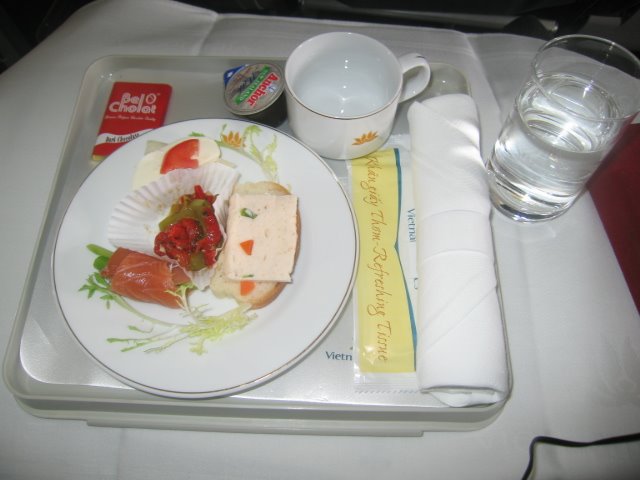
 Above, a simple tale of compare and contrast...
... below, well, the pictures tell the story but we wrote another one anyway.
The dizzying heights, the terrifying lows
What goes up must come down. Teddy de Burca Jnr. gets a taste for a habit he can’t afford to keep – flying business class
If you were ever wondering what’s different between business class and economy class on internal flights in Vietnam, the answer is, perhaps obviously, food and space.
Due to incredibly bad organisation on my part, my intended flight to Danang was fully booked, but there was space in business class, said the cunning woman at my local Vietnam Airlines ticket outlet. I had a tight schedule and for another couple of hundred thousand Vietnam dong it didn’t seem totally outrageous.
Anyway I was also curious to fly down with the jet setters on business and return with my fellow hoi polloi in economy. And how pleased was I when I received an invitation to the business class lounge where I could no doubt practice rubbing shoulders with the other go-getters.
Besides being the only person in shorts and a garish orange t-shirt, I admit I felt a bit inadequate in the mobile phone department and a laptop and a suitcase might have helped me assimilate better than my rucksack and plastic bag containing my toiletries and sandals. Still I guess they just took me for a flash young traveller – the sort who might have made millions after inventing a clip on-speedometer for snowboards and is now seeing the world at his leisure.
Now for a 55 minute flight between Danang and Hanoi, you’d hardly be bothered by a bit of discomfort, but the first difference on the plane is not surprisingly space – where there are three chairs down the back, up front there are only two. This will reduce the chances of a) your neighbour nodding off on your shoulder and snoring in your ear b) your neighbour elbowing you in the head when he turns the pages of his newspaper or c) everyone standing up awkwardly when someone on the inside has to go the toilet.
Then there’s the freshly prepared face towels, not the thin wet paper ones in wee plastic bags. You’re also presented with a juice. There’s also the marked increase in cordiality: “Good morning, sir!” It's all very pleasant.
Next up is the meal – as opposed to a bread bun with some ham, a shred or two of lettuce and a splodge of mayonnaise and a shot of water to wash it down (described as an “indefinable sandwich and a beaker of water” by one disgruntled punter), you are offered a piece of salmon sashimi, fish mousse on bread and insalata caprese (yes, that’s mozzarella and tomato in English, but when in business class it’s hard not to assume a pompous air).
On the side there’s a cloth napkin, a glass of water and a cup for coffee or tea. Why it was like a party in Vienna after a night at the opera.
Of course, on the way back to Hanoi I was back to where I belong, elbows drawn like knives and scrunched up in the cheap seats.
For this lowly travel writer, it was a brief moment in the sun sitting in business class – I’ll have to wait till the next time I muck up my own schedule or have the pleasure of being bumped up (before every trip I pray for it). Every now and then I can afford to live it up but sadly flying business class would be like drinking champagne on a Sprite budget.
Tuesday, August 22, 2006
How to get to the Land of Nod
Restless and jealous, Yorkie Pittstop wonders what he’s missing out on when it comes to post-lunch napping
After lunch, particularly when it’s searing hot outside, I always admire my colleagues attitude: eat lunch in the office, leaving ample time for a wee siesta. It looks lovely. And how they manage to just curl up in a chair or recline between two chairs pulled together is admirable.
On a hot Hanoi afternoon you can often see xe om drivers stretched along their motorbikes, head on the handlebars or xich lo drivers slumped in their own chairs. Fruit vendors can be found nodding off in doorsteps, inside markets sellers sleep on piles of fabric while in shops assistants can be found passed out under the cash register.
I’ll admit that I’ve tried in my office but perhaps there’s more to a post-lunch nap then meets the eye. Inevitably I end up looking as if a train just rolled over my cheek and forehead, just like when I was a kid and nodded off at school and the teacher asked me if I’d been asleep. “Oh no,” I’d say, looking up with a thick red line across my face. “Not me.”
I also struggle waking up again. It takes a couple of coffees and several splashes of water on the face to get me going again. I wish I could siesta, but it seems I’m conditioned to see the day through from dawn to whenever I head for the hills.
Besides the “art” of having a siesta there’s also the culturally ingrained (western) tendency to see taking one as a sign of idleness (and therefore you must be unemployed, downright lazy or fond of puffing on exotic cheroots). To work too hard in the west is seen as commitment to your job. But the truth is a quick nap could help productivity in the afternoon.
NASA (and they have a lot of brainy people involved so they must be right) research discovered the effects a 40-minute snooze had on pilots and astronauts and found there was a 34 per cent improvement in performance and a 100 per cent improvement in alertness. British Airways used this evidence to sanction naps for pilots.
Most adults around the world get an average of 6.5 hours, below the generally recommended 8 hours. Studies show that blood pressure and arterial blood pressure dropped during a siesta. A quick post noon nap also promotes physical well-being, improves your mood and memory and revitalises you. How can doing so little do so much, you wonder.
Oddly enough in Spain where the siesta is seen (at least by outsiders) as a national tradition, sleeping after lunch is becoming less common. Now, as the country aligns itself with international working times, less than 25 per cent of Spaniards enjoy a bit of a shuteye after lunch.
There are however now modern means to meet modern ways – even new terminology: the metronap (check out www.metronaps.com) – with downtown corporate nap parlours appearing in European and American cities. So dog tired business people can recharge the batteries, for a price that is.
Meanwhile in the UK, perhaps, the mad dogs will be left to themselves in the midday sun as Englishmen may soon be heading indoors. Each year as summer temperatures seem to be on the rise health groups are encouraging siestas as a way to beat heat fatigue and heatstroke.
In Germany there are reports of companies offering employees an extra 20 minutes at lunchtime to catch some zzzs – and apparently employees have taken to it rather well.
And so the pendulum swings – back in the tropics, at least in Vietnam, attitudes may be shifting as young professionals feel they don’t have the time for a siesta anymore. While others might prefer to use this free time to meet with friends for coffee or even go shopping.
But when the temperature is well over 30 degrees and considering in Vietnam I have longer lunch hours than I ever had before, plus there’s only so much coffee you can drink, there’s plenty of time and plenty of reasons to have forty winks. I just need to get into the rhythm of it. Perhaps all I have to do is practice… work on my naptitude, if you will.

Finger licking good, but only for some
The New KFC has been a vaguely controversial topic in Hanoi since opening last month. Who after all came to Vietnam to eat Western style fastfood?
Regardless, a few western acquaintances of mine turned up at a bia hoi with large bags of the famous battered chicken. Colleagues came to work with chicken burgers and fries. To be fair most seemed pretty happy with what they got. Those who steadfastly refuse to entertain the thought of eating “western junk” prefer not to mention the subject. Old timers will mumble something about the heady days when expats tucked into greasy fried chicken on Tran Hung Dao. The begrudgers mention we haven’t seen the last of avian flu (the answer to which, by the way, for KFC in Ho Chi Minh City was to push the fish burger).
As many Hanoians know plenty of KFC restaurants already exist in Ho Chi Minh City (there’s 20 in southern Vietnam), so despite the rather ironic novelty of being gleeful for the official arrival of western junk food in the capital city perhaps there’s less stigma attached to the psychological blow or impact that a McDonald’s opening would have.
The hold that such institutions have on westerners is rather curious – people have told me that despite never having really eaten McDonald’s much before coming to Asia they still feel compelled to eat there when they see one, say in Bangkok or Singapore. There’s a magnetic appeal to those golden arches (or whatever your preferred poison, for me it used to be a Whopper). Afterwards people will even admit they feel awful, but like any binge substance they come back to it. Again and again.
In a city full of Bangkok or Singapore’s culinary delights eating such junk food might seem like a heinous crime to many. So why do we do it?
Personally, I can blame the parents. As a child I was actually banned from eating McDonald’s by my mother. So, of course, when myself and my cousin (also banned from touching the stuff) came into money our first objective was a banquet at chez Ronald McDonald. In one sitting we would eat every kind of burger, knock back a couple of chocolate milkshakes, devour 20 chicken (I admit substance is debatable here) nuggets and a chocolate sundae.
So I know the guilty pleasure of a hamburger and fries but I’m also most definitely not alone in appreciating the obvious virtues of Vietnamese food. Streetside restaurants serving pho or bun dishes can be quickly prepared, making it for this humble columnist the ultimate fastfood (as in it comes fast but it’s healthy and you feel fine afterwards). A few travellers I’ve met told me they’d lost weight on trips to Vietnam despite eating like kings the whole time.
Would Vietnamese people eat in McDonald’s? A long time ago I would have said no, but as far as I know, thus far, there’s not a country in the world that has resisted Ronald McDonald’s formula (for obesity you might say), meanwhile KFC seems to be fairly upbeat on initial business (though it’s too early to judge). Although I can’t imagine any ba gia (old grannies) tucking into Big Mac meal, for young people it will probably prove popular enough.
Yes, it’s a sign of the times, it’s the way of the world, it’s what people want, but it’s also damn depressing, so depressing I think I’m going to go out and gorge myself on bun rieu, bun cha, pho ga, banh cuon, nem cuon, banh xeo, banh bao… after all we don’t need ‘finger lickin' good’ in Vietnam – we use chopsticks.
***********************************************************************************
Extra info from skimming through the internet...
What do Pamela Anderson, Martin Freeman of the Office, Sir Paul McCartney, Chrissie Hynde, His Holiness the Dalai Lama, the Black Eyed Peas, The Darkness and Ravi Shankur (Yes! the Ravi Shankur!) all have in common? Well they believe there are lots of other reasons not to eat KFC - even in America! You can check out these sites they're involved with and make your own decision - UK based one or the US version – or even watch a very disturbing video here. (Done by PETA - People for the Ethical Treatment of Animals).
Here's an article about how PETA plan to sue KFC, from The NY Times from today, August 22, and a few bits and bobs in a sober analysis by the Guardian from late last year.
Urban myths that may or may not be true: when KFC first translated the advertising slogan Finger lickin' good into Chinese, it came out as "eat your fingers off", while one guy claimed in Quebec, where KFC is known as PFK (Poulet Frit Kentucky), he saw a sign that read Finger licking' bon.
So "Finger lickin' ngon"? Well, once again, this is a land of chopsticks. But there's a question I didn't think of - are chopsticks actually available in KFC?
Tuesday, August 15, 2006
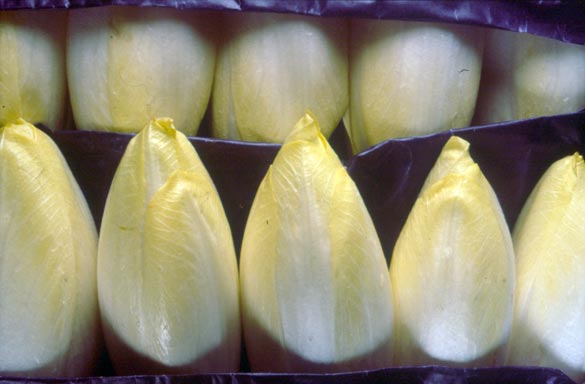 For those of you who think the Brussel sprout is the national veg of choice in Belgium think again... introducing The witloof now blogging his guts out from the heart of the EU.
Friday, August 11, 2006

A rare treat indeed, in fact a first, fashionista Petra Patterson slips into the controversy surrounding the plastic shoes now hitting the Hanoi streets... Crocs. (Check out the very sincere testimonials page.)
Is this the new Dep (dzep)?
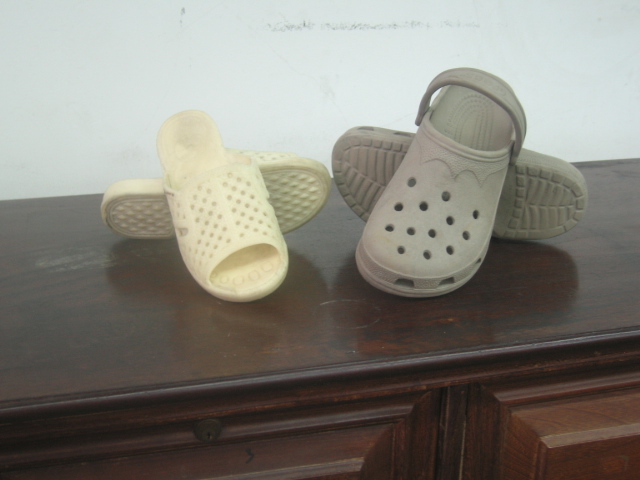
Over the last year the new foot craze around the world has been Crocs, a light sandal-shoe originally designed as a boating/outdoor shoe because of its slip-resistant, non-marking sole.
The company promises that you’ll “stand out, look good, stay comfortable” but despite the fact the shoe has been a massive hit in the US, and is now sweeping the rest of the world off it’s feet, people can only seem to agree that it’s comfortable.
As the expats and Hanoians return from summer holidays, the shoe is already ubiquitous in town, though not yet available in Vietnam. I couldn’t help but notice that at the last soiree I attended over half of the shoes (if not more) left by the door were Crocs.
But inside the house the shoe-cum-sandal seemed to be splitting the critics.
“They’re just so comfy,” gushed Simone from New Zealand.
“But why would you pay $30 for dep,” moaned Paul from England, seeing no difference between the classic Vietnamese shower dep and Crocs. “It’s just a plastic shoe.”
“I strongly recommend them for Hanoi,” said Huong from Vung Tau, who claimed the shoe is even durable enough to tackle a Minsk motorbike.
“They make me feel comfortable, clean and light,” said Tuan Anh, who picked up a pair in Bangkok. “But other Vietnamese guys think they’re very xau (ugly).”
Outside of Vietnam it appears Crocs are also “you either love ‘em or you don’t”.
Shoe Blogger Sam Lyster claims “any shoe that can survive a session in a dishwasher should be avoided at all costs,” describing them as “plastic clogs” that come in various “unappealing colours”; a US teen on another blog complained that “everyone in school wears them”, while others, well, judging by the astronomical sales, they’re clearly voting with their feet (second quarter revenues tripled to $85.6 million over $25.8 million last year).
But if you don’t stand out, and they’re not pleasing to your eye, why bother? Simone challenged me as we left the party, “go on, just try them on”, she said slipping me her shoe, and I must admit, they certainly were light on the feet, but you could make the same argument about dep, couldn’t you?
*****************************************************************************
If you’re curious to find out more, you can hear two extreme sides of the argument at www.crocfans.com and www.ihatecrocs.com respectively
Friday, August 04, 2006
Safe as houses, as long as you lock the door
A few years back I woke up on a bright Monday morning to a nice breeze coming through my room, which was most pleasant but rather unexpected. I sat up to realise the balcony doors were wide open. I scratched my head wondering had I foolishly left the doors like that all night. Possible as from time to time, my housemate and I would stand outside there in the evening, drink a beer or smoke a cigarette, while complaining about our other housemate, of course.
But I disremembered doing that the night before, in fact, I recalled, burnt out from the weekend’s indulgences, I went straight to bed and straight to sleep. So I climbed out of bed and ventured out to the balcony to investigate, perhaps, instinctively knowing what had happened but not wanting to even contemplate it.
Sure enough, outside there was a large empty envelope on the ground. It was an envelope I recognised. An envelope that hitherto I had known as “the big, fat envelope”, christened so, as it contained a month and a half’s salary, a lump sum I planned on spending on little old me on a Thai beach when school was out for the summer.
The cash was obviously gone; a veritable jackpot for whoever swiped it, and unlike jewellery or a CD player, completely untraceable. Shocked rather than upset, later on I told my neighbours, a couple of foreigners, as much to warn them to be careful (as in, don’t be naive like me and make sure you lock up at night, even hard-to-get-to-balcony doors).
“Oh yeah, we’ve been robbed lots of times,” said one, admitting that presuming the other to still be out they kept going to bed leaving their front door closed but unlocked.
On the last occasion one of them woke up as a shadowy hand hovered over the bedside table searching for a mobile phone or a wallet. He jumped up and chased him out of the house but the intruder was like a cat – up and over the gate and gone.
“I couldn’t chase him any further as I didn’t have any clothes on,” admitted the victim.
Of course, most urban Vietnamese houses have high gates, padlocks, and even barred windows. It’s pretty hard to get in, so those who try are probably well-practiced. At first I kept thinking about how amazing it was that the one time I hadn’t locked the balcony door I’d been burgled, until someone pointed put it mightn’t have been the first time they tried to get in.
Plus, even with locked doors, leaving windows open can be dangerous. Another friend told me how once he woke up to a spooky image – levitating trousers. He rubbed his eyes and looked again and watched as the trousers floated across the room. It took him a second to realise there was a man standing on his balcony with a large stick with which he’d plucked the trousers, through the bars, off my friend’s floor. My friend pounced towards the window and snatched the trousers back inside but the thief had already slipped out the wallet and – once again – instantly vanished into the night.
Of course, some of us are clearly more careless than others. Once, I ran out of the house late for a date and when I returned six hours later I discovered my keys dangling invitingly from the padlock. I might as well have put out a welcome mat and left drinks on the coffee table, says you.
A few years back I woke up on a bright Monday morning to a nice breeze coming through my room, which was most pleasant but rather unexpected. I sat up to realise the balcony doors were wide open. I scratched my head wondering had I foolishly left the doors like that all night. Possible as from time to time, my housemate and I would stand outside there in the evening, drink a beer or smoke a cigarette, while complaining about our other housemate, of course.
But I disremembered doing that the night before, in fact, I recalled, burnt out from the weekend’s indulgences, I went straight to bed and straight to sleep. So I climbed out of bed and ventured out to the balcony to investigate, perhaps, instinctively knowing what had happened but not wanting to even contemplate it.
Sure enough, outside there was a large empty envelope on the ground. It was an envelope I recognised. An envelope that hitherto I had known as “the big, fat envelope”, christened so, as it contained a month and a half’s salary, a lump sum I planned on spending on little old me on a Thai beach when school was out for the summer.
The cash was obviously gone; a veritable jackpot for whoever swiped it, and unlike jewellery or a CD player, completely untraceable. Shocked rather than upset, later on I told my neighbours, a couple of foreigners, as much to warn them to be careful (as in, don’t be naive like me and make sure you lock up at night, even hard-to-get-to-balcony doors).
“Oh yeah, we’ve been robbed lots of times,” said one, admitting that presuming the other to still be out they kept going to bed leaving their front door closed but unlocked.
On the last occasion one of them woke up as a shadowy hand hovered over the bedside table searching for a mobile phone or a wallet. He jumped up and chased him out of the house but the intruder was like a cat – up and over the gate and gone.
“I couldn’t chase him any further as I didn’t have any clothes on,” admitted the victim.
Of course, most urban Vietnamese houses have high gates, padlocks, and even barred windows. It’s pretty hard to get in, so those who try are probably well-practiced. At first I kept thinking about how amazing it was that the one time I hadn’t locked the balcony door I’d been burgled, until someone pointed put it mightn’t have been the first time they tried to get in.
Plus, even with locked doors, leaving windows open can be dangerous. Another friend told me how once he woke up to a spooky image – levitating trousers. He rubbed his eyes and looked again and watched as the trousers floated across the room. It took him a second to realise there was a man standing on his balcony with a large stick with which he’d plucked the trousers, through the bars, off my friend’s floor. My friend pounced towards the window and snatched the trousers back inside but the thief had already slipped out the wallet and – once again – instantly vanished into the night.
Of course, some of us are clearly more careless than others. Once, I ran out of the house late for a date and when I returned six hours later I discovered my keys dangling invitingly from the padlock. I might as well have put out a welcome mat and left drinks on the coffee table, says you.
Thursday, July 27, 2006
Southern styled weddings
Family and friends who come over for a wedding in Vietnam might be surprised by what happens on the happy day in Ho Chi Minh City, reckons Teddy de Burca Jnr.
Nothing is what it seems. You feel a bit otherworldly, perhaps because of the stag’s night drinks the night before, or perhaps you’re not used to being dressed in a suit on a hot summer’s day in Saigon.
You even wonder if you’ve arrived at the right spot as there appears to be three weddings in three restaurants in a row. A bride stands alone next door gazing hopefully at each car pulling up – the sooner everyone arrives, the sooner she can go in and sit down.
Proof you’re on the right track may or may not be Exhibit A: the photograph sitting on a stand outside. It is a portrait of the happy couple. One on which a studio, through the powers of photo shop and camera gimmickry, has turned two people you know into two people you can barely recognise. The demure bride has been turned into a vamped up vixen, while the characteristically laid back groom comes across as an ambitious corporate tiger.
On the whiteboard you check the names and, confirming it’s the right place, step inside, and sign your name in the large white book in which everyone else has left illegible squiggles. You resist the urge to scribble a treble clef rather than your name.
You’re ushered upstairs and try to find a group to eat with. After everyone else has turned up and found a seat the well groomed compere takes to the stage with the slick ease of a seasoned chat show host. Another day, another wedding.
Crackers pop, tinsel flies through the air and lands on the shoulders of the compere who’s now screaming about happiness, luck and success for the bride and groom.
At your table nobody has eaten all morning. Beers are poured. After one slug waiters appear opening more.
Eventually food is plonked on the table and the master of ceremonies steps off stage (probably to the wedding downstairs) and just as conversation threatens to begin music is pumped out of the speakers and eight dancers take to the stage. Though it’s more prancing than dancing. The young boys grin madly as they pirouette; while the girls look positively bored. Your shrimp salad is finished. No one has said a word at your table.
Next, in the vein of Milli Vanilli two performers begin to mime Endless Love. The boy is not much more than five foot above sea level, and a skinny-ma-link to boot, but he leans back and gives it soul as he pretends to be Lionel Ritchie. The girl looks like she’s effortlessly impersonating Diana Ross though she drops her microphone as Ross’ voice still warbles over the last few notes of every line.
Steamed Prawns in Coconut juice arrive as the dancers remerge, this time in Chinese garb – (Ni hao!). The ice is melting in your glass and the tiger beer is now two toned. When the large baked fish arrives you are treated to two comedians. Despite your best efforts the humour is lost on you. A huge burst of applause and uproarious laughter breaks out. You think the comedian’s hit the mark but it’s the table of giddy teenagers where the boys with spools of gel in their hair and girls with bubble-gum coloured clothes are tram phan tram-ing glasses of Sprite much to their own amusement.
The bride and groom stroll around from table to table. A camera man rolls along with them while a photographer snaps their every move – every clink chimes with a click and a flash. The red alcohol in their glasses stays at the same level as they toast with the guests. Despite a rousing finish to their set nobody claps as the comedians exit stage left.
The Chicken Rice arrives. More beers are opened though no one has drunk much. The bottles are left ambiguously in between other bottles. The restaurant’s profits, you presume. After yet another international dance routine (hello Korea!) next up on stage is a mask-wearing magician-mime artist.
He dons a chef’s hat, pulls out a rubber chicken and also a never-ending long piece of string from his mouth. He manages to grab some attention by inviting a foreign man to join him on stage and spinning plates on his bald head.
The hot pot arrives. Judging by people’s faces at your table everyone has lost their appetite. Then finally the music stops. The compere says one more round of thank yous, bows and bounds off stage (possibly straight into the wedding downstairs to say farewell there).
People lean back, cigarettes are lit and smoke is puffed into the air. Then the guests shift to the exits, hop into taxis which quickly disappear into the Saigon afternoon traffic. Another day, another wedding.
As you turn back to see who’s left you spot the groom sitting with his baffled-looking friends who travelled from abroad, no doubt anticipating a traditional Vietnamese wedding. You wonder is he trying to explain what just happened.
Family and friends who come over for a wedding in Vietnam might be surprised by what happens on the happy day in Ho Chi Minh City, reckons Teddy de Burca Jnr.
Nothing is what it seems. You feel a bit otherworldly, perhaps because of the stag’s night drinks the night before, or perhaps you’re not used to being dressed in a suit on a hot summer’s day in Saigon.
You even wonder if you’ve arrived at the right spot as there appears to be three weddings in three restaurants in a row. A bride stands alone next door gazing hopefully at each car pulling up – the sooner everyone arrives, the sooner she can go in and sit down.
Proof you’re on the right track may or may not be Exhibit A: the photograph sitting on a stand outside. It is a portrait of the happy couple. One on which a studio, through the powers of photo shop and camera gimmickry, has turned two people you know into two people you can barely recognise. The demure bride has been turned into a vamped up vixen, while the characteristically laid back groom comes across as an ambitious corporate tiger.
On the whiteboard you check the names and, confirming it’s the right place, step inside, and sign your name in the large white book in which everyone else has left illegible squiggles. You resist the urge to scribble a treble clef rather than your name.
You’re ushered upstairs and try to find a group to eat with. After everyone else has turned up and found a seat the well groomed compere takes to the stage with the slick ease of a seasoned chat show host. Another day, another wedding.
Crackers pop, tinsel flies through the air and lands on the shoulders of the compere who’s now screaming about happiness, luck and success for the bride and groom.
At your table nobody has eaten all morning. Beers are poured. After one slug waiters appear opening more.
Eventually food is plonked on the table and the master of ceremonies steps off stage (probably to the wedding downstairs) and just as conversation threatens to begin music is pumped out of the speakers and eight dancers take to the stage. Though it’s more prancing than dancing. The young boys grin madly as they pirouette; while the girls look positively bored. Your shrimp salad is finished. No one has said a word at your table.
Next, in the vein of Milli Vanilli two performers begin to mime Endless Love. The boy is not much more than five foot above sea level, and a skinny-ma-link to boot, but he leans back and gives it soul as he pretends to be Lionel Ritchie. The girl looks like she’s effortlessly impersonating Diana Ross though she drops her microphone as Ross’ voice still warbles over the last few notes of every line.
Steamed Prawns in Coconut juice arrive as the dancers remerge, this time in Chinese garb – (Ni hao!). The ice is melting in your glass and the tiger beer is now two toned. When the large baked fish arrives you are treated to two comedians. Despite your best efforts the humour is lost on you. A huge burst of applause and uproarious laughter breaks out. You think the comedian’s hit the mark but it’s the table of giddy teenagers where the boys with spools of gel in their hair and girls with bubble-gum coloured clothes are tram phan tram-ing glasses of Sprite much to their own amusement.
The bride and groom stroll around from table to table. A camera man rolls along with them while a photographer snaps their every move – every clink chimes with a click and a flash. The red alcohol in their glasses stays at the same level as they toast with the guests. Despite a rousing finish to their set nobody claps as the comedians exit stage left.
The Chicken Rice arrives. More beers are opened though no one has drunk much. The bottles are left ambiguously in between other bottles. The restaurant’s profits, you presume. After yet another international dance routine (hello Korea!) next up on stage is a mask-wearing magician-mime artist.
He dons a chef’s hat, pulls out a rubber chicken and also a never-ending long piece of string from his mouth. He manages to grab some attention by inviting a foreign man to join him on stage and spinning plates on his bald head.
The hot pot arrives. Judging by people’s faces at your table everyone has lost their appetite. Then finally the music stops. The compere says one more round of thank yous, bows and bounds off stage (possibly straight into the wedding downstairs to say farewell there).
People lean back, cigarettes are lit and smoke is puffed into the air. Then the guests shift to the exits, hop into taxis which quickly disappear into the Saigon afternoon traffic. Another day, another wedding.
As you turn back to see who’s left you spot the groom sitting with his baffled-looking friends who travelled from abroad, no doubt anticipating a traditional Vietnamese wedding. You wonder is he trying to explain what just happened.
Thursday, July 20, 2006
Pretty hot under the vertical ray of the sun
Hot and bothered Teddy de Burca Jnr. visits a traditional doctor in search of a remedy to help him cool down but, in the end, comes away with a little bit too much information
The summer is hard for someone who has been genetically engineered to live in a peat bog. Of course, everyone suffers in the heat of Hanoi, it’s irrepressible, but there are a select unlucky few who suffer more than most and it seems I am one of the main contenders for hottest man (sadly just in terms of temperature) in Hanoi.
If my friends are looking for me at a party or a crowded bar, they just check by all the fans. Somewhere under or beside a propeller I’ll be standing in a soggy shirt with ice cubes in my armpits.
Which I can live with usually, but the recent world cup meant an unhealthy combination of bizarre sleeping hours, copious amounts of beer, and way too much coffee to keep me awake during working hours the next day, and I was left rundown and riddled in spots.
I knew it was time to – saying this word still hurts like a kick to the teeth – detox. A
Vietnamese friend told me to cool down I needed more Yin and less Yang and wrote down some diet tips: along with coffee, liquor and spicy food, I had to kick the “hot” fruits (e.g. mango, lychee) and dig into the cooling ones (melon, dragon fruit); drink plenty of Linh Chi (longevity mushroom), artichoke tea and water by the bucket load.
As I sat glumly in a café - not drinking coffee but a glass of iced chalk (apparently it’s called bot san and made from kudzu and cools the blood) - my partner’s erudite and worldly sister, Hanh, asked if I wanted to go to a “medicinal doctor”.
What she meant was a traditional doctor who plies his trade with weird and wonderful herbs. He came highly recommended she said (but for what she didn’t say) and it certainly wouldn’t hurt to try it out. He might help me “cool down”.
Perhaps, more out of curiosity I agreed, so Hanh and I headed off to the far side of the city to find this “medicine man”. His clinic turned out to be his family house. His receptionist-slash-daughter led us into the front room which was dank and dimly lit. Along the shelves that surrounded the room were large jars, the kind you’d know from sweet shops, normally filled with fudge, apple drops and cola bottles, but here they contained nothing but mysterious roots and herbs. The names were written on plasters and stuck on the bottle, but I have no idea what any of them were.
The medicine man emerged, a chipper chap, who looked delighted to have a very special patient on a Sunday. He began to ask me questions about my private life, not the 20 question treatment, but part of his “analysis”. He took my pulse. Looked in my throat. Asked a number of questions, a few of which concerned, embarrassingly enough for Hanh, stool movement and urine colour.
Then after a while satisfied with his diagnosis he began to write out what had to be done. A lot of it was what I’d already been told or guessed – reduce spicy food, alcohol, coffee, he also included shrimps and crab, all of which was bad enough but then I noticed something else he said had to be reduced: sinh hoat vo chong (husband and wife “activities” I found out later).
Then as regards the colour of my urine he whispered in a conspiratorial tone to my now highly embarrassed (or was she highly amused?) companion to tell my wife that my metaphorical salmon might not be swimming up the metaphorical stream.
But I couldn’t defend my honour: as these bombshells about my personal life detonated around me I sat blithely unawares, while smiling politely and nodding my head as if it were all on the money – (Hanh didn’t translate what he said until we had got back to the café). Then triumphantly medicine man pulled out four large packs of white and brown “herbs/ medicine”, which were the size of small peppercorns, and told me I had to eat the lot in a month, before charging me VND250,000 for the privilege of having my reputation put to the sword (not to mention doubting my manhood).
Of course, as I said, I didn’t find any of this out until later and once I did I was quick to dismiss the man as a quack. But now at home looking at my pile of medicine (who knows what it is or where it came from) I can't help wondering am I more of a sucker if I throw the VND250,000 herbs away or if I eat the whole pile down as instructed. After all, a spoonful of medicine may help the temperature go down and this summer is far from over.
Hot and bothered Teddy de Burca Jnr. visits a traditional doctor in search of a remedy to help him cool down but, in the end, comes away with a little bit too much information
The summer is hard for someone who has been genetically engineered to live in a peat bog. Of course, everyone suffers in the heat of Hanoi, it’s irrepressible, but there are a select unlucky few who suffer more than most and it seems I am one of the main contenders for hottest man (sadly just in terms of temperature) in Hanoi.
If my friends are looking for me at a party or a crowded bar, they just check by all the fans. Somewhere under or beside a propeller I’ll be standing in a soggy shirt with ice cubes in my armpits.
Which I can live with usually, but the recent world cup meant an unhealthy combination of bizarre sleeping hours, copious amounts of beer, and way too much coffee to keep me awake during working hours the next day, and I was left rundown and riddled in spots.
I knew it was time to – saying this word still hurts like a kick to the teeth – detox. A
Vietnamese friend told me to cool down I needed more Yin and less Yang and wrote down some diet tips: along with coffee, liquor and spicy food, I had to kick the “hot” fruits (e.g. mango, lychee) and dig into the cooling ones (melon, dragon fruit); drink plenty of Linh Chi (longevity mushroom), artichoke tea and water by the bucket load.
As I sat glumly in a café - not drinking coffee but a glass of iced chalk (apparently it’s called bot san and made from kudzu and cools the blood) - my partner’s erudite and worldly sister, Hanh, asked if I wanted to go to a “medicinal doctor”.
What she meant was a traditional doctor who plies his trade with weird and wonderful herbs. He came highly recommended she said (but for what she didn’t say) and it certainly wouldn’t hurt to try it out. He might help me “cool down”.
Perhaps, more out of curiosity I agreed, so Hanh and I headed off to the far side of the city to find this “medicine man”. His clinic turned out to be his family house. His receptionist-slash-daughter led us into the front room which was dank and dimly lit. Along the shelves that surrounded the room were large jars, the kind you’d know from sweet shops, normally filled with fudge, apple drops and cola bottles, but here they contained nothing but mysterious roots and herbs. The names were written on plasters and stuck on the bottle, but I have no idea what any of them were.
The medicine man emerged, a chipper chap, who looked delighted to have a very special patient on a Sunday. He began to ask me questions about my private life, not the 20 question treatment, but part of his “analysis”. He took my pulse. Looked in my throat. Asked a number of questions, a few of which concerned, embarrassingly enough for Hanh, stool movement and urine colour.
Then after a while satisfied with his diagnosis he began to write out what had to be done. A lot of it was what I’d already been told or guessed – reduce spicy food, alcohol, coffee, he also included shrimps and crab, all of which was bad enough but then I noticed something else he said had to be reduced: sinh hoat vo chong (husband and wife “activities” I found out later).
Then as regards the colour of my urine he whispered in a conspiratorial tone to my now highly embarrassed (or was she highly amused?) companion to tell my wife that my metaphorical salmon might not be swimming up the metaphorical stream.
But I couldn’t defend my honour: as these bombshells about my personal life detonated around me I sat blithely unawares, while smiling politely and nodding my head as if it were all on the money – (Hanh didn’t translate what he said until we had got back to the café). Then triumphantly medicine man pulled out four large packs of white and brown “herbs/ medicine”, which were the size of small peppercorns, and told me I had to eat the lot in a month, before charging me VND250,000 for the privilege of having my reputation put to the sword (not to mention doubting my manhood).
Of course, as I said, I didn’t find any of this out until later and once I did I was quick to dismiss the man as a quack. But now at home looking at my pile of medicine (who knows what it is or where it came from) I can't help wondering am I more of a sucker if I throw the VND250,000 herbs away or if I eat the whole pile down as instructed. After all, a spoonful of medicine may help the temperature go down and this summer is far from over.
Friday, July 14, 2006
Link to a story about Mai Phat Sau Nghin Ruoi (Fined 6,500) ... and I thought Frank Zappa was cruel to his kids, says you.
It's 20 question time
If you’re not fluent in Vietnamese then travelling through the remote countryside can seem pretty repetitive in the conversation department – but maybe that’s a good thing, argues Teddy de Burca Jnr.
Every trip I make into the countryside is usually good for my exceedingly pedestrian spoken Vietnamese, especially in the back of beyond, where little to no English is spoken. It means I’m forced into speaking and making more of an effort. So like a student after intensive language drills I return with real zest in my speech (which gradually then wears off, of course).
It’s not like on the beach in Hoi An, a tourist trap, where decent English is spoken by a lot of the locals. There I guard my knowledge of Vietnamese like a concealed weapon to be pulled out only when I am a) being ripped off or b) being pestered.
As the hawkers sidle up the beach towards wherever I’m sitting the tourists around scuttle away, into the restaurant, or into the sea, but I remain the definition of unruffled. Little do they know who they’re dealing with, I chuckle to myself.
When the beach urchins plonk themselves down beside me and begin to poke me in the arm, I slash through the pitiful pleas of “you buy one for me” with a curt “toi khong muon” or whatever negative response tickles my fancy on the occasion.
Of course that doesn’t actually work. (Why is it no matter how long I live in Vietnam I labour under the illusion that this would send them packing?) If there’s one thing that might cheer up the half-starved child’s day it’s the chance of chatting with a foreigner in Vietnamese but don’t I look pretty silly as I can’t understand their central Vietnamese dialect and it becomes apparent they can run rings around me in English, too.
But on the number of motorbike trips I’ve taken up north, in some pretty out of the way towns, speaking Vietnamese is a practicality. You have to speak to eat and find somewhere to sleep. I normally stop and ask at the local bia hoi, tea stall or café for advice. That’s where the 20 questions start flying. It’s like the conversational equivalent of the 110m hurdles. I don’t need to tell you what the questions are – “are you married? How big is your salary? Do you like Vietnamese women? Do you want to marry one?”
There’s a tendency to be bored by these conversations, so it’s pretty common for expats to learn a diverting tactic or a few crowd pleasing phrases (Am I in Cambodia? Or I’ve got two wives already but one more is ok), which can be whipped out in the event of a dull conversation; sort of a get out of jail free card. In reality it’s probably equivalent to a Vietnamese person who spoke Pidgin English suddenly saying, “Tally ho!” instead of “let’s go”, which would be funny but it wouldn’t mean they’re good.
Although a lot of people find it frustrating, I, however, see it as a good indicator of how bad my Vietnamese is. If you’re struggling over simple small talk, or can’t change the subject to something interesting, then let’s face it, you’re not very good. It’s like looking at your face after a late night in a mirror under fluorescent light. The stark truth is revealed, somewhat harshly.
We all live in Vietnam, some of us short term, a lot of us long term, and a lot of us would like to think we’re speaking Vietnamese fairly well, or at least give that impression, even when we’re not. I’ve certainly done my fair share of showboating in front of family and friends from home by simply ordering coffee with no sugar.
“My god, you’re fluent!” shrieked my mother when she first visited.
“Ah yes, of course,” my father said, as if speaking Asian languages ran in the family genes (undoubtedly his side) despite the fact no one had ever even set foot in the place.
“Well, I get by,” I said, knowing that my honest response is assumed to be highly commendable modesty.
But, I know the truth, I’m a pidgin speaker, and there’ll have to be a lot more boring conversations for that to change anytime soon. Every language student needs repetition to achieve fluency. That’s what the 20 questions are all about – it’s show us what you can do. The less questions asked, the more likely it is you’re actually having a conversation.
If you’re not fluent in Vietnamese then travelling through the remote countryside can seem pretty repetitive in the conversation department – but maybe that’s a good thing, argues Teddy de Burca Jnr.
Every trip I make into the countryside is usually good for my exceedingly pedestrian spoken Vietnamese, especially in the back of beyond, where little to no English is spoken. It means I’m forced into speaking and making more of an effort. So like a student after intensive language drills I return with real zest in my speech (which gradually then wears off, of course).
It’s not like on the beach in Hoi An, a tourist trap, where decent English is spoken by a lot of the locals. There I guard my knowledge of Vietnamese like a concealed weapon to be pulled out only when I am a) being ripped off or b) being pestered.
As the hawkers sidle up the beach towards wherever I’m sitting the tourists around scuttle away, into the restaurant, or into the sea, but I remain the definition of unruffled. Little do they know who they’re dealing with, I chuckle to myself.
When the beach urchins plonk themselves down beside me and begin to poke me in the arm, I slash through the pitiful pleas of “you buy one for me” with a curt “toi khong muon” or whatever negative response tickles my fancy on the occasion.
Of course that doesn’t actually work. (Why is it no matter how long I live in Vietnam I labour under the illusion that this would send them packing?) If there’s one thing that might cheer up the half-starved child’s day it’s the chance of chatting with a foreigner in Vietnamese but don’t I look pretty silly as I can’t understand their central Vietnamese dialect and it becomes apparent they can run rings around me in English, too.
But on the number of motorbike trips I’ve taken up north, in some pretty out of the way towns, speaking Vietnamese is a practicality. You have to speak to eat and find somewhere to sleep. I normally stop and ask at the local bia hoi, tea stall or café for advice. That’s where the 20 questions start flying. It’s like the conversational equivalent of the 110m hurdles. I don’t need to tell you what the questions are – “are you married? How big is your salary? Do you like Vietnamese women? Do you want to marry one?”
There’s a tendency to be bored by these conversations, so it’s pretty common for expats to learn a diverting tactic or a few crowd pleasing phrases (Am I in Cambodia? Or I’ve got two wives already but one more is ok), which can be whipped out in the event of a dull conversation; sort of a get out of jail free card. In reality it’s probably equivalent to a Vietnamese person who spoke Pidgin English suddenly saying, “Tally ho!” instead of “let’s go”, which would be funny but it wouldn’t mean they’re good.
Although a lot of people find it frustrating, I, however, see it as a good indicator of how bad my Vietnamese is. If you’re struggling over simple small talk, or can’t change the subject to something interesting, then let’s face it, you’re not very good. It’s like looking at your face after a late night in a mirror under fluorescent light. The stark truth is revealed, somewhat harshly.
We all live in Vietnam, some of us short term, a lot of us long term, and a lot of us would like to think we’re speaking Vietnamese fairly well, or at least give that impression, even when we’re not. I’ve certainly done my fair share of showboating in front of family and friends from home by simply ordering coffee with no sugar.
“My god, you’re fluent!” shrieked my mother when she first visited.
“Ah yes, of course,” my father said, as if speaking Asian languages ran in the family genes (undoubtedly his side) despite the fact no one had ever even set foot in the place.
“Well, I get by,” I said, knowing that my honest response is assumed to be highly commendable modesty.
But, I know the truth, I’m a pidgin speaker, and there’ll have to be a lot more boring conversations for that to change anytime soon. Every language student needs repetition to achieve fluency. That’s what the 20 questions are all about – it’s show us what you can do. The less questions asked, the more likely it is you’re actually having a conversation.
Monday, July 10, 2006
Thursday, July 06, 2006
A little less conversation (it's ok by me!)
Gruff service, as long as it’s also quick service, has its advantages and rather suits popular Hanoi lunch spots, at least so says Teddy de Burca Jnr.
Recently I read in a local paper that service in some typical Hanoi restaurants was more “hostile than hospitable”. The reporter went onto question the etiquette and manners of Vietnamese restaurateurs in this day and age.
As interesting as it is to see this debate arise in the Vietnamese media, as a foreigner I sort of see this gruff service, at pho stalls and so on, as part and parcel of the Vietnamese lunchtime rush, and even inevitable, considering the amount of people being served in such a short space of time.
There’s always a kind of exhilarating yet manic air pre-lunchtime in Hanoi. As if, at a quarter to 12, you can here the collective smack of realisation by several million people saying all at once, “feed me!”
Clearly, no one wants to muck around. Men roll their sleeves up, women roll them down and everyone jumps onto their motorbikes and hurtles off, driving as if hunger might just kill them, rather than say, an accident (as if!).
If you’re heading for a popular restaurant, like “the” bun cha place on Hang Manh, for example, you’d do well to get a seat between the hours of 12 and one. By noon the bao ve (parking staff) are in full modus operandi, as in on their feet for a change; they tell you where you should park your bike, but as everyone scrambles for the last plastic stool I highly recommend the “pretend you don’t hear them” tactic and leave it on the street.
Who cares that they might mutter expletives in your honour behind your back, you get the last seat, and find yourself snugly sandwiched in between fellow punters, listening to the sounds of happy munching.
There’s no menu in these places. For bun cha you generally have to order a small or large bowl and specify how many spring rolls you want. Newcomers (as in naïve tourists) don’t get to choose. The servers just slap down a large platter of spring rolls, for which of course the newcomer will pay whether they eat them or not.
In Com Binh Dan I like the point-and-run ordering system. Inside the door you wag your index finger at your preferred meat, fish and veg, tell them if you want soup or not and then try and find a table. The food will then find you.
With such dubiously young staff in such establishments, even if they had time to chat with you, mightn’t you struggle to find something in common? (If you feel like trying though, I recommend, “Where’d you buy your dep (plastic sandals)?” for an opening gambit.)
In Vietnamese places there’s no after dinner mint, no espresso, no desserts; when replete, people just up and leave, often still chewing the last morsel, picking their teeth or lighting a cigarette, and paying as they leave. As soon as the seats are empty, people fill them again. Ship them in, ship them out.
Now the aforementioned article said Vietnamese people were being directly abused and that restaurateurs even felt that customers expected this (reminds me of those deliberately abusive restaurants in America) which is unfortunate but as a foreigner you will either be blithely unawares to any such flak or else, if you speak any of the local lingo, probably be treated quite well, at least in my experience.
One doesn’t always have time for leisurely lunches, and you certainly don’t need silver service to enjoy a good meal in this fair country. Vietnamese food is the ultimate fastfood: Pho, banh cuon, bun bo, bun cha, com – all of these dishes are near instant, healthy, and damn tasty. You then have time to enjoy the rest of your lunch hour(s) at your own pace. Why you even have time for a snooze if you want.
On the other side of the universe, I mean city, western restaurants, where coffee is never complimentary but a chat with the manager is, it’s quite the opposite. But I don’t need the banter, the business cards or the buttering up. With the greatest respect in the world, I need a menu and a waiter with paper and pen or a good memory.
Yes, I like service prompt, discrete and if that means it also being gruff, then two (good things) out of three ain’t bad. Don’t you think that when Elvis Presley sang, “Don’t procrastinate, don’t articulate, Girl, it’s getting late, getting’ upset waitin’ around” in A little less Conversation what he was really trying to say was, “listen, honey bunny, where the hell’s my cheeseburger?”
Gruff service, as long as it’s also quick service, has its advantages and rather suits popular Hanoi lunch spots, at least so says Teddy de Burca Jnr.
Recently I read in a local paper that service in some typical Hanoi restaurants was more “hostile than hospitable”. The reporter went onto question the etiquette and manners of Vietnamese restaurateurs in this day and age.
As interesting as it is to see this debate arise in the Vietnamese media, as a foreigner I sort of see this gruff service, at pho stalls and so on, as part and parcel of the Vietnamese lunchtime rush, and even inevitable, considering the amount of people being served in such a short space of time.
There’s always a kind of exhilarating yet manic air pre-lunchtime in Hanoi. As if, at a quarter to 12, you can here the collective smack of realisation by several million people saying all at once, “feed me!”
Clearly, no one wants to muck around. Men roll their sleeves up, women roll them down and everyone jumps onto their motorbikes and hurtles off, driving as if hunger might just kill them, rather than say, an accident (as if!).
If you’re heading for a popular restaurant, like “the” bun cha place on Hang Manh, for example, you’d do well to get a seat between the hours of 12 and one. By noon the bao ve (parking staff) are in full modus operandi, as in on their feet for a change; they tell you where you should park your bike, but as everyone scrambles for the last plastic stool I highly recommend the “pretend you don’t hear them” tactic and leave it on the street.
Who cares that they might mutter expletives in your honour behind your back, you get the last seat, and find yourself snugly sandwiched in between fellow punters, listening to the sounds of happy munching.
There’s no menu in these places. For bun cha you generally have to order a small or large bowl and specify how many spring rolls you want. Newcomers (as in naïve tourists) don’t get to choose. The servers just slap down a large platter of spring rolls, for which of course the newcomer will pay whether they eat them or not.
In Com Binh Dan I like the point-and-run ordering system. Inside the door you wag your index finger at your preferred meat, fish and veg, tell them if you want soup or not and then try and find a table. The food will then find you.
With such dubiously young staff in such establishments, even if they had time to chat with you, mightn’t you struggle to find something in common? (If you feel like trying though, I recommend, “Where’d you buy your dep (plastic sandals)?” for an opening gambit.)
In Vietnamese places there’s no after dinner mint, no espresso, no desserts; when replete, people just up and leave, often still chewing the last morsel, picking their teeth or lighting a cigarette, and paying as they leave. As soon as the seats are empty, people fill them again. Ship them in, ship them out.
Now the aforementioned article said Vietnamese people were being directly abused and that restaurateurs even felt that customers expected this (reminds me of those deliberately abusive restaurants in America) which is unfortunate but as a foreigner you will either be blithely unawares to any such flak or else, if you speak any of the local lingo, probably be treated quite well, at least in my experience.
One doesn’t always have time for leisurely lunches, and you certainly don’t need silver service to enjoy a good meal in this fair country. Vietnamese food is the ultimate fastfood: Pho, banh cuon, bun bo, bun cha, com – all of these dishes are near instant, healthy, and damn tasty. You then have time to enjoy the rest of your lunch hour(s) at your own pace. Why you even have time for a snooze if you want.
On the other side of the universe, I mean city, western restaurants, where coffee is never complimentary but a chat with the manager is, it’s quite the opposite. But I don’t need the banter, the business cards or the buttering up. With the greatest respect in the world, I need a menu and a waiter with paper and pen or a good memory.
Yes, I like service prompt, discrete and if that means it also being gruff, then two (good things) out of three ain’t bad. Don’t you think that when Elvis Presley sang, “Don’t procrastinate, don’t articulate, Girl, it’s getting late, getting’ upset waitin’ around” in A little less Conversation what he was really trying to say was, “listen, honey bunny, where the hell’s my cheeseburger?”
Tuesday, July 04, 2006
Link to a piece on Hanoi food joints being more "hostile than hospitable" here. Course, Teddy being old, cantankerous and argumentative, says that's the point. He's writing a response but we haven't seen him for a week, or is it a month? Come back on Friday to see if anything's up...
If you want Vietnamese food with ultra-polite service upstairsforthinking points out (on the same website) an article on the place for you... Arigatou Elliott san!
If you want Vietnamese food with ultra-polite service upstairsforthinking points out (on the same website) an article on the place for you... Arigatou Elliott san!
Monday, July 03, 2006
Entering the Twilight Zone...
Yorkie Pittstop discovers coming back to Vietnam from overseas during the world cup is the perfect time to be jet lagged
The streets are alive, but at odd times of night. As I drive home at 4am, wide awake, I wonder how soon the sun will be rising and how many people driving past are just up or going home.
A world cup in Europe means Asia burns the midnight oil. Tactics for watching late games is a fine pickle of a conundrum. Do you stay up until two or head to bed for a few hours and get up?
If you stay up, the danger is you'll be out all night. You'll meet friends and agree to watch it together. So you all stay out drinking, comparing theories on why Brazil are misfiring, why Owen Hargreaves is or isn’t the missing link and complaining about having to work during such an important global event.
By the time the game starts you are completely drunk. Either you stay out and can’t remember the game the next day, or you go home and end up falling into a stupor on the couch and miss everything. Either way you wake up at eight am and have to check the result on the internet.
Or you decide you’ll stay in, you set the alarm but when falling asleep the first two hours are the deepest. You don’t even notice turning off the alarm at two am. You wake up at eight am and check the result on the internet.
Another alternative, definitely preferred by locals, is watching the repeat game at 6am. Foreigners are generally allergic to this – why does getting up at 2am sound easier to us? – plus, people don’t seem to like the idea that there is already a result.
This is understandable. The act is done. Millions if not billions of people around the world already know the result, so you feel like a bit of a dolt not knowing, plus doesn’t it seem silly cheering at the telly at 6am when there’s nothing left to cheer for? So people usually end up sleeping in anyway and, well, checking the result on the internet.
Clearly, not everyone is so naturally lazy. Everywhere around the city heads are slumped on desks. Boys scratch sleepy heads as they drag their feet out for a bowl of pho. Men rub bleary eyes at their local café while reading a copy of The Thao. It is a month of madness that Vietnam happily embraces.
After being in Europe watching the first half of the cup I’ve adjusted as smoothly to this timezone as I’ve ever done. My jet lag in fact has been my secret weapon. The ability to drop off for an hour or two and wake for no reason whatsoever is usually infuriating. You end up wandering the house at 3am wishing you had some milk so you could make hot milk. During the world cup however, there’s football to be watched. It’ll make the post world cup blues harder to get over as my sleeping habits are now more akin to a cat’s, I’m neither here nor there (is this what it’s like in the… Twilight Zone?), but it’s only every four years, and there’s only one week left, so next Monday will be the last time our bosses have to look at our sleepy heads.
Grumpy employers (as in the ones who don’t like football) should be thankful the next world cup won’t go any further west. If it was in South America, for example, no one would turn up to work at all.
Which gives me a business idea for 2014: widescreen TVs at pho stalls…
Yorkie Pittstop discovers coming back to Vietnam from overseas during the world cup is the perfect time to be jet lagged
The streets are alive, but at odd times of night. As I drive home at 4am, wide awake, I wonder how soon the sun will be rising and how many people driving past are just up or going home.
A world cup in Europe means Asia burns the midnight oil. Tactics for watching late games is a fine pickle of a conundrum. Do you stay up until two or head to bed for a few hours and get up?
If you stay up, the danger is you'll be out all night. You'll meet friends and agree to watch it together. So you all stay out drinking, comparing theories on why Brazil are misfiring, why Owen Hargreaves is or isn’t the missing link and complaining about having to work during such an important global event.
By the time the game starts you are completely drunk. Either you stay out and can’t remember the game the next day, or you go home and end up falling into a stupor on the couch and miss everything. Either way you wake up at eight am and have to check the result on the internet.
Or you decide you’ll stay in, you set the alarm but when falling asleep the first two hours are the deepest. You don’t even notice turning off the alarm at two am. You wake up at eight am and check the result on the internet.
Another alternative, definitely preferred by locals, is watching the repeat game at 6am. Foreigners are generally allergic to this – why does getting up at 2am sound easier to us? – plus, people don’t seem to like the idea that there is already a result.
This is understandable. The act is done. Millions if not billions of people around the world already know the result, so you feel like a bit of a dolt not knowing, plus doesn’t it seem silly cheering at the telly at 6am when there’s nothing left to cheer for? So people usually end up sleeping in anyway and, well, checking the result on the internet.
Clearly, not everyone is so naturally lazy. Everywhere around the city heads are slumped on desks. Boys scratch sleepy heads as they drag their feet out for a bowl of pho. Men rub bleary eyes at their local café while reading a copy of The Thao. It is a month of madness that Vietnam happily embraces.
After being in Europe watching the first half of the cup I’ve adjusted as smoothly to this timezone as I’ve ever done. My jet lag in fact has been my secret weapon. The ability to drop off for an hour or two and wake for no reason whatsoever is usually infuriating. You end up wandering the house at 3am wishing you had some milk so you could make hot milk. During the world cup however, there’s football to be watched. It’ll make the post world cup blues harder to get over as my sleeping habits are now more akin to a cat’s, I’m neither here nor there (is this what it’s like in the… Twilight Zone?), but it’s only every four years, and there’s only one week left, so next Monday will be the last time our bosses have to look at our sleepy heads.
Grumpy employers (as in the ones who don’t like football) should be thankful the next world cup won’t go any further west. If it was in South America, for example, no one would turn up to work at all.
Which gives me a business idea for 2014: widescreen TVs at pho stalls…
Thursday, June 01, 2006
All you can eat, too good to be true
Do you ever suffer from diner’s remorse? Yorkie Pittstop contemplates where he might be going wrong at the buffet
Buffets are a strange animal. People sidle up to me and whisper “the buffet at [such and such] a restaurant is the bees and knees”… and then tap their nose, as if I am now the proud owner of some kind of secret weapon, or as if up until that moment I hadn't been living life to the full. So I go, and I eat, and I eat, and I eat, and I eat until I can eat no more. And after I throw in the face towel and admit defeat, I feel absolutely terrible.
It’s hardly the healthiest of concepts, I mean, running around shoving as much raw fish, hot meat and alcohol into your stomach over a two-hour period. It sounds like an endurance contest you might see on Japanese TV. Of which, the winner is the last one to vomit.
But that’s what buffets seem to be like, at least to me. Though I’m sure the accountants of hotels and restaurants see nothing but healthy profits, despite that the fact that’s it’s created to seem like absolute fiscal madness – all you can eat, free flow drinks… “how could we possibly be profiting from this gargantuan generosity?”
At first it seems like some heavenly vision, a sea of food surrounds you. You feel like you’ve snuck into a royal palace banquet while the King’s away. Yet, two hours later, I invariably end up with post-binge blues. How could so much food make me feel so bad?
Perhaps you, dear reader, are smarter than I am. I know, for starters, my filling-the-plate-tactics are all wrong. I always end up with an incongruous and bizarre mix, like, sushi, blue cheese, curry slop, Parma ham, a couple of dodgy looking oysters and a prawn cocktail on the same plate.
I also rush into “unknown” dishes. In my gluttony to fill my plate with several of the hot dishes, I slap everything on, but on returning to my place at the table, I discover the chicken is suffering from severe dehydration or the beef is leathery, and am I the only who suddenly feels guilty? I can’t “not” eat it, what with that surly waitress hovering around, eyeing up the unfinished plates with a mean eye, looking like she might tell.
There’s also the stand up sit-down conundrum, as myself and my partner eat at different speeds, it seems whenever I return she’s getting up, or vice versa. We can miss each other for a whole hour and only meet over coffee feeling sickly-full. I glance over at the mountain of desserts, which I’d eyed on my way in – muttering “all mine, all mine” – but at that stage a wafer-thin mint might very well be the death of me.
As ever when it comes to eating, large Vietnamese groups have the right tactics. Large groups mean delegation. The sons are sent to grab piles of crab and oysters, while the daughters grab plates of rice and meats, while dad hits the carvery and mum grabs the vegetables and salads. Everything is placed in the middle and everyone sits down to a convivial and civil dining experience – no rushing about and no indigestion.
Of course, perhaps with practice (at the same buffet) I could hone my skills, and end up figuring out a system – stick to the old cuts, lamb and the desserts, take 15 plates at once and sit down for an hour – and feel like I’m coming out on top, but then again, that all takes time and (cha-ching say the accountants) money.
Wouldn’t I have been better off eating somewhere I liked all along? There is, after all, no shortage of places in
Friday, May 26, 2006
You never know if the price is right
(But haggle, haggle, haggle, oi, oi, oi!)
Price fighter Teddy de Burca Jnr. admires the competitive sport of haggling, which is part and parcel of everyday life in Vietnam
I came to Asia wearing sandals, but hanging out in the Bangkok markets I learnt that you had to have your haggle boots on in this fair continent.
The first experiences can be humiliating, in hindsight. You know you looked too keen, “oh my!” you gasped to your partner, “That’s such a cool shirt” she agreed. “How much?” you squeaked. The ‘been-here-seen-this all before’ trader sized you up in an instant and after analysing your enthusiasm, place in the demographic pool, nationality, dress sense, naïve expression and sunburnt nose, he coolly charged you probably about four times the price.
I thought I was smart by saying “oh no you don’t” and knocking a few dollars off the initial quoted price but I still ended up buying it for at least double. After I left there was no high five with his family. He’d seen me coming a mile away and novice western-hagglers are easy pickings.
On arriving in Vietnam, I soon learnt bartering or haggling is a way of life here. At first it seems you get to fight for everything: fruit, xe om fares, rent, electricity bills with your landlord – why I even haggled for oil at a petrol station once; the pump attendant was wearing a handkerchief mask, but I could tell she was smiling when she tried to charge me three times the normal price.
Living here “dat qua” are often the first words you learn, until a Vietnamese friend tells you to say “I’m not a chicken” in Vietnamese, and although you suspect it’s a practical joke and feel pretty stupid saying it in the market, it seems to work.
The locals, if you watch them, are fond of the ‘put the price on the table first’ trick. You might see them pick up a cap then ask how much it is before answering their own question: “VND20,000, phai khong?” for example. This way you’re controlling the haggle, or throwing the first punch, so to speak. The “walk away and expect them to come running after you” trick never really worked for me. It seems invariably sellers are like patient fishermen, she or he knows the big fish will come, sooner or later – sure isn’t one born every minute?
One foreign friend of mine is fond of acting out an entire dialogue. He picks a price he thinks is right, say VND70,000 for a shirt, then he begins, “I’ll give you 35,000 for this”, before answering to himself, “VND35,000? Are you mad? I have a wife and family to feed, it costs VND100,000!”, “VND100,000?” he continues. “You should be wearing a mask you barefaced bandit! I’ll give you VND40,000 and that’s my final offer”, and so on, until he ends by slapping down VND70,000 on the table. Admittedly his success ration is well below 50 per cent, but worth a shot if you don’t mind making a complete spectacle of yourself.
Another foreigner told me he decided to take a Vietnamese colleague along to the cloth market, Cho Hom, on Pho Hue street - just presuming she would know the price, as if all Vietnamese women were born with a price list of fruit, shoes and clothes, swimming around their happy heads. It ended in disaster. He knew he was being overcharged but the Vietnamese colleague foolishly agreed on a price with the trader. He stormed off thinking she was right behind him. When he found her 10 minutes later she was in tears holding the large bag of cloth that he had been haggling for. After he had fled the sellers had – she said – bullied her into buying it.
But despite this sob story (not to mention all the times you were taken to the cleaners) haggling is an art form and a battle to be admired: The opening gambits. The outrageous first price. Your insulting offer in reply. The glowering looks. That feeling of the begrudging respect from the trader as you play hardball. The nods of approval from passers by when you finally score a kilo of mangoes (even though you only wanted one single fruit) for roughly the right price (but not necessarily the right weight).
Despite this, I must admit, increasingly, I find myself hanging around supermarkets and staring at fixed price tags on market streets, but years from now, I hope I can still pull off the gloves and do my “Marvelous Marvin Haggler” routine because sometimes, as we all know, there’s a thrill in not knowing if the price is right.
(But haggle, haggle, haggle, oi, oi, oi!)
Price fighter Teddy de Burca Jnr. admires the competitive sport of haggling, which is part and parcel of everyday life in Vietnam
I came to Asia wearing sandals, but hanging out in the Bangkok markets I learnt that you had to have your haggle boots on in this fair continent.
The first experiences can be humiliating, in hindsight. You know you looked too keen, “oh my!” you gasped to your partner, “That’s such a cool shirt” she agreed. “How much?” you squeaked. The ‘been-here-seen-this all before’ trader sized you up in an instant and after analysing your enthusiasm, place in the demographic pool, nationality, dress sense, naïve expression and sunburnt nose, he coolly charged you probably about four times the price.
I thought I was smart by saying “oh no you don’t” and knocking a few dollars off the initial quoted price but I still ended up buying it for at least double. After I left there was no high five with his family. He’d seen me coming a mile away and novice western-hagglers are easy pickings.
On arriving in Vietnam, I soon learnt bartering or haggling is a way of life here. At first it seems you get to fight for everything: fruit, xe om fares, rent, electricity bills with your landlord – why I even haggled for oil at a petrol station once; the pump attendant was wearing a handkerchief mask, but I could tell she was smiling when she tried to charge me three times the normal price.
Living here “dat qua” are often the first words you learn, until a Vietnamese friend tells you to say “I’m not a chicken” in Vietnamese, and although you suspect it’s a practical joke and feel pretty stupid saying it in the market, it seems to work.
The locals, if you watch them, are fond of the ‘put the price on the table first’ trick. You might see them pick up a cap then ask how much it is before answering their own question: “VND20,000, phai khong?” for example. This way you’re controlling the haggle, or throwing the first punch, so to speak. The “walk away and expect them to come running after you” trick never really worked for me. It seems invariably sellers are like patient fishermen, she or he knows the big fish will come, sooner or later – sure isn’t one born every minute?
One foreign friend of mine is fond of acting out an entire dialogue. He picks a price he thinks is right, say VND70,000 for a shirt, then he begins, “I’ll give you 35,000 for this”, before answering to himself, “VND35,000? Are you mad? I have a wife and family to feed, it costs VND100,000!”, “VND100,000?” he continues. “You should be wearing a mask you barefaced bandit! I’ll give you VND40,000 and that’s my final offer”, and so on, until he ends by slapping down VND70,000 on the table. Admittedly his success ration is well below 50 per cent, but worth a shot if you don’t mind making a complete spectacle of yourself.
Another foreigner told me he decided to take a Vietnamese colleague along to the cloth market, Cho Hom, on Pho Hue street - just presuming she would know the price, as if all Vietnamese women were born with a price list of fruit, shoes and clothes, swimming around their happy heads. It ended in disaster. He knew he was being overcharged but the Vietnamese colleague foolishly agreed on a price with the trader. He stormed off thinking she was right behind him. When he found her 10 minutes later she was in tears holding the large bag of cloth that he had been haggling for. After he had fled the sellers had – she said – bullied her into buying it.
But despite this sob story (not to mention all the times you were taken to the cleaners) haggling is an art form and a battle to be admired: The opening gambits. The outrageous first price. Your insulting offer in reply. The glowering looks. That feeling of the begrudging respect from the trader as you play hardball. The nods of approval from passers by when you finally score a kilo of mangoes (even though you only wanted one single fruit) for roughly the right price (but not necessarily the right weight).
Despite this, I must admit, increasingly, I find myself hanging around supermarkets and staring at fixed price tags on market streets, but years from now, I hope I can still pull off the gloves and do my “Marvelous Marvin Haggler” routine because sometimes, as we all know, there’s a thrill in not knowing if the price is right.
Monday, May 22, 2006
Hello - is it me you're looking for?
While on holidays Teddy de Burca Jnr. rediscovered the simple joy of a simple hello in the middle of nowhere, before forgetting it ever happened at all
Of course, living in Vietnam it’s inevitable that you will become used to, if not immune to, all the children saying “hello” to you, and all the grown ups who also say, er, “hello”, as you pass them each and everyday, here, there and everywhere.
But you can’t be a happy go luck foreigner all of the time – except for that one guy who we all know who is always happy, yeah, you know the one, he doesn’t even get hangovers he’s so incorrigibly happy-go-lucky – so after a hard day’s work you can’t be blamed for dropping your head, switching into getting-home-mode and ignoring everything around you.
There are after all thousands of foreigners in Vietnam and, therefore, if I alone hear 10 hellos a day that means there are tens of thousands of hellos uttered everyday, which multiplied by 365 is a staggeringly, if not frighteningly, large number of hellos being said every year. So who could blame you for giving up on that word altogether (if so, may I suggest experimenting with an exotic “buon giorno” or a polite “good day to you, sir” instead).
But, if, or when, the city depersonalises you to this extent you should know it’s time to get out of town. Of course, if you fancy driving out of town it is a labour Hercules himself would have struggled to pull off (though I read that one of his 12 labours was to impregnate each of King Thespius of Thespia’s 50 daughters, which if you ask me, even if you failed, though Hercules didn’t, you might not be too bothered with the other 11 tasks and start writing your autobiography). For there is a Biblical proverb, I’m sure, that goes “the road to peace and tranquillity is not easy, in fact it’s horrible”, or is it “the path to a nice weekend away is a particularly hairy one”. Or how about the expression “trucks and cars and motorbikes may break my bones or even kill me but it’s the incessant beeps that really make me cry” – Book of Corinthians, perhaps?
Nevertheless through the dirt and past the gigantic speeding automated vehicles driven by men who look like they’re 15 years old, you travel, and somewhere, out there, way out there, and definitely past Thai Nguyen, you will find roads that are joyously empty and air that is actually nice to breathe.
And wherever you are – on the road to Sapa, winding your way down to Ba Be Lake, lost on the way to Ha Giang – the wind will be blowing through your hair, so you will slow down to take in the scenery and realise that the last interfering noise is the engine of your motorbike, so you’ll turn it off and roll to a standstill and listen to that sweet sound of eat-your-heart-out-Simon-and-Garfunkel-silence until, that is, you hear a small voice behind you say, “Hello!”.
Yes, it has been six months since your last hello, and you swore you’d never say it again, you said it was history, but when you wheel around and see a small girl beaming at you with what must be at that very monment the widest smile in the north of Vietnam, even though your sunburnt face is covered in mud and you might easily forgive her for considering you to be some kind of bogey man, and you know you can’t deny her, as you might hear 365 times 10 hellos per annum but it’s not every day the bogeyman pulls up outside her house, so you say “Hello!” before she tears away screaming with joy because you made her day.
However – it would be out of character to end so pleasantly - the only problem for you is at some stage you have to turn back. And yes, the drive back into Hanoi is just as horrific as the drive away, the only difference being your trip is over and you’re totally exhausted. So when you end up pulling up to your gate with deafened ears, grit in your eyes, an aching back and a stiff neck, thinking why didn’t I take the train, you find that you can barely get off your bike.
And as you fumble for your keys, you hear the pitter-patter of tiny footsteps running up to you and a kid materialises beside your knee, and as the lock clicks open and just before you collapse inside the gate, you mutter, “Listen kid, you know that I know you see lots of foreigners on this street everyday, so forget it” but unperturbed by your gobbledygook he stares you dead in the eye and shouts “hello!” before racing away while screaming with joy and you realise, he doesn’t even need you to make his own day. All he needs is that one little word – Hello!
While on holidays Teddy de Burca Jnr. rediscovered the simple joy of a simple hello in the middle of nowhere, before forgetting it ever happened at all
Of course, living in Vietnam it’s inevitable that you will become used to, if not immune to, all the children saying “hello” to you, and all the grown ups who also say, er, “hello”, as you pass them each and everyday, here, there and everywhere.
But you can’t be a happy go luck foreigner all of the time – except for that one guy who we all know who is always happy, yeah, you know the one, he doesn’t even get hangovers he’s so incorrigibly happy-go-lucky – so after a hard day’s work you can’t be blamed for dropping your head, switching into getting-home-mode and ignoring everything around you.
There are after all thousands of foreigners in Vietnam and, therefore, if I alone hear 10 hellos a day that means there are tens of thousands of hellos uttered everyday, which multiplied by 365 is a staggeringly, if not frighteningly, large number of hellos being said every year. So who could blame you for giving up on that word altogether (if so, may I suggest experimenting with an exotic “buon giorno” or a polite “good day to you, sir” instead).
But, if, or when, the city depersonalises you to this extent you should know it’s time to get out of town. Of course, if you fancy driving out of town it is a labour Hercules himself would have struggled to pull off (though I read that one of his 12 labours was to impregnate each of King Thespius of Thespia’s 50 daughters, which if you ask me, even if you failed, though Hercules didn’t, you might not be too bothered with the other 11 tasks and start writing your autobiography). For there is a Biblical proverb, I’m sure, that goes “the road to peace and tranquillity is not easy, in fact it’s horrible”, or is it “the path to a nice weekend away is a particularly hairy one”. Or how about the expression “trucks and cars and motorbikes may break my bones or even kill me but it’s the incessant beeps that really make me cry” – Book of Corinthians, perhaps?
Nevertheless through the dirt and past the gigantic speeding automated vehicles driven by men who look like they’re 15 years old, you travel, and somewhere, out there, way out there, and definitely past Thai Nguyen, you will find roads that are joyously empty and air that is actually nice to breathe.
And wherever you are – on the road to Sapa, winding your way down to Ba Be Lake, lost on the way to Ha Giang – the wind will be blowing through your hair, so you will slow down to take in the scenery and realise that the last interfering noise is the engine of your motorbike, so you’ll turn it off and roll to a standstill and listen to that sweet sound of eat-your-heart-out-Simon-and-Garfunkel-silence until, that is, you hear a small voice behind you say, “Hello!”.
Yes, it has been six months since your last hello, and you swore you’d never say it again, you said it was history, but when you wheel around and see a small girl beaming at you with what must be at that very monment the widest smile in the north of Vietnam, even though your sunburnt face is covered in mud and you might easily forgive her for considering you to be some kind of bogey man, and you know you can’t deny her, as you might hear 365 times 10 hellos per annum but it’s not every day the bogeyman pulls up outside her house, so you say “Hello!” before she tears away screaming with joy because you made her day.
However – it would be out of character to end so pleasantly - the only problem for you is at some stage you have to turn back. And yes, the drive back into Hanoi is just as horrific as the drive away, the only difference being your trip is over and you’re totally exhausted. So when you end up pulling up to your gate with deafened ears, grit in your eyes, an aching back and a stiff neck, thinking why didn’t I take the train, you find that you can barely get off your bike.
And as you fumble for your keys, you hear the pitter-patter of tiny footsteps running up to you and a kid materialises beside your knee, and as the lock clicks open and just before you collapse inside the gate, you mutter, “Listen kid, you know that I know you see lots of foreigners on this street everyday, so forget it” but unperturbed by your gobbledygook he stares you dead in the eye and shouts “hello!” before racing away while screaming with joy and you realise, he doesn’t even need you to make his own day. All he needs is that one little word – Hello!
Friday, April 14, 2006
Put THAT in your pipe and smoke it
The traditional pipe smokers in Vietnam must have been born with iron lungs, says Teddy de Burca Jnr.
Thanks to the power of thuoc lao (the traditional Vietnamese pipe) I have seen hardy men’s eyes glaze over before they fell flat on their faces, foreign tourists upchuck their dinner into the large ashtray-bowl that is always conveniently provided (though it’s for the ash more than the vomit), and once I even saw an old African-American man turn completely white, but I’ll get back to all that later.
Of course “pipe smoking” conjures up agreeable images of distinguished gents in smoking jackets by a fire with an after dinner cognac in hand, or perhaps a gritty old sea dog, who had a girl in every port in his day, but now is content to puff his pipe as he casts his eye over his only true lifelong love, the ungovernable sea – oh ye fickle mistress!
But with Vietnamese pipes there is little refinement. The pipes – like wee bazookas – are called dieu cay, and the process of smoking one is referred to as hut thuoc lao (smoking the pipe) and if, like a hapless cadet with heavy weaponry, you’re unsure of how to use it, it might blow your head off. An after dinner mint it is not.
The pipe is made from a long thick piece of bamboo, usually with a thin coat of varnish, up to 0.7m long, with a hole at one end, where you suck, and a wee cone, or bowl, that juts out, near the bottom, which is where the tobacco is packed in. The tobacco is coarse, thick and black, as if its been burnt and then left to sit in the sun.
The smoker begins by taking a knob of the tobacco and rolling it in the palm of their hand, before packing it in the bowl. Then with a match, the smoker simultaneously lights the tobacco while drawing and exhaling, a la Bill Clinton, i.e. not inhaling into the lungs, to generate a body of smoke inside, which is cooled by water in the pipe.Then you blow the tobacco out and take a blast.
As the smoke is drawn in anger the pipe gurgles and whistles. It’s a sound I came to love when I first landed in Vietnam. It says you’re on the streets, amongst the people, in a bia hoi, sitting at tea stalls. It says someone-somewhere is getting their lungs slowly obliterated.
Of course, you can’t help but admire the panache of the locals smoking it with a fair degree of nonchalance, so it’s pretty easy to think of your glory days of late nights, bongs and pipes and say “step aside wee man”.
But this water pipe may very well be your waterloo. If you do try it, go easy on the tobacco. The more you pack in and the longer you inhale the more likely you’ll experience a head rush. Not surprisingly, perhaps, as you have just flooded your blood stream with a massive whack of nicotine.
One friend has a particularly wicked after-dinner habit of making it look easy to newcomers. Then, of course, as above, they want to try it. One healthy plume of black smoke through the body later their eyes glaze over, their forehead cracks into a sweat, their body slumps back and if you’re unlucky enough, you can start playing, “I don’t think we had that for dinner, did we?”
Which brings me back to the African American man, who from across a restaurant watched my friend puff away on a pipe. The man seemed impressed, walked over, said “how do you do”, eyed down the pipe as though it were a rifle. He told my friend, who still had smoke oozing out of his mouth, as if his innards were on fire, that he hadn’t smoked a pipe since the mid-80s, which wouldn’t stop him taking it to his table and giving it a shot. A minute later when I looked up, he’d turned as white as a ghost, his head was tilted to the side and his arms hung limply.
The Vietnamese waiter said, “Ong gia say nhu dieu do” (Could mean “high as a kite” but also “the old fellow is so stoned he dropped the pipe”). Personally, I thought he was dead. I rushed off to get him a glass of water, but when I came back he’d somehow dragged himself out of the restaurant and skedaddled.
Of course, if all that hasn’t put you off smoking thuoc lao, well then I guess nothing will, so you might as well put this in your pipe and smoke it. Just don’t try standing up too quickly after you do.
The traditional pipe smokers in Vietnam must have been born with iron lungs, says Teddy de Burca Jnr.
Thanks to the power of thuoc lao (the traditional Vietnamese pipe) I have seen hardy men’s eyes glaze over before they fell flat on their faces, foreign tourists upchuck their dinner into the large ashtray-bowl that is always conveniently provided (though it’s for the ash more than the vomit), and once I even saw an old African-American man turn completely white, but I’ll get back to all that later.
Of course “pipe smoking” conjures up agreeable images of distinguished gents in smoking jackets by a fire with an after dinner cognac in hand, or perhaps a gritty old sea dog, who had a girl in every port in his day, but now is content to puff his pipe as he casts his eye over his only true lifelong love, the ungovernable sea – oh ye fickle mistress!
But with Vietnamese pipes there is little refinement. The pipes – like wee bazookas – are called dieu cay, and the process of smoking one is referred to as hut thuoc lao (smoking the pipe) and if, like a hapless cadet with heavy weaponry, you’re unsure of how to use it, it might blow your head off. An after dinner mint it is not.
The pipe is made from a long thick piece of bamboo, usually with a thin coat of varnish, up to 0.7m long, with a hole at one end, where you suck, and a wee cone, or bowl, that juts out, near the bottom, which is where the tobacco is packed in. The tobacco is coarse, thick and black, as if its been burnt and then left to sit in the sun.
The smoker begins by taking a knob of the tobacco and rolling it in the palm of their hand, before packing it in the bowl. Then with a match, the smoker simultaneously lights the tobacco while drawing and exhaling, a la Bill Clinton, i.e. not inhaling into the lungs, to generate a body of smoke inside, which is cooled by water in the pipe.Then you blow the tobacco out and take a blast.
As the smoke is drawn in anger the pipe gurgles and whistles. It’s a sound I came to love when I first landed in Vietnam. It says you’re on the streets, amongst the people, in a bia hoi, sitting at tea stalls. It says someone-somewhere is getting their lungs slowly obliterated.
Of course, you can’t help but admire the panache of the locals smoking it with a fair degree of nonchalance, so it’s pretty easy to think of your glory days of late nights, bongs and pipes and say “step aside wee man”.
But this water pipe may very well be your waterloo. If you do try it, go easy on the tobacco. The more you pack in and the longer you inhale the more likely you’ll experience a head rush. Not surprisingly, perhaps, as you have just flooded your blood stream with a massive whack of nicotine.
One friend has a particularly wicked after-dinner habit of making it look easy to newcomers. Then, of course, as above, they want to try it. One healthy plume of black smoke through the body later their eyes glaze over, their forehead cracks into a sweat, their body slumps back and if you’re unlucky enough, you can start playing, “I don’t think we had that for dinner, did we?”
Which brings me back to the African American man, who from across a restaurant watched my friend puff away on a pipe. The man seemed impressed, walked over, said “how do you do”, eyed down the pipe as though it were a rifle. He told my friend, who still had smoke oozing out of his mouth, as if his innards were on fire, that he hadn’t smoked a pipe since the mid-80s, which wouldn’t stop him taking it to his table and giving it a shot. A minute later when I looked up, he’d turned as white as a ghost, his head was tilted to the side and his arms hung limply.
The Vietnamese waiter said, “Ong gia say nhu dieu do” (Could mean “high as a kite” but also “the old fellow is so stoned he dropped the pipe”). Personally, I thought he was dead. I rushed off to get him a glass of water, but when I came back he’d somehow dragged himself out of the restaurant and skedaddled.
Of course, if all that hasn’t put you off smoking thuoc lao, well then I guess nothing will, so you might as well put this in your pipe and smoke it. Just don’t try standing up too quickly after you do.
Subscribe to:
Posts (Atom)
