Southern styled weddings
Family and friends who come over for a wedding in Vietnam might be surprised by what happens on the happy day in Ho Chi Minh City, reckons Teddy de Burca Jnr.
Nothing is what it seems. You feel a bit otherworldly, perhaps because of the stag’s night drinks the night before, or perhaps you’re not used to being dressed in a suit on a hot summer’s day in Saigon.
You even wonder if you’ve arrived at the right spot as there appears to be three weddings in three restaurants in a row. A bride stands alone next door gazing hopefully at each car pulling up – the sooner everyone arrives, the sooner she can go in and sit down.
Proof you’re on the right track may or may not be Exhibit A: the photograph sitting on a stand outside. It is a portrait of the happy couple. One on which a studio, through the powers of photo shop and camera gimmickry, has turned two people you know into two people you can barely recognise. The demure bride has been turned into a vamped up vixen, while the characteristically laid back groom comes across as an ambitious corporate tiger.
On the whiteboard you check the names and, confirming it’s the right place, step inside, and sign your name in the large white book in which everyone else has left illegible squiggles. You resist the urge to scribble a treble clef rather than your name.
You’re ushered upstairs and try to find a group to eat with. After everyone else has turned up and found a seat the well groomed compere takes to the stage with the slick ease of a seasoned chat show host. Another day, another wedding.
Crackers pop, tinsel flies through the air and lands on the shoulders of the compere who’s now screaming about happiness, luck and success for the bride and groom.
At your table nobody has eaten all morning. Beers are poured. After one slug waiters appear opening more.
Eventually food is plonked on the table and the master of ceremonies steps off stage (probably to the wedding downstairs) and just as conversation threatens to begin music is pumped out of the speakers and eight dancers take to the stage. Though it’s more prancing than dancing. The young boys grin madly as they pirouette; while the girls look positively bored. Your shrimp salad is finished. No one has said a word at your table.
Next, in the vein of Milli Vanilli two performers begin to mime Endless Love. The boy is not much more than five foot above sea level, and a skinny-ma-link to boot, but he leans back and gives it soul as he pretends to be Lionel Ritchie. The girl looks like she’s effortlessly impersonating Diana Ross though she drops her microphone as Ross’ voice still warbles over the last few notes of every line.
Steamed Prawns in Coconut juice arrive as the dancers remerge, this time in Chinese garb – (Ni hao!). The ice is melting in your glass and the tiger beer is now two toned. When the large baked fish arrives you are treated to two comedians. Despite your best efforts the humour is lost on you. A huge burst of applause and uproarious laughter breaks out. You think the comedian’s hit the mark but it’s the table of giddy teenagers where the boys with spools of gel in their hair and girls with bubble-gum coloured clothes are tram phan tram-ing glasses of Sprite much to their own amusement.
The bride and groom stroll around from table to table. A camera man rolls along with them while a photographer snaps their every move – every clink chimes with a click and a flash. The red alcohol in their glasses stays at the same level as they toast with the guests. Despite a rousing finish to their set nobody claps as the comedians exit stage left.
The Chicken Rice arrives. More beers are opened though no one has drunk much. The bottles are left ambiguously in between other bottles. The restaurant’s profits, you presume. After yet another international dance routine (hello Korea!) next up on stage is a mask-wearing magician-mime artist.
He dons a chef’s hat, pulls out a rubber chicken and also a never-ending long piece of string from his mouth. He manages to grab some attention by inviting a foreign man to join him on stage and spinning plates on his bald head.
The hot pot arrives. Judging by people’s faces at your table everyone has lost their appetite. Then finally the music stops. The compere says one more round of thank yous, bows and bounds off stage (possibly straight into the wedding downstairs to say farewell there).
People lean back, cigarettes are lit and smoke is puffed into the air. Then the guests shift to the exits, hop into taxis which quickly disappear into the Saigon afternoon traffic. Another day, another wedding.
As you turn back to see who’s left you spot the groom sitting with his baffled-looking friends who travelled from abroad, no doubt anticipating a traditional Vietnamese wedding. You wonder is he trying to explain what just happened.
Thursday, July 27, 2006


Thursday, July 20, 2006
Pretty hot under the vertical ray of the sun
Hot and bothered Teddy de Burca Jnr. visits a traditional doctor in search of a remedy to help him cool down but, in the end, comes away with a little bit too much information
The summer is hard for someone who has been genetically engineered to live in a peat bog. Of course, everyone suffers in the heat of Hanoi, it’s irrepressible, but there are a select unlucky few who suffer more than most and it seems I am one of the main contenders for hottest man (sadly just in terms of temperature) in Hanoi.
If my friends are looking for me at a party or a crowded bar, they just check by all the fans. Somewhere under or beside a propeller I’ll be standing in a soggy shirt with ice cubes in my armpits.
Which I can live with usually, but the recent world cup meant an unhealthy combination of bizarre sleeping hours, copious amounts of beer, and way too much coffee to keep me awake during working hours the next day, and I was left rundown and riddled in spots.
I knew it was time to – saying this word still hurts like a kick to the teeth – detox. A
Vietnamese friend told me to cool down I needed more Yin and less Yang and wrote down some diet tips: along with coffee, liquor and spicy food, I had to kick the “hot” fruits (e.g. mango, lychee) and dig into the cooling ones (melon, dragon fruit); drink plenty of Linh Chi (longevity mushroom), artichoke tea and water by the bucket load.
As I sat glumly in a café - not drinking coffee but a glass of iced chalk (apparently it’s called bot san and made from kudzu and cools the blood) - my partner’s erudite and worldly sister, Hanh, asked if I wanted to go to a “medicinal doctor”.
What she meant was a traditional doctor who plies his trade with weird and wonderful herbs. He came highly recommended she said (but for what she didn’t say) and it certainly wouldn’t hurt to try it out. He might help me “cool down”.
Perhaps, more out of curiosity I agreed, so Hanh and I headed off to the far side of the city to find this “medicine man”. His clinic turned out to be his family house. His receptionist-slash-daughter led us into the front room which was dank and dimly lit. Along the shelves that surrounded the room were large jars, the kind you’d know from sweet shops, normally filled with fudge, apple drops and cola bottles, but here they contained nothing but mysterious roots and herbs. The names were written on plasters and stuck on the bottle, but I have no idea what any of them were.
The medicine man emerged, a chipper chap, who looked delighted to have a very special patient on a Sunday. He began to ask me questions about my private life, not the 20 question treatment, but part of his “analysis”. He took my pulse. Looked in my throat. Asked a number of questions, a few of which concerned, embarrassingly enough for Hanh, stool movement and urine colour.
Then after a while satisfied with his diagnosis he began to write out what had to be done. A lot of it was what I’d already been told or guessed – reduce spicy food, alcohol, coffee, he also included shrimps and crab, all of which was bad enough but then I noticed something else he said had to be reduced: sinh hoat vo chong (husband and wife “activities” I found out later).
Then as regards the colour of my urine he whispered in a conspiratorial tone to my now highly embarrassed (or was she highly amused?) companion to tell my wife that my metaphorical salmon might not be swimming up the metaphorical stream.
But I couldn’t defend my honour: as these bombshells about my personal life detonated around me I sat blithely unawares, while smiling politely and nodding my head as if it were all on the money – (Hanh didn’t translate what he said until we had got back to the café). Then triumphantly medicine man pulled out four large packs of white and brown “herbs/ medicine”, which were the size of small peppercorns, and told me I had to eat the lot in a month, before charging me VND250,000 for the privilege of having my reputation put to the sword (not to mention doubting my manhood).
Of course, as I said, I didn’t find any of this out until later and once I did I was quick to dismiss the man as a quack. But now at home looking at my pile of medicine (who knows what it is or where it came from) I can't help wondering am I more of a sucker if I throw the VND250,000 herbs away or if I eat the whole pile down as instructed. After all, a spoonful of medicine may help the temperature go down and this summer is far from over.
Hot and bothered Teddy de Burca Jnr. visits a traditional doctor in search of a remedy to help him cool down but, in the end, comes away with a little bit too much information
The summer is hard for someone who has been genetically engineered to live in a peat bog. Of course, everyone suffers in the heat of Hanoi, it’s irrepressible, but there are a select unlucky few who suffer more than most and it seems I am one of the main contenders for hottest man (sadly just in terms of temperature) in Hanoi.
If my friends are looking for me at a party or a crowded bar, they just check by all the fans. Somewhere under or beside a propeller I’ll be standing in a soggy shirt with ice cubes in my armpits.
Which I can live with usually, but the recent world cup meant an unhealthy combination of bizarre sleeping hours, copious amounts of beer, and way too much coffee to keep me awake during working hours the next day, and I was left rundown and riddled in spots.
I knew it was time to – saying this word still hurts like a kick to the teeth – detox. A
Vietnamese friend told me to cool down I needed more Yin and less Yang and wrote down some diet tips: along with coffee, liquor and spicy food, I had to kick the “hot” fruits (e.g. mango, lychee) and dig into the cooling ones (melon, dragon fruit); drink plenty of Linh Chi (longevity mushroom), artichoke tea and water by the bucket load.
As I sat glumly in a café - not drinking coffee but a glass of iced chalk (apparently it’s called bot san and made from kudzu and cools the blood) - my partner’s erudite and worldly sister, Hanh, asked if I wanted to go to a “medicinal doctor”.
What she meant was a traditional doctor who plies his trade with weird and wonderful herbs. He came highly recommended she said (but for what she didn’t say) and it certainly wouldn’t hurt to try it out. He might help me “cool down”.
Perhaps, more out of curiosity I agreed, so Hanh and I headed off to the far side of the city to find this “medicine man”. His clinic turned out to be his family house. His receptionist-slash-daughter led us into the front room which was dank and dimly lit. Along the shelves that surrounded the room were large jars, the kind you’d know from sweet shops, normally filled with fudge, apple drops and cola bottles, but here they contained nothing but mysterious roots and herbs. The names were written on plasters and stuck on the bottle, but I have no idea what any of them were.
The medicine man emerged, a chipper chap, who looked delighted to have a very special patient on a Sunday. He began to ask me questions about my private life, not the 20 question treatment, but part of his “analysis”. He took my pulse. Looked in my throat. Asked a number of questions, a few of which concerned, embarrassingly enough for Hanh, stool movement and urine colour.
Then after a while satisfied with his diagnosis he began to write out what had to be done. A lot of it was what I’d already been told or guessed – reduce spicy food, alcohol, coffee, he also included shrimps and crab, all of which was bad enough but then I noticed something else he said had to be reduced: sinh hoat vo chong (husband and wife “activities” I found out later).
Then as regards the colour of my urine he whispered in a conspiratorial tone to my now highly embarrassed (or was she highly amused?) companion to tell my wife that my metaphorical salmon might not be swimming up the metaphorical stream.
But I couldn’t defend my honour: as these bombshells about my personal life detonated around me I sat blithely unawares, while smiling politely and nodding my head as if it were all on the money – (Hanh didn’t translate what he said until we had got back to the café). Then triumphantly medicine man pulled out four large packs of white and brown “herbs/ medicine”, which were the size of small peppercorns, and told me I had to eat the lot in a month, before charging me VND250,000 for the privilege of having my reputation put to the sword (not to mention doubting my manhood).
Of course, as I said, I didn’t find any of this out until later and once I did I was quick to dismiss the man as a quack. But now at home looking at my pile of medicine (who knows what it is or where it came from) I can't help wondering am I more of a sucker if I throw the VND250,000 herbs away or if I eat the whole pile down as instructed. After all, a spoonful of medicine may help the temperature go down and this summer is far from over.
Friday, July 14, 2006
Link to a story about Mai Phat Sau Nghin Ruoi (Fined 6,500) ... and I thought Frank Zappa was cruel to his kids, says you.
It's 20 question time
If you’re not fluent in Vietnamese then travelling through the remote countryside can seem pretty repetitive in the conversation department – but maybe that’s a good thing, argues Teddy de Burca Jnr.
Every trip I make into the countryside is usually good for my exceedingly pedestrian spoken Vietnamese, especially in the back of beyond, where little to no English is spoken. It means I’m forced into speaking and making more of an effort. So like a student after intensive language drills I return with real zest in my speech (which gradually then wears off, of course).
It’s not like on the beach in Hoi An, a tourist trap, where decent English is spoken by a lot of the locals. There I guard my knowledge of Vietnamese like a concealed weapon to be pulled out only when I am a) being ripped off or b) being pestered.
As the hawkers sidle up the beach towards wherever I’m sitting the tourists around scuttle away, into the restaurant, or into the sea, but I remain the definition of unruffled. Little do they know who they’re dealing with, I chuckle to myself.
When the beach urchins plonk themselves down beside me and begin to poke me in the arm, I slash through the pitiful pleas of “you buy one for me” with a curt “toi khong muon” or whatever negative response tickles my fancy on the occasion.
Of course that doesn’t actually work. (Why is it no matter how long I live in Vietnam I labour under the illusion that this would send them packing?) If there’s one thing that might cheer up the half-starved child’s day it’s the chance of chatting with a foreigner in Vietnamese but don’t I look pretty silly as I can’t understand their central Vietnamese dialect and it becomes apparent they can run rings around me in English, too.
But on the number of motorbike trips I’ve taken up north, in some pretty out of the way towns, speaking Vietnamese is a practicality. You have to speak to eat and find somewhere to sleep. I normally stop and ask at the local bia hoi, tea stall or café for advice. That’s where the 20 questions start flying. It’s like the conversational equivalent of the 110m hurdles. I don’t need to tell you what the questions are – “are you married? How big is your salary? Do you like Vietnamese women? Do you want to marry one?”
There’s a tendency to be bored by these conversations, so it’s pretty common for expats to learn a diverting tactic or a few crowd pleasing phrases (Am I in Cambodia? Or I’ve got two wives already but one more is ok), which can be whipped out in the event of a dull conversation; sort of a get out of jail free card. In reality it’s probably equivalent to a Vietnamese person who spoke Pidgin English suddenly saying, “Tally ho!” instead of “let’s go”, which would be funny but it wouldn’t mean they’re good.
Although a lot of people find it frustrating, I, however, see it as a good indicator of how bad my Vietnamese is. If you’re struggling over simple small talk, or can’t change the subject to something interesting, then let’s face it, you’re not very good. It’s like looking at your face after a late night in a mirror under fluorescent light. The stark truth is revealed, somewhat harshly.
We all live in Vietnam, some of us short term, a lot of us long term, and a lot of us would like to think we’re speaking Vietnamese fairly well, or at least give that impression, even when we’re not. I’ve certainly done my fair share of showboating in front of family and friends from home by simply ordering coffee with no sugar.
“My god, you’re fluent!” shrieked my mother when she first visited.
“Ah yes, of course,” my father said, as if speaking Asian languages ran in the family genes (undoubtedly his side) despite the fact no one had ever even set foot in the place.
“Well, I get by,” I said, knowing that my honest response is assumed to be highly commendable modesty.
But, I know the truth, I’m a pidgin speaker, and there’ll have to be a lot more boring conversations for that to change anytime soon. Every language student needs repetition to achieve fluency. That’s what the 20 questions are all about – it’s show us what you can do. The less questions asked, the more likely it is you’re actually having a conversation.
If you’re not fluent in Vietnamese then travelling through the remote countryside can seem pretty repetitive in the conversation department – but maybe that’s a good thing, argues Teddy de Burca Jnr.
Every trip I make into the countryside is usually good for my exceedingly pedestrian spoken Vietnamese, especially in the back of beyond, where little to no English is spoken. It means I’m forced into speaking and making more of an effort. So like a student after intensive language drills I return with real zest in my speech (which gradually then wears off, of course).
It’s not like on the beach in Hoi An, a tourist trap, where decent English is spoken by a lot of the locals. There I guard my knowledge of Vietnamese like a concealed weapon to be pulled out only when I am a) being ripped off or b) being pestered.
As the hawkers sidle up the beach towards wherever I’m sitting the tourists around scuttle away, into the restaurant, or into the sea, but I remain the definition of unruffled. Little do they know who they’re dealing with, I chuckle to myself.
When the beach urchins plonk themselves down beside me and begin to poke me in the arm, I slash through the pitiful pleas of “you buy one for me” with a curt “toi khong muon” or whatever negative response tickles my fancy on the occasion.
Of course that doesn’t actually work. (Why is it no matter how long I live in Vietnam I labour under the illusion that this would send them packing?) If there’s one thing that might cheer up the half-starved child’s day it’s the chance of chatting with a foreigner in Vietnamese but don’t I look pretty silly as I can’t understand their central Vietnamese dialect and it becomes apparent they can run rings around me in English, too.
But on the number of motorbike trips I’ve taken up north, in some pretty out of the way towns, speaking Vietnamese is a practicality. You have to speak to eat and find somewhere to sleep. I normally stop and ask at the local bia hoi, tea stall or café for advice. That’s where the 20 questions start flying. It’s like the conversational equivalent of the 110m hurdles. I don’t need to tell you what the questions are – “are you married? How big is your salary? Do you like Vietnamese women? Do you want to marry one?”
There’s a tendency to be bored by these conversations, so it’s pretty common for expats to learn a diverting tactic or a few crowd pleasing phrases (Am I in Cambodia? Or I’ve got two wives already but one more is ok), which can be whipped out in the event of a dull conversation; sort of a get out of jail free card. In reality it’s probably equivalent to a Vietnamese person who spoke Pidgin English suddenly saying, “Tally ho!” instead of “let’s go”, which would be funny but it wouldn’t mean they’re good.
Although a lot of people find it frustrating, I, however, see it as a good indicator of how bad my Vietnamese is. If you’re struggling over simple small talk, or can’t change the subject to something interesting, then let’s face it, you’re not very good. It’s like looking at your face after a late night in a mirror under fluorescent light. The stark truth is revealed, somewhat harshly.
We all live in Vietnam, some of us short term, a lot of us long term, and a lot of us would like to think we’re speaking Vietnamese fairly well, or at least give that impression, even when we’re not. I’ve certainly done my fair share of showboating in front of family and friends from home by simply ordering coffee with no sugar.
“My god, you’re fluent!” shrieked my mother when she first visited.
“Ah yes, of course,” my father said, as if speaking Asian languages ran in the family genes (undoubtedly his side) despite the fact no one had ever even set foot in the place.
“Well, I get by,” I said, knowing that my honest response is assumed to be highly commendable modesty.
But, I know the truth, I’m a pidgin speaker, and there’ll have to be a lot more boring conversations for that to change anytime soon. Every language student needs repetition to achieve fluency. That’s what the 20 questions are all about – it’s show us what you can do. The less questions asked, the more likely it is you’re actually having a conversation.
Monday, July 10, 2006
Thursday, July 06, 2006
A little less conversation (it's ok by me!)
Gruff service, as long as it’s also quick service, has its advantages and rather suits popular Hanoi lunch spots, at least so says Teddy de Burca Jnr.
Recently I read in a local paper that service in some typical Hanoi restaurants was more “hostile than hospitable”. The reporter went onto question the etiquette and manners of Vietnamese restaurateurs in this day and age.
As interesting as it is to see this debate arise in the Vietnamese media, as a foreigner I sort of see this gruff service, at pho stalls and so on, as part and parcel of the Vietnamese lunchtime rush, and even inevitable, considering the amount of people being served in such a short space of time.
There’s always a kind of exhilarating yet manic air pre-lunchtime in Hanoi. As if, at a quarter to 12, you can here the collective smack of realisation by several million people saying all at once, “feed me!”
Clearly, no one wants to muck around. Men roll their sleeves up, women roll them down and everyone jumps onto their motorbikes and hurtles off, driving as if hunger might just kill them, rather than say, an accident (as if!).
If you’re heading for a popular restaurant, like “the” bun cha place on Hang Manh, for example, you’d do well to get a seat between the hours of 12 and one. By noon the bao ve (parking staff) are in full modus operandi, as in on their feet for a change; they tell you where you should park your bike, but as everyone scrambles for the last plastic stool I highly recommend the “pretend you don’t hear them” tactic and leave it on the street.
Who cares that they might mutter expletives in your honour behind your back, you get the last seat, and find yourself snugly sandwiched in between fellow punters, listening to the sounds of happy munching.
There’s no menu in these places. For bun cha you generally have to order a small or large bowl and specify how many spring rolls you want. Newcomers (as in naïve tourists) don’t get to choose. The servers just slap down a large platter of spring rolls, for which of course the newcomer will pay whether they eat them or not.
In Com Binh Dan I like the point-and-run ordering system. Inside the door you wag your index finger at your preferred meat, fish and veg, tell them if you want soup or not and then try and find a table. The food will then find you.
With such dubiously young staff in such establishments, even if they had time to chat with you, mightn’t you struggle to find something in common? (If you feel like trying though, I recommend, “Where’d you buy your dep (plastic sandals)?” for an opening gambit.)
In Vietnamese places there’s no after dinner mint, no espresso, no desserts; when replete, people just up and leave, often still chewing the last morsel, picking their teeth or lighting a cigarette, and paying as they leave. As soon as the seats are empty, people fill them again. Ship them in, ship them out.
Now the aforementioned article said Vietnamese people were being directly abused and that restaurateurs even felt that customers expected this (reminds me of those deliberately abusive restaurants in America) which is unfortunate but as a foreigner you will either be blithely unawares to any such flak or else, if you speak any of the local lingo, probably be treated quite well, at least in my experience.
One doesn’t always have time for leisurely lunches, and you certainly don’t need silver service to enjoy a good meal in this fair country. Vietnamese food is the ultimate fastfood: Pho, banh cuon, bun bo, bun cha, com – all of these dishes are near instant, healthy, and damn tasty. You then have time to enjoy the rest of your lunch hour(s) at your own pace. Why you even have time for a snooze if you want.
On the other side of the universe, I mean city, western restaurants, where coffee is never complimentary but a chat with the manager is, it’s quite the opposite. But I don’t need the banter, the business cards or the buttering up. With the greatest respect in the world, I need a menu and a waiter with paper and pen or a good memory.
Yes, I like service prompt, discrete and if that means it also being gruff, then two (good things) out of three ain’t bad. Don’t you think that when Elvis Presley sang, “Don’t procrastinate, don’t articulate, Girl, it’s getting late, getting’ upset waitin’ around” in A little less Conversation what he was really trying to say was, “listen, honey bunny, where the hell’s my cheeseburger?”
Gruff service, as long as it’s also quick service, has its advantages and rather suits popular Hanoi lunch spots, at least so says Teddy de Burca Jnr.
Recently I read in a local paper that service in some typical Hanoi restaurants was more “hostile than hospitable”. The reporter went onto question the etiquette and manners of Vietnamese restaurateurs in this day and age.
As interesting as it is to see this debate arise in the Vietnamese media, as a foreigner I sort of see this gruff service, at pho stalls and so on, as part and parcel of the Vietnamese lunchtime rush, and even inevitable, considering the amount of people being served in such a short space of time.
There’s always a kind of exhilarating yet manic air pre-lunchtime in Hanoi. As if, at a quarter to 12, you can here the collective smack of realisation by several million people saying all at once, “feed me!”
Clearly, no one wants to muck around. Men roll their sleeves up, women roll them down and everyone jumps onto their motorbikes and hurtles off, driving as if hunger might just kill them, rather than say, an accident (as if!).
If you’re heading for a popular restaurant, like “the” bun cha place on Hang Manh, for example, you’d do well to get a seat between the hours of 12 and one. By noon the bao ve (parking staff) are in full modus operandi, as in on their feet for a change; they tell you where you should park your bike, but as everyone scrambles for the last plastic stool I highly recommend the “pretend you don’t hear them” tactic and leave it on the street.
Who cares that they might mutter expletives in your honour behind your back, you get the last seat, and find yourself snugly sandwiched in between fellow punters, listening to the sounds of happy munching.
There’s no menu in these places. For bun cha you generally have to order a small or large bowl and specify how many spring rolls you want. Newcomers (as in naïve tourists) don’t get to choose. The servers just slap down a large platter of spring rolls, for which of course the newcomer will pay whether they eat them or not.
In Com Binh Dan I like the point-and-run ordering system. Inside the door you wag your index finger at your preferred meat, fish and veg, tell them if you want soup or not and then try and find a table. The food will then find you.
With such dubiously young staff in such establishments, even if they had time to chat with you, mightn’t you struggle to find something in common? (If you feel like trying though, I recommend, “Where’d you buy your dep (plastic sandals)?” for an opening gambit.)
In Vietnamese places there’s no after dinner mint, no espresso, no desserts; when replete, people just up and leave, often still chewing the last morsel, picking their teeth or lighting a cigarette, and paying as they leave. As soon as the seats are empty, people fill them again. Ship them in, ship them out.
Now the aforementioned article said Vietnamese people were being directly abused and that restaurateurs even felt that customers expected this (reminds me of those deliberately abusive restaurants in America) which is unfortunate but as a foreigner you will either be blithely unawares to any such flak or else, if you speak any of the local lingo, probably be treated quite well, at least in my experience.
One doesn’t always have time for leisurely lunches, and you certainly don’t need silver service to enjoy a good meal in this fair country. Vietnamese food is the ultimate fastfood: Pho, banh cuon, bun bo, bun cha, com – all of these dishes are near instant, healthy, and damn tasty. You then have time to enjoy the rest of your lunch hour(s) at your own pace. Why you even have time for a snooze if you want.
On the other side of the universe, I mean city, western restaurants, where coffee is never complimentary but a chat with the manager is, it’s quite the opposite. But I don’t need the banter, the business cards or the buttering up. With the greatest respect in the world, I need a menu and a waiter with paper and pen or a good memory.
Yes, I like service prompt, discrete and if that means it also being gruff, then two (good things) out of three ain’t bad. Don’t you think that when Elvis Presley sang, “Don’t procrastinate, don’t articulate, Girl, it’s getting late, getting’ upset waitin’ around” in A little less Conversation what he was really trying to say was, “listen, honey bunny, where the hell’s my cheeseburger?”
Tuesday, July 04, 2006
Link to a piece on Hanoi food joints being more "hostile than hospitable" here. Course, Teddy being old, cantankerous and argumentative, says that's the point. He's writing a response but we haven't seen him for a week, or is it a month? Come back on Friday to see if anything's up...
If you want Vietnamese food with ultra-polite service upstairsforthinking points out (on the same website) an article on the place for you... Arigatou Elliott san!
If you want Vietnamese food with ultra-polite service upstairsforthinking points out (on the same website) an article on the place for you... Arigatou Elliott san!
Monday, July 03, 2006
Entering the Twilight Zone...
Yorkie Pittstop discovers coming back to Vietnam from overseas during the world cup is the perfect time to be jet lagged
The streets are alive, but at odd times of night. As I drive home at 4am, wide awake, I wonder how soon the sun will be rising and how many people driving past are just up or going home.
A world cup in Europe means Asia burns the midnight oil. Tactics for watching late games is a fine pickle of a conundrum. Do you stay up until two or head to bed for a few hours and get up?
If you stay up, the danger is you'll be out all night. You'll meet friends and agree to watch it together. So you all stay out drinking, comparing theories on why Brazil are misfiring, why Owen Hargreaves is or isn’t the missing link and complaining about having to work during such an important global event.
By the time the game starts you are completely drunk. Either you stay out and can’t remember the game the next day, or you go home and end up falling into a stupor on the couch and miss everything. Either way you wake up at eight am and have to check the result on the internet.
Or you decide you’ll stay in, you set the alarm but when falling asleep the first two hours are the deepest. You don’t even notice turning off the alarm at two am. You wake up at eight am and check the result on the internet.
Another alternative, definitely preferred by locals, is watching the repeat game at 6am. Foreigners are generally allergic to this – why does getting up at 2am sound easier to us? – plus, people don’t seem to like the idea that there is already a result.
This is understandable. The act is done. Millions if not billions of people around the world already know the result, so you feel like a bit of a dolt not knowing, plus doesn’t it seem silly cheering at the telly at 6am when there’s nothing left to cheer for? So people usually end up sleeping in anyway and, well, checking the result on the internet.
Clearly, not everyone is so naturally lazy. Everywhere around the city heads are slumped on desks. Boys scratch sleepy heads as they drag their feet out for a bowl of pho. Men rub bleary eyes at their local café while reading a copy of The Thao. It is a month of madness that Vietnam happily embraces.
After being in Europe watching the first half of the cup I’ve adjusted as smoothly to this timezone as I’ve ever done. My jet lag in fact has been my secret weapon. The ability to drop off for an hour or two and wake for no reason whatsoever is usually infuriating. You end up wandering the house at 3am wishing you had some milk so you could make hot milk. During the world cup however, there’s football to be watched. It’ll make the post world cup blues harder to get over as my sleeping habits are now more akin to a cat’s, I’m neither here nor there (is this what it’s like in the… Twilight Zone?), but it’s only every four years, and there’s only one week left, so next Monday will be the last time our bosses have to look at our sleepy heads.
Grumpy employers (as in the ones who don’t like football) should be thankful the next world cup won’t go any further west. If it was in South America, for example, no one would turn up to work at all.
Which gives me a business idea for 2014: widescreen TVs at pho stalls…
Yorkie Pittstop discovers coming back to Vietnam from overseas during the world cup is the perfect time to be jet lagged
The streets are alive, but at odd times of night. As I drive home at 4am, wide awake, I wonder how soon the sun will be rising and how many people driving past are just up or going home.
A world cup in Europe means Asia burns the midnight oil. Tactics for watching late games is a fine pickle of a conundrum. Do you stay up until two or head to bed for a few hours and get up?
If you stay up, the danger is you'll be out all night. You'll meet friends and agree to watch it together. So you all stay out drinking, comparing theories on why Brazil are misfiring, why Owen Hargreaves is or isn’t the missing link and complaining about having to work during such an important global event.
By the time the game starts you are completely drunk. Either you stay out and can’t remember the game the next day, or you go home and end up falling into a stupor on the couch and miss everything. Either way you wake up at eight am and have to check the result on the internet.
Or you decide you’ll stay in, you set the alarm but when falling asleep the first two hours are the deepest. You don’t even notice turning off the alarm at two am. You wake up at eight am and check the result on the internet.
Another alternative, definitely preferred by locals, is watching the repeat game at 6am. Foreigners are generally allergic to this – why does getting up at 2am sound easier to us? – plus, people don’t seem to like the idea that there is already a result.
This is understandable. The act is done. Millions if not billions of people around the world already know the result, so you feel like a bit of a dolt not knowing, plus doesn’t it seem silly cheering at the telly at 6am when there’s nothing left to cheer for? So people usually end up sleeping in anyway and, well, checking the result on the internet.
Clearly, not everyone is so naturally lazy. Everywhere around the city heads are slumped on desks. Boys scratch sleepy heads as they drag their feet out for a bowl of pho. Men rub bleary eyes at their local café while reading a copy of The Thao. It is a month of madness that Vietnam happily embraces.
After being in Europe watching the first half of the cup I’ve adjusted as smoothly to this timezone as I’ve ever done. My jet lag in fact has been my secret weapon. The ability to drop off for an hour or two and wake for no reason whatsoever is usually infuriating. You end up wandering the house at 3am wishing you had some milk so you could make hot milk. During the world cup however, there’s football to be watched. It’ll make the post world cup blues harder to get over as my sleeping habits are now more akin to a cat’s, I’m neither here nor there (is this what it’s like in the… Twilight Zone?), but it’s only every four years, and there’s only one week left, so next Monday will be the last time our bosses have to look at our sleepy heads.
Grumpy employers (as in the ones who don’t like football) should be thankful the next world cup won’t go any further west. If it was in South America, for example, no one would turn up to work at all.
Which gives me a business idea for 2014: widescreen TVs at pho stalls…
Thursday, June 01, 2006
All you can eat, too good to be true
Do you ever suffer from diner’s remorse? Yorkie Pittstop contemplates where he might be going wrong at the buffet
Buffets are a strange animal. People sidle up to me and whisper “the buffet at [such and such] a restaurant is the bees and knees”… and then tap their nose, as if I am now the proud owner of some kind of secret weapon, or as if up until that moment I hadn't been living life to the full. So I go, and I eat, and I eat, and I eat, and I eat until I can eat no more. And after I throw in the face towel and admit defeat, I feel absolutely terrible.
It’s hardly the healthiest of concepts, I mean, running around shoving as much raw fish, hot meat and alcohol into your stomach over a two-hour period. It sounds like an endurance contest you might see on Japanese TV. Of which, the winner is the last one to vomit.
But that’s what buffets seem to be like, at least to me. Though I’m sure the accountants of hotels and restaurants see nothing but healthy profits, despite that the fact that’s it’s created to seem like absolute fiscal madness – all you can eat, free flow drinks… “how could we possibly be profiting from this gargantuan generosity?”
At first it seems like some heavenly vision, a sea of food surrounds you. You feel like you’ve snuck into a royal palace banquet while the King’s away. Yet, two hours later, I invariably end up with post-binge blues. How could so much food make me feel so bad?
Perhaps you, dear reader, are smarter than I am. I know, for starters, my filling-the-plate-tactics are all wrong. I always end up with an incongruous and bizarre mix, like, sushi, blue cheese, curry slop, Parma ham, a couple of dodgy looking oysters and a prawn cocktail on the same plate.
I also rush into “unknown” dishes. In my gluttony to fill my plate with several of the hot dishes, I slap everything on, but on returning to my place at the table, I discover the chicken is suffering from severe dehydration or the beef is leathery, and am I the only who suddenly feels guilty? I can’t “not” eat it, what with that surly waitress hovering around, eyeing up the unfinished plates with a mean eye, looking like she might tell.
There’s also the stand up sit-down conundrum, as myself and my partner eat at different speeds, it seems whenever I return she’s getting up, or vice versa. We can miss each other for a whole hour and only meet over coffee feeling sickly-full. I glance over at the mountain of desserts, which I’d eyed on my way in – muttering “all mine, all mine” – but at that stage a wafer-thin mint might very well be the death of me.
As ever when it comes to eating, large Vietnamese groups have the right tactics. Large groups mean delegation. The sons are sent to grab piles of crab and oysters, while the daughters grab plates of rice and meats, while dad hits the carvery and mum grabs the vegetables and salads. Everything is placed in the middle and everyone sits down to a convivial and civil dining experience – no rushing about and no indigestion.
Of course, perhaps with practice (at the same buffet) I could hone my skills, and end up figuring out a system – stick to the old cuts, lamb and the desserts, take 15 plates at once and sit down for an hour – and feel like I’m coming out on top, but then again, that all takes time and (cha-ching say the accountants) money.
Wouldn’t I have been better off eating somewhere I liked all along? There is, after all, no shortage of places in
Friday, May 26, 2006
You never know if the price is right
(But haggle, haggle, haggle, oi, oi, oi!)
Price fighter Teddy de Burca Jnr. admires the competitive sport of haggling, which is part and parcel of everyday life in Vietnam
I came to Asia wearing sandals, but hanging out in the Bangkok markets I learnt that you had to have your haggle boots on in this fair continent.
The first experiences can be humiliating, in hindsight. You know you looked too keen, “oh my!” you gasped to your partner, “That’s such a cool shirt” she agreed. “How much?” you squeaked. The ‘been-here-seen-this all before’ trader sized you up in an instant and after analysing your enthusiasm, place in the demographic pool, nationality, dress sense, naïve expression and sunburnt nose, he coolly charged you probably about four times the price.
I thought I was smart by saying “oh no you don’t” and knocking a few dollars off the initial quoted price but I still ended up buying it for at least double. After I left there was no high five with his family. He’d seen me coming a mile away and novice western-hagglers are easy pickings.
On arriving in Vietnam, I soon learnt bartering or haggling is a way of life here. At first it seems you get to fight for everything: fruit, xe om fares, rent, electricity bills with your landlord – why I even haggled for oil at a petrol station once; the pump attendant was wearing a handkerchief mask, but I could tell she was smiling when she tried to charge me three times the normal price.
Living here “dat qua” are often the first words you learn, until a Vietnamese friend tells you to say “I’m not a chicken” in Vietnamese, and although you suspect it’s a practical joke and feel pretty stupid saying it in the market, it seems to work.
The locals, if you watch them, are fond of the ‘put the price on the table first’ trick. You might see them pick up a cap then ask how much it is before answering their own question: “VND20,000, phai khong?” for example. This way you’re controlling the haggle, or throwing the first punch, so to speak. The “walk away and expect them to come running after you” trick never really worked for me. It seems invariably sellers are like patient fishermen, she or he knows the big fish will come, sooner or later – sure isn’t one born every minute?
One foreign friend of mine is fond of acting out an entire dialogue. He picks a price he thinks is right, say VND70,000 for a shirt, then he begins, “I’ll give you 35,000 for this”, before answering to himself, “VND35,000? Are you mad? I have a wife and family to feed, it costs VND100,000!”, “VND100,000?” he continues. “You should be wearing a mask you barefaced bandit! I’ll give you VND40,000 and that’s my final offer”, and so on, until he ends by slapping down VND70,000 on the table. Admittedly his success ration is well below 50 per cent, but worth a shot if you don’t mind making a complete spectacle of yourself.
Another foreigner told me he decided to take a Vietnamese colleague along to the cloth market, Cho Hom, on Pho Hue street - just presuming she would know the price, as if all Vietnamese women were born with a price list of fruit, shoes and clothes, swimming around their happy heads. It ended in disaster. He knew he was being overcharged but the Vietnamese colleague foolishly agreed on a price with the trader. He stormed off thinking she was right behind him. When he found her 10 minutes later she was in tears holding the large bag of cloth that he had been haggling for. After he had fled the sellers had – she said – bullied her into buying it.
But despite this sob story (not to mention all the times you were taken to the cleaners) haggling is an art form and a battle to be admired: The opening gambits. The outrageous first price. Your insulting offer in reply. The glowering looks. That feeling of the begrudging respect from the trader as you play hardball. The nods of approval from passers by when you finally score a kilo of mangoes (even though you only wanted one single fruit) for roughly the right price (but not necessarily the right weight).
Despite this, I must admit, increasingly, I find myself hanging around supermarkets and staring at fixed price tags on market streets, but years from now, I hope I can still pull off the gloves and do my “Marvelous Marvin Haggler” routine because sometimes, as we all know, there’s a thrill in not knowing if the price is right.
(But haggle, haggle, haggle, oi, oi, oi!)
Price fighter Teddy de Burca Jnr. admires the competitive sport of haggling, which is part and parcel of everyday life in Vietnam
I came to Asia wearing sandals, but hanging out in the Bangkok markets I learnt that you had to have your haggle boots on in this fair continent.
The first experiences can be humiliating, in hindsight. You know you looked too keen, “oh my!” you gasped to your partner, “That’s such a cool shirt” she agreed. “How much?” you squeaked. The ‘been-here-seen-this all before’ trader sized you up in an instant and after analysing your enthusiasm, place in the demographic pool, nationality, dress sense, naïve expression and sunburnt nose, he coolly charged you probably about four times the price.
I thought I was smart by saying “oh no you don’t” and knocking a few dollars off the initial quoted price but I still ended up buying it for at least double. After I left there was no high five with his family. He’d seen me coming a mile away and novice western-hagglers are easy pickings.
On arriving in Vietnam, I soon learnt bartering or haggling is a way of life here. At first it seems you get to fight for everything: fruit, xe om fares, rent, electricity bills with your landlord – why I even haggled for oil at a petrol station once; the pump attendant was wearing a handkerchief mask, but I could tell she was smiling when she tried to charge me three times the normal price.
Living here “dat qua” are often the first words you learn, until a Vietnamese friend tells you to say “I’m not a chicken” in Vietnamese, and although you suspect it’s a practical joke and feel pretty stupid saying it in the market, it seems to work.
The locals, if you watch them, are fond of the ‘put the price on the table first’ trick. You might see them pick up a cap then ask how much it is before answering their own question: “VND20,000, phai khong?” for example. This way you’re controlling the haggle, or throwing the first punch, so to speak. The “walk away and expect them to come running after you” trick never really worked for me. It seems invariably sellers are like patient fishermen, she or he knows the big fish will come, sooner or later – sure isn’t one born every minute?
One foreign friend of mine is fond of acting out an entire dialogue. He picks a price he thinks is right, say VND70,000 for a shirt, then he begins, “I’ll give you 35,000 for this”, before answering to himself, “VND35,000? Are you mad? I have a wife and family to feed, it costs VND100,000!”, “VND100,000?” he continues. “You should be wearing a mask you barefaced bandit! I’ll give you VND40,000 and that’s my final offer”, and so on, until he ends by slapping down VND70,000 on the table. Admittedly his success ration is well below 50 per cent, but worth a shot if you don’t mind making a complete spectacle of yourself.
Another foreigner told me he decided to take a Vietnamese colleague along to the cloth market, Cho Hom, on Pho Hue street - just presuming she would know the price, as if all Vietnamese women were born with a price list of fruit, shoes and clothes, swimming around their happy heads. It ended in disaster. He knew he was being overcharged but the Vietnamese colleague foolishly agreed on a price with the trader. He stormed off thinking she was right behind him. When he found her 10 minutes later she was in tears holding the large bag of cloth that he had been haggling for. After he had fled the sellers had – she said – bullied her into buying it.
But despite this sob story (not to mention all the times you were taken to the cleaners) haggling is an art form and a battle to be admired: The opening gambits. The outrageous first price. Your insulting offer in reply. The glowering looks. That feeling of the begrudging respect from the trader as you play hardball. The nods of approval from passers by when you finally score a kilo of mangoes (even though you only wanted one single fruit) for roughly the right price (but not necessarily the right weight).
Despite this, I must admit, increasingly, I find myself hanging around supermarkets and staring at fixed price tags on market streets, but years from now, I hope I can still pull off the gloves and do my “Marvelous Marvin Haggler” routine because sometimes, as we all know, there’s a thrill in not knowing if the price is right.
Monday, May 22, 2006
Hello - is it me you're looking for?
While on holidays Teddy de Burca Jnr. rediscovered the simple joy of a simple hello in the middle of nowhere, before forgetting it ever happened at all
Of course, living in Vietnam it’s inevitable that you will become used to, if not immune to, all the children saying “hello” to you, and all the grown ups who also say, er, “hello”, as you pass them each and everyday, here, there and everywhere.
But you can’t be a happy go luck foreigner all of the time – except for that one guy who we all know who is always happy, yeah, you know the one, he doesn’t even get hangovers he’s so incorrigibly happy-go-lucky – so after a hard day’s work you can’t be blamed for dropping your head, switching into getting-home-mode and ignoring everything around you.
There are after all thousands of foreigners in Vietnam and, therefore, if I alone hear 10 hellos a day that means there are tens of thousands of hellos uttered everyday, which multiplied by 365 is a staggeringly, if not frighteningly, large number of hellos being said every year. So who could blame you for giving up on that word altogether (if so, may I suggest experimenting with an exotic “buon giorno” or a polite “good day to you, sir” instead).
But, if, or when, the city depersonalises you to this extent you should know it’s time to get out of town. Of course, if you fancy driving out of town it is a labour Hercules himself would have struggled to pull off (though I read that one of his 12 labours was to impregnate each of King Thespius of Thespia’s 50 daughters, which if you ask me, even if you failed, though Hercules didn’t, you might not be too bothered with the other 11 tasks and start writing your autobiography). For there is a Biblical proverb, I’m sure, that goes “the road to peace and tranquillity is not easy, in fact it’s horrible”, or is it “the path to a nice weekend away is a particularly hairy one”. Or how about the expression “trucks and cars and motorbikes may break my bones or even kill me but it’s the incessant beeps that really make me cry” – Book of Corinthians, perhaps?
Nevertheless through the dirt and past the gigantic speeding automated vehicles driven by men who look like they’re 15 years old, you travel, and somewhere, out there, way out there, and definitely past Thai Nguyen, you will find roads that are joyously empty and air that is actually nice to breathe.
And wherever you are – on the road to Sapa, winding your way down to Ba Be Lake, lost on the way to Ha Giang – the wind will be blowing through your hair, so you will slow down to take in the scenery and realise that the last interfering noise is the engine of your motorbike, so you’ll turn it off and roll to a standstill and listen to that sweet sound of eat-your-heart-out-Simon-and-Garfunkel-silence until, that is, you hear a small voice behind you say, “Hello!”.
Yes, it has been six months since your last hello, and you swore you’d never say it again, you said it was history, but when you wheel around and see a small girl beaming at you with what must be at that very monment the widest smile in the north of Vietnam, even though your sunburnt face is covered in mud and you might easily forgive her for considering you to be some kind of bogey man, and you know you can’t deny her, as you might hear 365 times 10 hellos per annum but it’s not every day the bogeyman pulls up outside her house, so you say “Hello!” before she tears away screaming with joy because you made her day.
However – it would be out of character to end so pleasantly - the only problem for you is at some stage you have to turn back. And yes, the drive back into Hanoi is just as horrific as the drive away, the only difference being your trip is over and you’re totally exhausted. So when you end up pulling up to your gate with deafened ears, grit in your eyes, an aching back and a stiff neck, thinking why didn’t I take the train, you find that you can barely get off your bike.
And as you fumble for your keys, you hear the pitter-patter of tiny footsteps running up to you and a kid materialises beside your knee, and as the lock clicks open and just before you collapse inside the gate, you mutter, “Listen kid, you know that I know you see lots of foreigners on this street everyday, so forget it” but unperturbed by your gobbledygook he stares you dead in the eye and shouts “hello!” before racing away while screaming with joy and you realise, he doesn’t even need you to make his own day. All he needs is that one little word – Hello!
While on holidays Teddy de Burca Jnr. rediscovered the simple joy of a simple hello in the middle of nowhere, before forgetting it ever happened at all
Of course, living in Vietnam it’s inevitable that you will become used to, if not immune to, all the children saying “hello” to you, and all the grown ups who also say, er, “hello”, as you pass them each and everyday, here, there and everywhere.
But you can’t be a happy go luck foreigner all of the time – except for that one guy who we all know who is always happy, yeah, you know the one, he doesn’t even get hangovers he’s so incorrigibly happy-go-lucky – so after a hard day’s work you can’t be blamed for dropping your head, switching into getting-home-mode and ignoring everything around you.
There are after all thousands of foreigners in Vietnam and, therefore, if I alone hear 10 hellos a day that means there are tens of thousands of hellos uttered everyday, which multiplied by 365 is a staggeringly, if not frighteningly, large number of hellos being said every year. So who could blame you for giving up on that word altogether (if so, may I suggest experimenting with an exotic “buon giorno” or a polite “good day to you, sir” instead).
But, if, or when, the city depersonalises you to this extent you should know it’s time to get out of town. Of course, if you fancy driving out of town it is a labour Hercules himself would have struggled to pull off (though I read that one of his 12 labours was to impregnate each of King Thespius of Thespia’s 50 daughters, which if you ask me, even if you failed, though Hercules didn’t, you might not be too bothered with the other 11 tasks and start writing your autobiography). For there is a Biblical proverb, I’m sure, that goes “the road to peace and tranquillity is not easy, in fact it’s horrible”, or is it “the path to a nice weekend away is a particularly hairy one”. Or how about the expression “trucks and cars and motorbikes may break my bones or even kill me but it’s the incessant beeps that really make me cry” – Book of Corinthians, perhaps?
Nevertheless through the dirt and past the gigantic speeding automated vehicles driven by men who look like they’re 15 years old, you travel, and somewhere, out there, way out there, and definitely past Thai Nguyen, you will find roads that are joyously empty and air that is actually nice to breathe.
And wherever you are – on the road to Sapa, winding your way down to Ba Be Lake, lost on the way to Ha Giang – the wind will be blowing through your hair, so you will slow down to take in the scenery and realise that the last interfering noise is the engine of your motorbike, so you’ll turn it off and roll to a standstill and listen to that sweet sound of eat-your-heart-out-Simon-and-Garfunkel-silence until, that is, you hear a small voice behind you say, “Hello!”.
Yes, it has been six months since your last hello, and you swore you’d never say it again, you said it was history, but when you wheel around and see a small girl beaming at you with what must be at that very monment the widest smile in the north of Vietnam, even though your sunburnt face is covered in mud and you might easily forgive her for considering you to be some kind of bogey man, and you know you can’t deny her, as you might hear 365 times 10 hellos per annum but it’s not every day the bogeyman pulls up outside her house, so you say “Hello!” before she tears away screaming with joy because you made her day.
However – it would be out of character to end so pleasantly - the only problem for you is at some stage you have to turn back. And yes, the drive back into Hanoi is just as horrific as the drive away, the only difference being your trip is over and you’re totally exhausted. So when you end up pulling up to your gate with deafened ears, grit in your eyes, an aching back and a stiff neck, thinking why didn’t I take the train, you find that you can barely get off your bike.
And as you fumble for your keys, you hear the pitter-patter of tiny footsteps running up to you and a kid materialises beside your knee, and as the lock clicks open and just before you collapse inside the gate, you mutter, “Listen kid, you know that I know you see lots of foreigners on this street everyday, so forget it” but unperturbed by your gobbledygook he stares you dead in the eye and shouts “hello!” before racing away while screaming with joy and you realise, he doesn’t even need you to make his own day. All he needs is that one little word – Hello!
Friday, April 14, 2006
Put THAT in your pipe and smoke it
The traditional pipe smokers in Vietnam must have been born with iron lungs, says Teddy de Burca Jnr.
Thanks to the power of thuoc lao (the traditional Vietnamese pipe) I have seen hardy men’s eyes glaze over before they fell flat on their faces, foreign tourists upchuck their dinner into the large ashtray-bowl that is always conveniently provided (though it’s for the ash more than the vomit), and once I even saw an old African-American man turn completely white, but I’ll get back to all that later.
Of course “pipe smoking” conjures up agreeable images of distinguished gents in smoking jackets by a fire with an after dinner cognac in hand, or perhaps a gritty old sea dog, who had a girl in every port in his day, but now is content to puff his pipe as he casts his eye over his only true lifelong love, the ungovernable sea – oh ye fickle mistress!
But with Vietnamese pipes there is little refinement. The pipes – like wee bazookas – are called dieu cay, and the process of smoking one is referred to as hut thuoc lao (smoking the pipe) and if, like a hapless cadet with heavy weaponry, you’re unsure of how to use it, it might blow your head off. An after dinner mint it is not.
The pipe is made from a long thick piece of bamboo, usually with a thin coat of varnish, up to 0.7m long, with a hole at one end, where you suck, and a wee cone, or bowl, that juts out, near the bottom, which is where the tobacco is packed in. The tobacco is coarse, thick and black, as if its been burnt and then left to sit in the sun.
The smoker begins by taking a knob of the tobacco and rolling it in the palm of their hand, before packing it in the bowl. Then with a match, the smoker simultaneously lights the tobacco while drawing and exhaling, a la Bill Clinton, i.e. not inhaling into the lungs, to generate a body of smoke inside, which is cooled by water in the pipe.Then you blow the tobacco out and take a blast.
As the smoke is drawn in anger the pipe gurgles and whistles. It’s a sound I came to love when I first landed in Vietnam. It says you’re on the streets, amongst the people, in a bia hoi, sitting at tea stalls. It says someone-somewhere is getting their lungs slowly obliterated.
Of course, you can’t help but admire the panache of the locals smoking it with a fair degree of nonchalance, so it’s pretty easy to think of your glory days of late nights, bongs and pipes and say “step aside wee man”.
But this water pipe may very well be your waterloo. If you do try it, go easy on the tobacco. The more you pack in and the longer you inhale the more likely you’ll experience a head rush. Not surprisingly, perhaps, as you have just flooded your blood stream with a massive whack of nicotine.
One friend has a particularly wicked after-dinner habit of making it look easy to newcomers. Then, of course, as above, they want to try it. One healthy plume of black smoke through the body later their eyes glaze over, their forehead cracks into a sweat, their body slumps back and if you’re unlucky enough, you can start playing, “I don’t think we had that for dinner, did we?”
Which brings me back to the African American man, who from across a restaurant watched my friend puff away on a pipe. The man seemed impressed, walked over, said “how do you do”, eyed down the pipe as though it were a rifle. He told my friend, who still had smoke oozing out of his mouth, as if his innards were on fire, that he hadn’t smoked a pipe since the mid-80s, which wouldn’t stop him taking it to his table and giving it a shot. A minute later when I looked up, he’d turned as white as a ghost, his head was tilted to the side and his arms hung limply.
The Vietnamese waiter said, “Ong gia say nhu dieu do” (Could mean “high as a kite” but also “the old fellow is so stoned he dropped the pipe”). Personally, I thought he was dead. I rushed off to get him a glass of water, but when I came back he’d somehow dragged himself out of the restaurant and skedaddled.
Of course, if all that hasn’t put you off smoking thuoc lao, well then I guess nothing will, so you might as well put this in your pipe and smoke it. Just don’t try standing up too quickly after you do.
The traditional pipe smokers in Vietnam must have been born with iron lungs, says Teddy de Burca Jnr.
Thanks to the power of thuoc lao (the traditional Vietnamese pipe) I have seen hardy men’s eyes glaze over before they fell flat on their faces, foreign tourists upchuck their dinner into the large ashtray-bowl that is always conveniently provided (though it’s for the ash more than the vomit), and once I even saw an old African-American man turn completely white, but I’ll get back to all that later.
Of course “pipe smoking” conjures up agreeable images of distinguished gents in smoking jackets by a fire with an after dinner cognac in hand, or perhaps a gritty old sea dog, who had a girl in every port in his day, but now is content to puff his pipe as he casts his eye over his only true lifelong love, the ungovernable sea – oh ye fickle mistress!
But with Vietnamese pipes there is little refinement. The pipes – like wee bazookas – are called dieu cay, and the process of smoking one is referred to as hut thuoc lao (smoking the pipe) and if, like a hapless cadet with heavy weaponry, you’re unsure of how to use it, it might blow your head off. An after dinner mint it is not.
The pipe is made from a long thick piece of bamboo, usually with a thin coat of varnish, up to 0.7m long, with a hole at one end, where you suck, and a wee cone, or bowl, that juts out, near the bottom, which is where the tobacco is packed in. The tobacco is coarse, thick and black, as if its been burnt and then left to sit in the sun.
The smoker begins by taking a knob of the tobacco and rolling it in the palm of their hand, before packing it in the bowl. Then with a match, the smoker simultaneously lights the tobacco while drawing and exhaling, a la Bill Clinton, i.e. not inhaling into the lungs, to generate a body of smoke inside, which is cooled by water in the pipe.Then you blow the tobacco out and take a blast.
As the smoke is drawn in anger the pipe gurgles and whistles. It’s a sound I came to love when I first landed in Vietnam. It says you’re on the streets, amongst the people, in a bia hoi, sitting at tea stalls. It says someone-somewhere is getting their lungs slowly obliterated.
Of course, you can’t help but admire the panache of the locals smoking it with a fair degree of nonchalance, so it’s pretty easy to think of your glory days of late nights, bongs and pipes and say “step aside wee man”.
But this water pipe may very well be your waterloo. If you do try it, go easy on the tobacco. The more you pack in and the longer you inhale the more likely you’ll experience a head rush. Not surprisingly, perhaps, as you have just flooded your blood stream with a massive whack of nicotine.
One friend has a particularly wicked after-dinner habit of making it look easy to newcomers. Then, of course, as above, they want to try it. One healthy plume of black smoke through the body later their eyes glaze over, their forehead cracks into a sweat, their body slumps back and if you’re unlucky enough, you can start playing, “I don’t think we had that for dinner, did we?”
Which brings me back to the African American man, who from across a restaurant watched my friend puff away on a pipe. The man seemed impressed, walked over, said “how do you do”, eyed down the pipe as though it were a rifle. He told my friend, who still had smoke oozing out of his mouth, as if his innards were on fire, that he hadn’t smoked a pipe since the mid-80s, which wouldn’t stop him taking it to his table and giving it a shot. A minute later when I looked up, he’d turned as white as a ghost, his head was tilted to the side and his arms hung limply.
The Vietnamese waiter said, “Ong gia say nhu dieu do” (Could mean “high as a kite” but also “the old fellow is so stoned he dropped the pipe”). Personally, I thought he was dead. I rushed off to get him a glass of water, but when I came back he’d somehow dragged himself out of the restaurant and skedaddled.
Of course, if all that hasn’t put you off smoking thuoc lao, well then I guess nothing will, so you might as well put this in your pipe and smoke it. Just don’t try standing up too quickly after you do.
Friday, March 31, 2006

To the brides and grooms
(To be made into a film: Four weddings and a few red bulls)
Teddy de Burca Jnr. doesn’t always have the time or the energy for a wedding, but that’s no problem, in Vietnam they only last an hour
At times during wedding season you might be forgiven for thinking the whole country was getting married.
Driving around the city you can see scores of blue tarpaulin-teepees set up in front of houses, loquacious relatives clambering off buses, with the old ladies in their best ao dai, running inside. On the steps of the Opera House or by West Lake wedding parties battle for space for photo shoots. Outside hotels and restaurants, groups of dolled up young lasses and boys with shiny shoes flirt with each other and tease each other over who’ll be next.
Odd though that, when I was a teacher, a young student once told me that seeing a wedding, or passing one, is bad luck. Which, if you couple that belief with the fact that weddings have a whole “lucky” season of their own, seems a trifle unfair. What could be as unavoidable in Vietnam as a wedding during wedding season, with the exception of traffic, my front door or maybe people with conical hats?
Perhaps, as the weddings themselves are so common and in such abundance is the reason they are wrapped up in half-an-afternoon or less. Which suits me fine – I like my leisurely Saturdays with no pressing engagements, slow coffees, large lunches, unfinished crosswords and falling asleep on the couch high on the agenda. Who doesn’t?
Now, back in western cultures you couldn’t do that – weddings last a whole day, from the sober-morning sermon at the church to the drunken-dancing competition around about midnight. There is no escape. If you’re directly involved as a best man or bridesmaid the build up will seem like a short lifetime.
But Vietnamese weddings, I must admit, have their advantages. You come, you sit, you eat a bit (that’s optional), you stand up, you clink a few glasses (that’s obligatory), shake hands with the recently made in-laws, slip an envelope in the heart-shaped box and head off back into the traffic, a little bit woozy, but happy that a day is still there for the taking, unless you have another wedding to go to, that is.
Though the swiftness is, understandably, disarming for some. One Australian friend got hitched to a Vietnamese woman. His mother made the trip out and all was going swimmingly. She was dining in a smaller room adjacent to the large hall where a horde of hundreds was feasting on the sticky rice-yellow chicken- set menu. When she finished she whispered to me that as the mother of the groom she felt she should go and say thanks to all the people who had come to see her son on his big day. But when she stepped into the larger hall she was mortified to see just a few waiters clearing up. Everyone had gone. Of course, she was convinced it was something she’d said, or done, or not done, or not said.
A fair few westerners have got married here in my time, and to be honest that’s where people start getting confused. The old when east-meets-west compromised rules-weddings. Vietnamese bride demands the photo-shoot tour, groom says fine but no Bia Ha Noi. They all work it out in the end but often resulting in four weddings (and a few Red Bulls!) with a wedding back in the westerner’s country, an engagement ceremony in the countryside here, a wedding for the extended Vietnamese relatives at lunchtime and a party for all the friends in the evening. So forget the “for better, for worse, in sickness and in health”, surviving multiple weddings is a real test of faith, commitment and patience. If you’re still together after all of the above, you should be pretty confident of staying the distance.
Friday, March 24, 2006
A smile for your troubles
Fraught and frazzled, but happy others aren’t complaining, or overreacting, Teddy de Burca Jnr. wonders how long people can keep smiling on the increasingly chaotic roads of Vietnam
At the end of the one-way street of Son Tay I pull around the corner, keeping an eye on the traffic coming from Kim Ma on my right. Both are one-way streets, so I shouldn’t have to suddenly be screeching to halt as a young boy (or perhaps he is a small youthful looking man) is coming the wrong way round the corner. We are lucky. Both of us manage to skid just to the side of each others’ handlebars. We end up nearly face to face – a little tete-a-tete on the side of the road – but our bikes aren’t even touching. My first instinct is to hurl abuse. I am a Westerner of the modern world and we don’t take kindly to being (nearly) run into though we would be equally outraged if it were the other way round and someone started abusing us. But as I open my mouth, ready to vent my vitriol, his face cracks into the biggest smile I have seen since the Cheshire cat made his stage debut.
What can I do? How could I shout and roar if the other person is absolutely thrilled to have had the luck to almost run into a foreigner so early on a Monday morning? The answer is I can’t. His smile is itself a kind of apology. So I smile back and mumble, “can than, nhe!” (literally, “Hey! Be careful”), which he laughs at and repeats to his girlfriend on the pillion (as if she’s the one who should be careful). Then without further ado, he accelerates away, still going on the wrong side of a one-way street, leaving me in his wake. I’ve been here for six years, but I’m still impressed at this flippant attitude towards near serious accidents – but I suppose in a city of so many millions, you’d have to be.
Norman Lewis, the late British travel writer and author of Dragon Apparent, came to Vietnam in the 1950s and while walking down a road in Ho Chi Minh City, in the days when traffic was a novelty, he saw a bus career around a corner and smash into a cyclist. The bike was crushed and the cyclist hurled to the ground. The bus driver bounded out the door and shook the hand of the cyclist, as if congratulating him (on not being killed, Lewis presumes) and the two men beamed at each other and everyone around, as if posing for an invisible photographer. The bus driver clambered back into his vehicle and continued on his way while the cyclist picked up his bike and started the long walk home with his bicycle around his shoulder, still grinning, chuffed that he had a story to tell when he got home and a trophy to prove it.
Now I know this is a quaint and distant image and that these days the reality is the traffic is frenetic and aggressive. Young drivers are provocative and deliberately reckless. As one travel journalist for the Guardian described it: this is the land where people use the “horn not the brakes”.
Though not for Anthony Bourdain, whose love for Vietnam extends to even the motorbike horn, which he interpreted rather fondly as nothing more than a “coming through, coming through, keep doing what you’re doing”. Now this wistful description works for me on a good day, but it hardly works as an umbrella under which all beeps fall. What about the “hey, can’t you see the light just went green?” or the “Clear the path for I am a truck and you shall know me by the trail of the dead”?
If you come from a culture where beeping can result in your nose being broken, this is hard for many to accept. You can try and turn around and complain, but of course, there’s that smile again! (Or perhaps even a hearty chuckle).
But I have seen foreigners lose it, plenty of times, most recently on Christmas Eve in Ho Chi Minh City, when everyone and everyone’s mother were out on the streets. The traffic was a flood of engines and wheels pouring down Hai Ba Trung street. But it wasn’t the season to be jolly for one western chap on his Honda@, who took great exception to the taxi that was also moving for the same chink of space and started kicking the bonnet and hurling abuse at the poor driver who, like everyone else, was just doing the best he could in a dire situation. The driver managed to get away and we both laughed at the overreaction on the stressed out foreigner’s part and agreed “Ong Tay dien”.
But as the traffic breeds like a rash in Vietnam’s major cities and more and more cars, motorbikes, trucks, SUVs hit the roads, how long can people in Vietnam keep smiling at the traffic lights?
Fraught and frazzled, but happy others aren’t complaining, or overreacting, Teddy de Burca Jnr. wonders how long people can keep smiling on the increasingly chaotic roads of Vietnam
At the end of the one-way street of Son Tay I pull around the corner, keeping an eye on the traffic coming from Kim Ma on my right. Both are one-way streets, so I shouldn’t have to suddenly be screeching to halt as a young boy (or perhaps he is a small youthful looking man) is coming the wrong way round the corner. We are lucky. Both of us manage to skid just to the side of each others’ handlebars. We end up nearly face to face – a little tete-a-tete on the side of the road – but our bikes aren’t even touching. My first instinct is to hurl abuse. I am a Westerner of the modern world and we don’t take kindly to being (nearly) run into though we would be equally outraged if it were the other way round and someone started abusing us. But as I open my mouth, ready to vent my vitriol, his face cracks into the biggest smile I have seen since the Cheshire cat made his stage debut.
What can I do? How could I shout and roar if the other person is absolutely thrilled to have had the luck to almost run into a foreigner so early on a Monday morning? The answer is I can’t. His smile is itself a kind of apology. So I smile back and mumble, “can than, nhe!” (literally, “Hey! Be careful”), which he laughs at and repeats to his girlfriend on the pillion (as if she’s the one who should be careful). Then without further ado, he accelerates away, still going on the wrong side of a one-way street, leaving me in his wake. I’ve been here for six years, but I’m still impressed at this flippant attitude towards near serious accidents – but I suppose in a city of so many millions, you’d have to be.
Norman Lewis, the late British travel writer and author of Dragon Apparent, came to Vietnam in the 1950s and while walking down a road in Ho Chi Minh City, in the days when traffic was a novelty, he saw a bus career around a corner and smash into a cyclist. The bike was crushed and the cyclist hurled to the ground. The bus driver bounded out the door and shook the hand of the cyclist, as if congratulating him (on not being killed, Lewis presumes) and the two men beamed at each other and everyone around, as if posing for an invisible photographer. The bus driver clambered back into his vehicle and continued on his way while the cyclist picked up his bike and started the long walk home with his bicycle around his shoulder, still grinning, chuffed that he had a story to tell when he got home and a trophy to prove it.
Now I know this is a quaint and distant image and that these days the reality is the traffic is frenetic and aggressive. Young drivers are provocative and deliberately reckless. As one travel journalist for the Guardian described it: this is the land where people use the “horn not the brakes”.
Though not for Anthony Bourdain, whose love for Vietnam extends to even the motorbike horn, which he interpreted rather fondly as nothing more than a “coming through, coming through, keep doing what you’re doing”. Now this wistful description works for me on a good day, but it hardly works as an umbrella under which all beeps fall. What about the “hey, can’t you see the light just went green?” or the “Clear the path for I am a truck and you shall know me by the trail of the dead”?
If you come from a culture where beeping can result in your nose being broken, this is hard for many to accept. You can try and turn around and complain, but of course, there’s that smile again! (Or perhaps even a hearty chuckle).
But I have seen foreigners lose it, plenty of times, most recently on Christmas Eve in Ho Chi Minh City, when everyone and everyone’s mother were out on the streets. The traffic was a flood of engines and wheels pouring down Hai Ba Trung street. But it wasn’t the season to be jolly for one western chap on his Honda@, who took great exception to the taxi that was also moving for the same chink of space and started kicking the bonnet and hurling abuse at the poor driver who, like everyone else, was just doing the best he could in a dire situation. The driver managed to get away and we both laughed at the overreaction on the stressed out foreigner’s part and agreed “Ong Tay dien”.
But as the traffic breeds like a rash in Vietnam’s major cities and more and more cars, motorbikes, trucks, SUVs hit the roads, how long can people in Vietnam keep smiling at the traffic lights?
Thursday, March 16, 2006
Head, shoulders, knees and toes - sing it!
Yorkie Pittstop first discovered the joy of healing hands the morning after a late night and he’s been bouncing out of bed ever since
If a man says he’s off to get a “goi dau” (literally shampoo head) or even a “mat xa chan” (foot massage), it’s often met with a seedy chuckle due to a sordid connotation, which I’ll leave to your respective imaginations to conjure up.
But getting a facial or a foot massage – two things I never did before coming to Vietnam – are routine habits of mine, and for good reason. When you’re down and out. Frazzled. Hung over. Hot. Flustered. Stressed. If you’re sick of the traffic and you need to escape the streets. Or just in the mood to spoil yourself. You are in a city – whether it’s Hanoi or Ho Chi Minh City – surrounded by foot massage parlours and hair salons offering cheap and cheerful services.
From the hole in the wall, head in a half a plastic bucket to the fancy AC salons downtown, places to get a hair wash are everywhere. You can spend as little as VND20,000 or as much as $20. You can even go for a double whammy – sing it with me “Head, shoulders, knees and toes” – a head massage followed by a foot massage.
The first time I did so it was after a particularly savage night on the town for a gentlemen friend’s stag night (please no seedy chuckles if I say we went to karaoke). The next morning I felt someone had hacked into my brain with a blunt instrument. After showering I struggled around to a reasonably swanky downtown establishment on the edge of the Old Quarter.
Normally I just went to a local cat toc (hairdresser) where a hair wash and face massage is perfunctory but pleasant. But in the swanky salon the process was positively Biblical. It was a near out of body experience. The price (not including tip) a mere VND50,000.
Then for the feet, on Le Duan, just off Dien Bien Phu street, a long time expat favourite is the enormous foot massage parlour, opposite Cao Ba Quat street.
Most places seem to follow the same formula.Your feet are dunked as they go over the shoulders, before taking on your knees, calves and of course your dinky little toes.
Your only problem might be a couple of lads come in and start puffing away on cigarettes, ask for the TV to be turned on and start shouting and roaring down their mobile phones. So ask for “mot cho yen tinh” (a quiet spot). And the price? Once again a positively paltry VND50,000. (Though, again, an extra tip is the norm).
The masseuse may not have studied for seven years on a mountaintop in Tibet, but my experiences have all been of a good, consistent standard, and as long as it helps my liver, or at least alleviates my hangover, I’ll keep going back.
So the next time you roll out of the wrong side of bed, be aware that this city is full of answers more healthy than a Codeine tablet or a hair of the dog. You’ll be singing “Head, shoulders, knees and toes” all the way home.
Yorkie Pittstop first discovered the joy of healing hands the morning after a late night and he’s been bouncing out of bed ever since
If a man says he’s off to get a “goi dau” (literally shampoo head) or even a “mat xa chan” (foot massage), it’s often met with a seedy chuckle due to a sordid connotation, which I’ll leave to your respective imaginations to conjure up.
But getting a facial or a foot massage – two things I never did before coming to Vietnam – are routine habits of mine, and for good reason. When you’re down and out. Frazzled. Hung over. Hot. Flustered. Stressed. If you’re sick of the traffic and you need to escape the streets. Or just in the mood to spoil yourself. You are in a city – whether it’s Hanoi or Ho Chi Minh City – surrounded by foot massage parlours and hair salons offering cheap and cheerful services.
From the hole in the wall, head in a half a plastic bucket to the fancy AC salons downtown, places to get a hair wash are everywhere. You can spend as little as VND20,000 or as much as $20. You can even go for a double whammy – sing it with me “Head, shoulders, knees and toes” – a head massage followed by a foot massage.
The first time I did so it was after a particularly savage night on the town for a gentlemen friend’s stag night (please no seedy chuckles if I say we went to karaoke). The next morning I felt someone had hacked into my brain with a blunt instrument. After showering I struggled around to a reasonably swanky downtown establishment on the edge of the Old Quarter.
Normally I just went to a local cat toc (hairdresser) where a hair wash and face massage is perfunctory but pleasant. But in the swanky salon the process was positively Biblical. It was a near out of body experience. The price (not including tip) a mere VND50,000.
Then for the feet, on Le Duan, just off Dien Bien Phu street, a long time expat favourite is the enormous foot massage parlour, opposite Cao Ba Quat street.
Most places seem to follow the same formula.Your feet are dunked as they go over the shoulders, before taking on your knees, calves and of course your dinky little toes.
Your only problem might be a couple of lads come in and start puffing away on cigarettes, ask for the TV to be turned on and start shouting and roaring down their mobile phones. So ask for “mot cho yen tinh” (a quiet spot). And the price? Once again a positively paltry VND50,000. (Though, again, an extra tip is the norm).
The masseuse may not have studied for seven years on a mountaintop in Tibet, but my experiences have all been of a good, consistent standard, and as long as it helps my liver, or at least alleviates my hangover, I’ll keep going back.
So the next time you roll out of the wrong side of bed, be aware that this city is full of answers more healthy than a Codeine tablet or a hair of the dog. You’ll be singing “Head, shoulders, knees and toes” all the way home.
Saturday, March 11, 2006
Online Fiction by Connla Stokes
The Lover's Nest
While listening to the sound of the recently-nested birds twittering on the balcony, the girlfriend lay in her bed – her hands behind her pretty head – and pictured the child she and her boyfriend would make together, soon. Ten little fingers. Ten little toes. The gurgle of pleasure when she tickled its nose, which, she was sure, would be like hers, for her boyfriend’s nose – large and hooked – would look rather out of place on a child.
Click here to read the rest.
The Lover's Nest
While listening to the sound of the recently-nested birds twittering on the balcony, the girlfriend lay in her bed – her hands behind her pretty head – and pictured the child she and her boyfriend would make together, soon. Ten little fingers. Ten little toes. The gurgle of pleasure when she tickled its nose, which, she was sure, would be like hers, for her boyfriend’s nose – large and hooked – would look rather out of place on a child.
Click here to read the rest.
Friday, March 10, 2006
I show you my country...
Teddy de Burca Jnr. tries to come to terms with the fact that from an Asian perspective certain countries, including Ireland, don’t get a mention
When I first came to Vietnam to work as a teacher none of my students knew where I came from. I would keep pronouncing “Ireland” over and over again, with the emphasis on the “r” sounding first syllable, in the hope they’d recognise it.
“Yes, I know,” one would reply, “I know Holland.”
“No, Ireland, not Holland,” I would correct them happily.
“Ah, yes – Iceland!” someone else would chime in.
“No, Arrrrland!” I’d say, writing it on the board to clarify the ‘r’-ness of the word.
This would provoke a mini-discussion, a wee conferral in Vietnamese of which I could pick out “I know, isn’t that the country where men wear dresses?”
“No, Scottish men wear kilts, but in Ireland we prefer trousers, as you can see,” I’d tell them, curtseying in my chinos. Then the penny would only drop for one savvy man who would jump up and shout, “Zoy (Roy) Keane!” the then captain of Irish football team and, far more importantly, Manchester United.
Was that it? Was Roy Keane our sole cultural ambassador? A man who is known in his home country as the Dark Destroyer and famous for his short fuse and ability to strike the fear of God into anyone looking at him, even his own teammates.
Not quite. I also discovered that the (seemingly nameless) members of Westlife, and previously Boyzone, were the only Irish people famous amongst the teenagers in Vietnam, which was nothing much to sing about either.
How funny it was to see the disappointment on student’s faces when I introduced myself as something other than Australian, American or English. But, in another way, it how refreshing it seemed as well. I had travelled a lot before and all across Europe and America I’d met people with plenty of opinions or notions on what it is to be Irish: We are usually drunk, we live on potatoes, we talk too much, most of the time incomprehensibly, we come from a land where it rains everyday, have close relations with sheep and it takes more than one of us to change a light bulb.
But the Vietnamese don’t know anyone of these clichés (truths). There is no “top of the morning” nonsense, no “craic”, no “shamrocks and shenanigans”, nothing but a blank stare of wonder. I could see them thinking: “how could an European country be so small and insignificant that Vietnam hasn’t even heard
of it?”
Briefly, I thought it was my chance for Year Zero. I had before me a blank canvas on which to construct history. I could have told them anything. I could have said: “Irish people speak better English than the English: fact!” and they would have scribbled this down studiously. I could have told them an Irish monk discovered America 800 years before Columbus but having taken a vow of silence he modestly kept it to himself.
But I decided to stick to language training and like to think I left my mark. Out there, somewhere, today, perhaps there are a few graduates of the Teddy de Burca Jnr. school of English, saying “howya” instead of “hello”, saying “‘tis” rather than “it is” and who know that Ray Houghton stuck it in the English net in Stuttgart, 1988. (My finest hour as a teacher came when one student aced his test and his classmate beside him said, “Good man yourself, Tuan Anh.”)
And despite an influx of Irish expatriates in recent times, including the establishment of an embassy, Ireland still isn’t quite on the mental map for most Vietnamese. When I meet locals for the first time I still like to play “see if you can guess where I’m from.” There are only so many native English speaking countries but they never get it. My only consolation is they’d say Ireland before Wales, which in the words of Ali G, is “a country just 200 miles from London” after all.
I should also do well to remember when I first told my grandmother I was going to live and work in Vietnam she gasped with dismay, took my hand and whispered, as if someone might be listening in: “But isn’t there a war on there?”
It seems, across the board, we little countries have a lot to learn about each other. So how about it Vietnam – I’ll show you my country, if you show me yours?
Teddy de Burca Jnr. tries to come to terms with the fact that from an Asian perspective certain countries, including Ireland, don’t get a mention
When I first came to Vietnam to work as a teacher none of my students knew where I came from. I would keep pronouncing “Ireland” over and over again, with the emphasis on the “r” sounding first syllable, in the hope they’d recognise it.
“Yes, I know,” one would reply, “I know Holland.”
“No, Ireland, not Holland,” I would correct them happily.
“Ah, yes – Iceland!” someone else would chime in.
“No, Arrrrland!” I’d say, writing it on the board to clarify the ‘r’-ness of the word.
This would provoke a mini-discussion, a wee conferral in Vietnamese of which I could pick out “I know, isn’t that the country where men wear dresses?”
“No, Scottish men wear kilts, but in Ireland we prefer trousers, as you can see,” I’d tell them, curtseying in my chinos. Then the penny would only drop for one savvy man who would jump up and shout, “Zoy (Roy) Keane!” the then captain of Irish football team and, far more importantly, Manchester United.
Was that it? Was Roy Keane our sole cultural ambassador? A man who is known in his home country as the Dark Destroyer and famous for his short fuse and ability to strike the fear of God into anyone looking at him, even his own teammates.
Not quite. I also discovered that the (seemingly nameless) members of Westlife, and previously Boyzone, were the only Irish people famous amongst the teenagers in Vietnam, which was nothing much to sing about either.
How funny it was to see the disappointment on student’s faces when I introduced myself as something other than Australian, American or English. But, in another way, it how refreshing it seemed as well. I had travelled a lot before and all across Europe and America I’d met people with plenty of opinions or notions on what it is to be Irish: We are usually drunk, we live on potatoes, we talk too much, most of the time incomprehensibly, we come from a land where it rains everyday, have close relations with sheep and it takes more than one of us to change a light bulb.
But the Vietnamese don’t know anyone of these clichés (truths). There is no “top of the morning” nonsense, no “craic”, no “shamrocks and shenanigans”, nothing but a blank stare of wonder. I could see them thinking: “how could an European country be so small and insignificant that Vietnam hasn’t even heard
of it?”
Briefly, I thought it was my chance for Year Zero. I had before me a blank canvas on which to construct history. I could have told them anything. I could have said: “Irish people speak better English than the English: fact!” and they would have scribbled this down studiously. I could have told them an Irish monk discovered America 800 years before Columbus but having taken a vow of silence he modestly kept it to himself.
But I decided to stick to language training and like to think I left my mark. Out there, somewhere, today, perhaps there are a few graduates of the Teddy de Burca Jnr. school of English, saying “howya” instead of “hello”, saying “‘tis” rather than “it is” and who know that Ray Houghton stuck it in the English net in Stuttgart, 1988. (My finest hour as a teacher came when one student aced his test and his classmate beside him said, “Good man yourself, Tuan Anh.”)
And despite an influx of Irish expatriates in recent times, including the establishment of an embassy, Ireland still isn’t quite on the mental map for most Vietnamese. When I meet locals for the first time I still like to play “see if you can guess where I’m from.” There are only so many native English speaking countries but they never get it. My only consolation is they’d say Ireland before Wales, which in the words of Ali G, is “a country just 200 miles from London” after all.
I should also do well to remember when I first told my grandmother I was going to live and work in Vietnam she gasped with dismay, took my hand and whispered, as if someone might be listening in: “But isn’t there a war on there?”
It seems, across the board, we little countries have a lot to learn about each other. So how about it Vietnam – I’ll show you my country, if you show me yours?
Just 'cos it's Paddy's day tommorow:
A non-biased account of Ireland and the history of America and the world
Ireland populated a large part of America: There are 34 million US residents who claim Irish ancestry. This number is almost nine times the population of Ireland itself (3.9 million). About one in 50 New Yorkers of European origin carry the genetic signature linked with Niall of the Nine Hostages, an Irish high king of the fifth century AD.
An Irish saint discovered America before Columbus: The ancient annals of Ireland include a detailed account of St Brendan the Navigator, who in the 6th Century sailed across the sea to a new world with a group of acolytes in a leather boat! The new world is believed to be America. The boat was simply a frame of wood covered in animal skin and then tarred. Tim Severin, author and explorer, was inspired by the story and by the feats of Heyerdahl, and to prove the doubters he built a replica, called it The Brendan and in 1976 he sailed across the Atlantic in it with a crew of five, proving that it could be done. Severin’s boat is on display in the Craggaunowen Project, Quin, County Clare, Ireland.
The Irish saved civilisation as we know it: In a so-called hinge of history, Ireland played a crucial role in maintaining Western culture while the Dark Ages settled on Europe. St. Patrick did not only help preach Christianity across Ireland, but he also he instilled a sense of literacy and learning that would create the conditions that allowed Ireland to become “the isle of saints and scholars”, thus preserving Western culture while Europe was being overrun by barbarians. Not only did Irish monks and scribes maintain the very record of Western civilization – copying manuscripts of Greek and Latin writers, both pagan and Christian, while libraries and learning on the continent were forever lost – they brought their uniquely Irish world-view to the task.
Saturday, March 04, 2006
Home thoughts from abroad
For those of ye in Ireland there's a Letter from Hanoi by Connla Stokes in the latest issue of Irish Homes magazine. So the next time you're in a newsagents to buy a pack of crisps or a Choc Ice saunter over to the mags and have a quick read while no one's looking. Alternatively, if you're also interested in houses, you could just buy the magazine.
For those of ye in Ireland there's a Letter from Hanoi by Connla Stokes in the latest issue of Irish Homes magazine. So the next time you're in a newsagents to buy a pack of crisps or a Choc Ice saunter over to the mags and have a quick read while no one's looking. Alternatively, if you're also interested in houses, you could just buy the magazine.
Thursday, March 02, 2006
Be wise and exercise (or not)
Never a man for gymnasiums, or working out much at all, Teddy de Burca Jnr. speculates on some alternative exercise routines to get healthy in the big smoke
Back in the old country, I used to stroll down to the park, but in Hanoi I just shoot past them on my motorbike, admiring the brief glimpse of greenery in the urban landscape.
Now I don’t climb mountains, I drive over them. I don’t walk around the corner to buy bread, because it cycles past my door. I never walk to work, or anywhere at all. In fact, I drive pretty much everywhere.
But all this time in the saddle, as wonderful as it is, makes me fear for the ticker that is my heart. I realise I should be trying to keep fit somehow. But being allergic to organised sport, I wonder what activities are out there for little old me and my knobbly knees.
One friend recommended when I went downtown to walk a bit more, do a bit of window-shopping and the like. But even if it were a good idea health wise, when I try it just seems too much trouble – the constant coos of the cyclo-drivers, the badgering postcard boys who won’t let up even when you tell them you’re not a tourist, the woman who sells green bananas stalking you down Hang Trong street. As much as you’d like to, it’s hard to switch off, put on the blinkers and aimlessly amble around.
In my mind, there’s only one thing worse than walking and that’s jogging. But hats off to the West Lake crowd. There seems to be a never-ending flow of determined joggers in that area – huffing and puffing up and down the road. So much so, if I were running for mayor of Tay-town, I’d promise treadmills on every street corner and stroll to a landslide victory.
Personally speaking, it would never work. Jogging makes me too thirsty and there’s too many cafés and bia hoi around, so I wouldn’t get very far.
Alternatively, I could join those that opt to cycle to work, and even to the pub, but there’s only two or three months a year I can manage that without melting. Then there’s the gymnasium with the AC in its favour, but the whole mentality of “if I pay $80 a month, it will make me exercise” seems like a self-imposed guilt trip, which is far too Catholic sounding for the heathen-likes of me.
Another suggestion was to try my hand at Kung Fu, but for a man who hasn’t touched his own toes in a decade or so, I might have to set my ambitions a little lower.
But as I’ve yet to find a Pétanque patch, or garden bowls outfit, I have to resign myself to sporadic bursts of exercise, which do happen from time to time, sometimes whenever I least expect it, meaning spontaneity is the key to my enthusiasm. Like the time I chased the shoeshine boy from Le Van Huu street all the way up Pho Hue to Hoan Kiem lake after he stole my shoe. The day I was crucified by a 65-year old man in a game of badminton (To make me feel better he let me play his granddaughter who beat me as well). The multiple occasions I’ve had to push my bike down the road when it ran out of petrol or got a puncture. The night I was drunk and swapped places with the Cyclo-driver. The impromptu game of football between myself and a bunch of foreigners against a town’s worth of barefoot 11-year olds in Mai Chau, (in a scene reminiscent of the film Zulu, they overran our midfield and annihilated us without mercy).
These little bursts of activity may save me, or they may not. For now, I’ll console myself with the words of my father Teddy senior, who never exercised a day in his life, and told anyone who asked him why he wasn’t out playing football, “Sure, I’m saving myself for the bedroom Olympics.”
No better man.
Never a man for gymnasiums, or working out much at all, Teddy de Burca Jnr. speculates on some alternative exercise routines to get healthy in the big smoke
Back in the old country, I used to stroll down to the park, but in Hanoi I just shoot past them on my motorbike, admiring the brief glimpse of greenery in the urban landscape.
Now I don’t climb mountains, I drive over them. I don’t walk around the corner to buy bread, because it cycles past my door. I never walk to work, or anywhere at all. In fact, I drive pretty much everywhere.
But all this time in the saddle, as wonderful as it is, makes me fear for the ticker that is my heart. I realise I should be trying to keep fit somehow. But being allergic to organised sport, I wonder what activities are out there for little old me and my knobbly knees.
One friend recommended when I went downtown to walk a bit more, do a bit of window-shopping and the like. But even if it were a good idea health wise, when I try it just seems too much trouble – the constant coos of the cyclo-drivers, the badgering postcard boys who won’t let up even when you tell them you’re not a tourist, the woman who sells green bananas stalking you down Hang Trong street. As much as you’d like to, it’s hard to switch off, put on the blinkers and aimlessly amble around.
In my mind, there’s only one thing worse than walking and that’s jogging. But hats off to the West Lake crowd. There seems to be a never-ending flow of determined joggers in that area – huffing and puffing up and down the road. So much so, if I were running for mayor of Tay-town, I’d promise treadmills on every street corner and stroll to a landslide victory.
Personally speaking, it would never work. Jogging makes me too thirsty and there’s too many cafés and bia hoi around, so I wouldn’t get very far.
Alternatively, I could join those that opt to cycle to work, and even to the pub, but there’s only two or three months a year I can manage that without melting. Then there’s the gymnasium with the AC in its favour, but the whole mentality of “if I pay $80 a month, it will make me exercise” seems like a self-imposed guilt trip, which is far too Catholic sounding for the heathen-likes of me.
Another suggestion was to try my hand at Kung Fu, but for a man who hasn’t touched his own toes in a decade or so, I might have to set my ambitions a little lower.
But as I’ve yet to find a Pétanque patch, or garden bowls outfit, I have to resign myself to sporadic bursts of exercise, which do happen from time to time, sometimes whenever I least expect it, meaning spontaneity is the key to my enthusiasm. Like the time I chased the shoeshine boy from Le Van Huu street all the way up Pho Hue to Hoan Kiem lake after he stole my shoe. The day I was crucified by a 65-year old man in a game of badminton (To make me feel better he let me play his granddaughter who beat me as well). The multiple occasions I’ve had to push my bike down the road when it ran out of petrol or got a puncture. The night I was drunk and swapped places with the Cyclo-driver. The impromptu game of football between myself and a bunch of foreigners against a town’s worth of barefoot 11-year olds in Mai Chau, (in a scene reminiscent of the film Zulu, they overran our midfield and annihilated us without mercy).
These little bursts of activity may save me, or they may not. For now, I’ll console myself with the words of my father Teddy senior, who never exercised a day in his life, and told anyone who asked him why he wasn’t out playing football, “Sure, I’m saving myself for the bedroom Olympics.”
No better man.
Monday, February 20, 2006
The one man travelling expat show part one
(This is perhaps the first installment of several
which are all based on the adventures of EXPAT MAN,
who dares to travel where everyone else is also travelling,
the only difference is he speaks 75 more words of Vietnamese)
Somewhere in Hoi An you sit in a café. It is kind of a boulangerie slash café. You spotted the Mille Feuille on the way in which will be complimented by a Café Macchiato. The waiter scoots past and a bunch of arms and eyebrows rise in an attempt to attract the young flustered man’s attention. You can’t resist a wry smile as you holler “em oi!” to which the young boy swivels on his heels and looks at you with a ready-to-serve smile.
“Cho anh mot ca phe va mot banh Mille Feuille,” you say with what you believe to be exquisite pronunciation.
As the waiter disappears, the other customers in the café are caught between resentment and respect. “Who is that man with such an alarming command of the local lingo? For he is no ordinary traveller.”
Yes – you are no “tourist” travelling through Vietnam from North to South, or vice versa, you are EXPAT MAN. You have no time for these trifling conversations about how to find the cheapest hotel in Hue or the price of butter in Laos. Would you be caught dead wearing a Red Bull T-shirt or fisherman trousers? Of course not.
Nor are you clutching “the Bible” (The Lonely planet) close to your chest. That is because EXPAT MAN knows where he is going. You have been here frequently. You have immersed yourself in the culture. In fact, this must be your favourite boulangerie in all of Indochina! You have no need for a trusty sidekick like Shoeshine Boy, who is giving the regular tourists the 20 question treatment. When Shoeshine Boy asks you from where you come from you scoff, “Vietnam!”
Earlier on perhaps the tourists saw you haggling in the market and although no one understood your Vietnamese the other tourists didn’t know that, they just looked in awe and admitted, “EXPAT MAN sure is one hell of a haggler.”
Back in the cafe as they admire your cultural know how, the waiter arrives back and serves you, with an honest effort of panache, a plate of fried bread with two poached eggs and a coconut shake.
“Xin moi anh (here you are),” he says with a big smile, before heading off to take the other customers orders in English.
Saying nothing, and too ashamed to look up as you realise your mangled Vietnamese phrasing is to blame, you begin to eat the eggs and sip your coconut shake and begin to wonder what will happen when you order the bill. Then again, perhaps you should just do the sensible thing and say it in English. Or at least improve your pronunciation in the meantime. Or perhaps you should try a bit of French as you are in a boulangerie, or is the right word patisserie?
Never you mind.
(This is perhaps the first installment of several
which are all based on the adventures of EXPAT MAN,
who dares to travel where everyone else is also travelling,
the only difference is he speaks 75 more words of Vietnamese)
Somewhere in Hoi An you sit in a café. It is kind of a boulangerie slash café. You spotted the Mille Feuille on the way in which will be complimented by a Café Macchiato. The waiter scoots past and a bunch of arms and eyebrows rise in an attempt to attract the young flustered man’s attention. You can’t resist a wry smile as you holler “em oi!” to which the young boy swivels on his heels and looks at you with a ready-to-serve smile.
“Cho anh mot ca phe va mot banh Mille Feuille,” you say with what you believe to be exquisite pronunciation.
As the waiter disappears, the other customers in the café are caught between resentment and respect. “Who is that man with such an alarming command of the local lingo? For he is no ordinary traveller.”
Yes – you are no “tourist” travelling through Vietnam from North to South, or vice versa, you are EXPAT MAN. You have no time for these trifling conversations about how to find the cheapest hotel in Hue or the price of butter in Laos. Would you be caught dead wearing a Red Bull T-shirt or fisherman trousers? Of course not.
Nor are you clutching “the Bible” (The Lonely planet) close to your chest. That is because EXPAT MAN knows where he is going. You have been here frequently. You have immersed yourself in the culture. In fact, this must be your favourite boulangerie in all of Indochina! You have no need for a trusty sidekick like Shoeshine Boy, who is giving the regular tourists the 20 question treatment. When Shoeshine Boy asks you from where you come from you scoff, “Vietnam!”
Earlier on perhaps the tourists saw you haggling in the market and although no one understood your Vietnamese the other tourists didn’t know that, they just looked in awe and admitted, “EXPAT MAN sure is one hell of a haggler.”
Back in the cafe as they admire your cultural know how, the waiter arrives back and serves you, with an honest effort of panache, a plate of fried bread with two poached eggs and a coconut shake.
“Xin moi anh (here you are),” he says with a big smile, before heading off to take the other customers orders in English.
Saying nothing, and too ashamed to look up as you realise your mangled Vietnamese phrasing is to blame, you begin to eat the eggs and sip your coconut shake and begin to wonder what will happen when you order the bill. Then again, perhaps you should just do the sensible thing and say it in English. Or at least improve your pronunciation in the meantime. Or perhaps you should try a bit of French as you are in a boulangerie, or is the right word patisserie?
Never you mind.
Thursday, February 16, 2006
Get it while you can
Spoilt rotten and perfectly happy about it, Teddy de Burca Jnr explains why it would seem like too much hard work to go back home
In the past, which now seems so long ago I look at it as more like a previous life, I used to do many things. I used to cook regularly. I used to clean my house everyday. Lord – I even used to polish my own shoes and fix the punctures on my rusty old bicycle. What’s more, I definitely never paid anyone to shave my beard off or clean my ears.
But Vietnam spoils a man, and perhaps a woman too. Now, I am living in La-la Land. A sort of personalised Utopia, a place I always dreamt existed, but thought I would never find; where the lazy man lives like an idle prince, where the dishes can be left in the sink and be magically washed overnight, where you can go for a coffee and walk away with clean shoes. It is a land that positively encourages me not to lift a finger in the domestic sense. I’m not saying it’s right, I’m just saying that’s how it is.
Whenever friends of mine are packing up and leaving Vietnam they prattle on about what they’ll miss – the friends, the culture and the way she might look at you on a soft Spring day while hurtling through the traffic. And all of that is all very well, but let’s get down to the meat of the matter: what they will also miss, perhaps more at first, is having their shoes shined for VND2,000; getting their house cleaned by a maid for $30 or $40 a month; the fact that they cannot afford to have a slap up dinner (or lunch) whenever they feel like it.
In Vietnam, for people working full time with kids, there is the joy of having a nanny, a cook and a maid all rolled into one for a very affordable fee. The only drawback might be after spending so much time with the super-nanny your kid will pick up Vietnamese so fast you’ll come home one day to find the little whippersnapper gossiping with the housewives and maids down the street about how much you spend on take away pizza every month and you won’t understand a single word.
One friend of mine left Vietnam for a distant land called Japan. His life was pretty much turned back to front. From a huge cheap villa he ended up in an overpriced matchbox apartment. The price of coffee multiplied itself by about 20 times. Suddenly he didn’t have so much free time and he couldn’t afford sushi lunches (ironic eh?)*.
When I did a rapid-fire survey on friends it revealed a host of lifestyle habits that could not be realised back home: having a whole wardrobe tailor made clothes, getting a weekly four-dollar foot rub, being invited to drink with complete strangers (accepting is optional), never having to make your own bed, being able to afford, and find taxis, or if you can’t, at least a xe om (motorbike taxi).
Of course, we all have our paths to follow, and for many foreigners there’ll come a day when they head for the hills, but in the meantime, you should be savouring these moments and abundance of pleasures, because, I promise you, after you leave you’ll miss it all, or at least not be so happy about facing the housework back home.
If you still don’t believe me then I’ll leave you with my emphatic closing argument: imagine vacuuming the house.
A frightening thought, if I say so myself.
*Apparently that isn't true (see comments by Elliott). That character is sort of composite character of few people who went to Japan. One teacher friend who went to Tokyo thought naively things would work as easily as Hanoi - arrive, hang out, drink bia, meet folk, get work, stay - but he lasted 10 days, his meagre savings chewed up by the Tokyo prices and he complained he didn't even get a chance to eat sushi!
A very brief survey of reasons people like living in Vietnam:
From RR of England:
“The fact that I am relatively large here - get to feel like a big man”
“Lots of very pretty girls giggling and flirting with me in that very cute Vina way”
“The cost of living of course applies to a wide range of benefits beyond just eating out- eg. massages, weekends away”
“Random strangers will invite me to eat or drink with them (and the food is healthier and better)”
“I have never been ill in Vietnam”
“The weather, climate is of course infinitely better”
“I am much safer in Vietnam”
“Get to go to Model parties, parties at the Italian Ambassador's house”
From SJC of Australia
“Endless bia and bun cha and bun rieu cua”
“Never having to make my own bed (or clean the house!)”
“A vibrant food scene – street, other Vina, international … you name it… great food going on at all levels “
“Possibility of having my entire wardrobe custom made”
“Being able to drive from my house to Laos (or Cambodia or the northern mountains or … wherever)”
“Only a hop skip and a jump from Bangkok (where I hear they do quite good liver transplants at a fraction of the price in the west!)”
“My employer’s deeply relaxed attitude to results”
From PM of Australia
“Riding my motorbike around”
“Eating Vietnamese food nearly every day”
“Having massages whenever I want, without the fear of budgetary retribution”
“Paying double for a shoe shine, just to make myself feel like a responsible global citizen”
“Not paying tax...”
“Catching taxis, with the same freedom associated with having a massage”
“Watch the latest DVDs for nuthin”
“You can be sillier when drunk and not get punched”
“Shootin the shit with Jackie Chan”
Thursday, February 09, 2006
Admit it - sharing is caring
When it comes to eating out with a group of friends, Westerners, or at least Teddy de Burca Jnr.’s family, could learn a lot from Asian style dining
When I go back to sunny, cosmopolitan Ireland and eat out with my family or friends, or when one ventures east to visit me here, while we collectively peruse the menu in a restaurant I often hear the line “I’m having the veal” or whatever dish tickles their fancy.
It always jars slightly; every year a little more. In fact, I’d go as far as to say after over half a decade in Vietnam, where sharing is indeed caring at the dinner table, it sounds downright selfish.
Sure, I know the norm back home is for everyone to choose their own starter and a main course. If someone makes too much noise about how good the dish is you can always ask for some, but all people do is cut off a little corner of the tasty morsel and pass it over on a side plate.
The attitude seems to be why share a dinner when you have exactly what you want in front of you? Get your own steak. After all, you’re the idiot that ordered the green bean salad.
Even at home plates are served individually with seconds left in the pot. It is every man and woman for themselves. The quicker you eat, the more seconds you get to shovel on your plate. The biggest pig gets the most swill, would say my uncle, who is a man that I should add outgrew his bed thanks to this belief. Every single one of us would eat with a protective arm curled around the plate lest someone try to pinch your last spud.
So what a relief it has become, and a way of life too, in Asia with everything in the middle and everyone sharing. Now, no matter what kind of restaurant I go to – Vietnamese, Japanese, Italian, Indian or Thai (Ok, I’ll admit this philosophy doesn’t wash with sandwiches, hamburgers or kebabs) everyone just orders a few dishes and everything is plonked in the middle to be tasted and shared.
Furthermore, new research by dieticians claims that sharing food means you eat less helping you stay trim and healthy, even though you might feel like you’re eating more. You naturally adjust your consumption to those who are eating with you.
Of course, there’s no persuading some people. Recently my old friend from county Fingal, just north of Dublin, came out to see what the fuss was all about in Southeast Asia and we went out with a group of folk to an Italian joint. People did the usual and ordered salads, bruschetta, pizza, pasta and a couple of carafes of wine to be shared around, but my dear visitor was having none of it. Slapping the menu shut and staring the waitress dead in the eye, he said: “I’ll have the beef steak and a beer” and the unsaid subtext was there for all to see: he wasn’t planning on sharing it. It was, I believe, his loss.
Monday, January 30, 2006
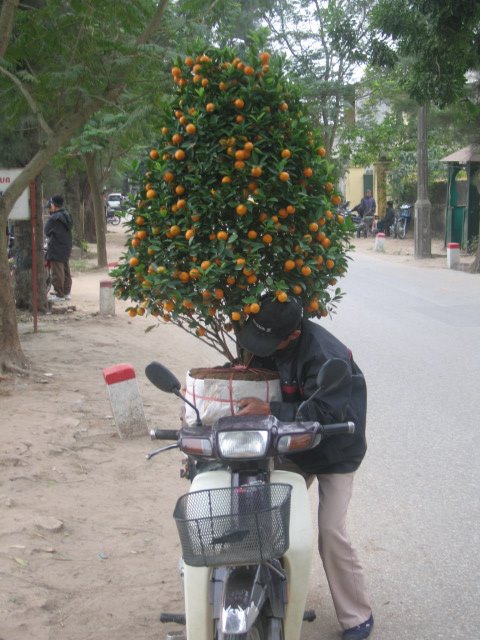
A letter from Hanoi to no one in particular, somewhere else, on a late January day
The Lunar New Year (Tet Vietnam) approaches
As a result of a constant urban-rural shift no one is really sure of the exact statistic but at times it feels like every single one of them is driving down the same road.
Vietnam's Tet holiday is best described as Christmas, New Year and Easter all rolled into one. People must give thanks to family, ancestors, house spirits, cousins, colleagues, and last, but not least, their boss.
“It's Tet already,” a street side seller says with a cute smile a week before Tet. Everyone needs to make a little extra.
From the archives, if you miss or remember the kumquats
Subscribe to:
Posts (Atom)
