The one man travelling expat show part one
(This is perhaps the first installment of several
which are all based on the adventures of EXPAT MAN,
who dares to travel where everyone else is also travelling,
the only difference is he speaks 75 more words of Vietnamese)
Somewhere in Hoi An you sit in a café. It is kind of a boulangerie slash café. You spotted the Mille Feuille on the way in which will be complimented by a Café Macchiato. The waiter scoots past and a bunch of arms and eyebrows rise in an attempt to attract the young flustered man’s attention. You can’t resist a wry smile as you holler “em oi!” to which the young boy swivels on his heels and looks at you with a ready-to-serve smile.
“Cho anh mot ca phe va mot banh Mille Feuille,” you say with what you believe to be exquisite pronunciation.
As the waiter disappears, the other customers in the café are caught between resentment and respect. “Who is that man with such an alarming command of the local lingo? For he is no ordinary traveller.”
Yes – you are no “tourist” travelling through Vietnam from North to South, or vice versa, you are EXPAT MAN. You have no time for these trifling conversations about how to find the cheapest hotel in Hue or the price of butter in Laos. Would you be caught dead wearing a Red Bull T-shirt or fisherman trousers? Of course not.
Nor are you clutching “the Bible” (The Lonely planet) close to your chest. That is because EXPAT MAN knows where he is going. You have been here frequently. You have immersed yourself in the culture. In fact, this must be your favourite boulangerie in all of Indochina! You have no need for a trusty sidekick like Shoeshine Boy, who is giving the regular tourists the 20 question treatment. When Shoeshine Boy asks you from where you come from you scoff, “Vietnam!”
Earlier on perhaps the tourists saw you haggling in the market and although no one understood your Vietnamese the other tourists didn’t know that, they just looked in awe and admitted, “EXPAT MAN sure is one hell of a haggler.”
Back in the cafe as they admire your cultural know how, the waiter arrives back and serves you, with an honest effort of panache, a plate of fried bread with two poached eggs and a coconut shake.
“Xin moi anh (here you are),” he says with a big smile, before heading off to take the other customers orders in English.
Saying nothing, and too ashamed to look up as you realise your mangled Vietnamese phrasing is to blame, you begin to eat the eggs and sip your coconut shake and begin to wonder what will happen when you order the bill. Then again, perhaps you should just do the sensible thing and say it in English. Or at least improve your pronunciation in the meantime. Or perhaps you should try a bit of French as you are in a boulangerie, or is the right word patisserie?
Never you mind.
Monday, February 20, 2006


Thursday, February 16, 2006
Get it while you can
Spoilt rotten and perfectly happy about it, Teddy de Burca Jnr explains why it would seem like too much hard work to go back home
In the past, which now seems so long ago I look at it as more like a previous life, I used to do many things. I used to cook regularly. I used to clean my house everyday. Lord – I even used to polish my own shoes and fix the punctures on my rusty old bicycle. What’s more, I definitely never paid anyone to shave my beard off or clean my ears.
But Vietnam spoils a man, and perhaps a woman too. Now, I am living in La-la Land. A sort of personalised Utopia, a place I always dreamt existed, but thought I would never find; where the lazy man lives like an idle prince, where the dishes can be left in the sink and be magically washed overnight, where you can go for a coffee and walk away with clean shoes. It is a land that positively encourages me not to lift a finger in the domestic sense. I’m not saying it’s right, I’m just saying that’s how it is.
Whenever friends of mine are packing up and leaving Vietnam they prattle on about what they’ll miss – the friends, the culture and the way she might look at you on a soft Spring day while hurtling through the traffic. And all of that is all very well, but let’s get down to the meat of the matter: what they will also miss, perhaps more at first, is having their shoes shined for VND2,000; getting their house cleaned by a maid for $30 or $40 a month; the fact that they cannot afford to have a slap up dinner (or lunch) whenever they feel like it.
In Vietnam, for people working full time with kids, there is the joy of having a nanny, a cook and a maid all rolled into one for a very affordable fee. The only drawback might be after spending so much time with the super-nanny your kid will pick up Vietnamese so fast you’ll come home one day to find the little whippersnapper gossiping with the housewives and maids down the street about how much you spend on take away pizza every month and you won’t understand a single word.
One friend of mine left Vietnam for a distant land called Japan. His life was pretty much turned back to front. From a huge cheap villa he ended up in an overpriced matchbox apartment. The price of coffee multiplied itself by about 20 times. Suddenly he didn’t have so much free time and he couldn’t afford sushi lunches (ironic eh?)*.
When I did a rapid-fire survey on friends it revealed a host of lifestyle habits that could not be realised back home: having a whole wardrobe tailor made clothes, getting a weekly four-dollar foot rub, being invited to drink with complete strangers (accepting is optional), never having to make your own bed, being able to afford, and find taxis, or if you can’t, at least a xe om (motorbike taxi).
Of course, we all have our paths to follow, and for many foreigners there’ll come a day when they head for the hills, but in the meantime, you should be savouring these moments and abundance of pleasures, because, I promise you, after you leave you’ll miss it all, or at least not be so happy about facing the housework back home.
If you still don’t believe me then I’ll leave you with my emphatic closing argument: imagine vacuuming the house.
A frightening thought, if I say so myself.
*Apparently that isn't true (see comments by Elliott). That character is sort of composite character of few people who went to Japan. One teacher friend who went to Tokyo thought naively things would work as easily as Hanoi - arrive, hang out, drink bia, meet folk, get work, stay - but he lasted 10 days, his meagre savings chewed up by the Tokyo prices and he complained he didn't even get a chance to eat sushi!
A very brief survey of reasons people like living in Vietnam:
From RR of England:
“The fact that I am relatively large here - get to feel like a big man”
“Lots of very pretty girls giggling and flirting with me in that very cute Vina way”
“The cost of living of course applies to a wide range of benefits beyond just eating out- eg. massages, weekends away”
“Random strangers will invite me to eat or drink with them (and the food is healthier and better)”
“I have never been ill in Vietnam”
“The weather, climate is of course infinitely better”
“I am much safer in Vietnam”
“Get to go to Model parties, parties at the Italian Ambassador's house”
From SJC of Australia
“Endless bia and bun cha and bun rieu cua”
“Never having to make my own bed (or clean the house!)”
“A vibrant food scene – street, other Vina, international … you name it… great food going on at all levels “
“Possibility of having my entire wardrobe custom made”
“Being able to drive from my house to Laos (or Cambodia or the northern mountains or … wherever)”
“Only a hop skip and a jump from Bangkok (where I hear they do quite good liver transplants at a fraction of the price in the west!)”
“My employer’s deeply relaxed attitude to results”
From PM of Australia
“Riding my motorbike around”
“Eating Vietnamese food nearly every day”
“Having massages whenever I want, without the fear of budgetary retribution”
“Paying double for a shoe shine, just to make myself feel like a responsible global citizen”
“Not paying tax...”
“Catching taxis, with the same freedom associated with having a massage”
“Watch the latest DVDs for nuthin”
“You can be sillier when drunk and not get punched”
“Shootin the shit with Jackie Chan”
Thursday, February 09, 2006
Admit it - sharing is caring
When it comes to eating out with a group of friends, Westerners, or at least Teddy de Burca Jnr.’s family, could learn a lot from Asian style dining
When I go back to sunny, cosmopolitan Ireland and eat out with my family or friends, or when one ventures east to visit me here, while we collectively peruse the menu in a restaurant I often hear the line “I’m having the veal” or whatever dish tickles their fancy.
It always jars slightly; every year a little more. In fact, I’d go as far as to say after over half a decade in Vietnam, where sharing is indeed caring at the dinner table, it sounds downright selfish.
Sure, I know the norm back home is for everyone to choose their own starter and a main course. If someone makes too much noise about how good the dish is you can always ask for some, but all people do is cut off a little corner of the tasty morsel and pass it over on a side plate.
The attitude seems to be why share a dinner when you have exactly what you want in front of you? Get your own steak. After all, you’re the idiot that ordered the green bean salad.
Even at home plates are served individually with seconds left in the pot. It is every man and woman for themselves. The quicker you eat, the more seconds you get to shovel on your plate. The biggest pig gets the most swill, would say my uncle, who is a man that I should add outgrew his bed thanks to this belief. Every single one of us would eat with a protective arm curled around the plate lest someone try to pinch your last spud.
So what a relief it has become, and a way of life too, in Asia with everything in the middle and everyone sharing. Now, no matter what kind of restaurant I go to – Vietnamese, Japanese, Italian, Indian or Thai (Ok, I’ll admit this philosophy doesn’t wash with sandwiches, hamburgers or kebabs) everyone just orders a few dishes and everything is plonked in the middle to be tasted and shared.
Furthermore, new research by dieticians claims that sharing food means you eat less helping you stay trim and healthy, even though you might feel like you’re eating more. You naturally adjust your consumption to those who are eating with you.
Of course, there’s no persuading some people. Recently my old friend from county Fingal, just north of Dublin, came out to see what the fuss was all about in Southeast Asia and we went out with a group of folk to an Italian joint. People did the usual and ordered salads, bruschetta, pizza, pasta and a couple of carafes of wine to be shared around, but my dear visitor was having none of it. Slapping the menu shut and staring the waitress dead in the eye, he said: “I’ll have the beef steak and a beer” and the unsaid subtext was there for all to see: he wasn’t planning on sharing it. It was, I believe, his loss.
Monday, January 30, 2006
A letter from Hanoi to no one in particular, somewhere else, on a late January day
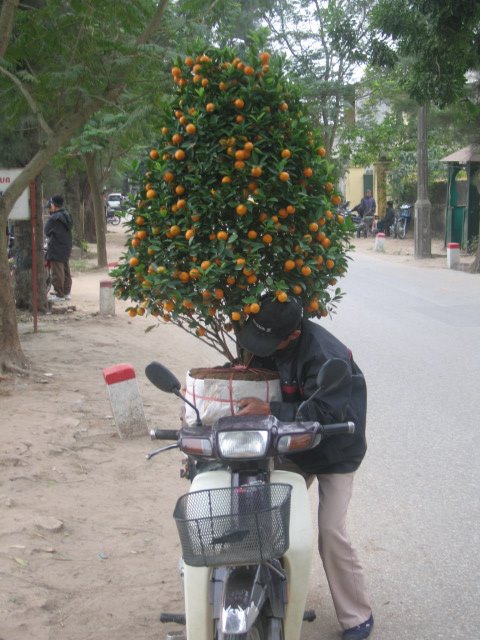
The Lunar New Year (Tet Vietnam) approaches
As a result of a constant urban-rural shift no one is really sure of the exact statistic but at times it feels like every single one of them is driving down the same road.
Vietnam's Tet holiday is best described as Christmas, New Year and Easter all rolled into one. People must give thanks to family, ancestors, house spirits, cousins, colleagues, and last, but not least, their boss.
“It's Tet already,” a street side seller says with a cute smile a week before Tet. Everyone needs to make a little extra.
From the archives, if you miss or remember the kumquats
Thursday, January 12, 2006
A crash course in tightening your finances
If you’re suffering from empty-wallet syndrome because you blew all your cash over Christmas and New Year and need to tighten up the finances before the Tet (Lunar New Year) holidays take note of these classic thrifty tips for tightening up your personal finances
1 Water: Don’t be fooled by companies or restaurants that expect you to actually pay for a substance that fills most of the earth. Hark back to the day when you first heard that people in France paid for something called “Perrier” and scoffed over your glass of tap water. Since then events have spiralled. Now mineral water is the norm – at home, in work and in most eateries. But why not just boil up tap water or bring other people’s empty bottles to work and fill them from the cooler? Or, when you’re in a restaurant just ask for a “glass of iced water” or “mot coc nuoc loc”. None of that bottled stuff which costs a dollar. The average recommended daily intake or water is 3 litres, while the average cost of water is VND5,000 per litre so your annual savings by not buying any could be, on average, VND5.79 million ($365).
2 Food: Even if you don’t particularly like socialising, parties, soirees, opening nights and dos are happening all the time and are a great way to eat and drink for free. That’s right. It’s a no-hands-in-your-pocket bonanza. You don’t even need to think of elaborate ways to avoid the bill. The main tactics are a) getting invited b) if not invited, finding someone who is c) if you don’t know anyone, just turn up anyway d) coming early and getting stuck in e) fasting for a day prior to the event to maximise eating capabilities. Annual savings: incalculable.
3 Transport: This is a tricky one. You have the option of just not buying a motorbike, but how do you get to work? How about moving house to your colleague’s neighbourhood and get them to drive you. Or move next door to your office, or better still, work from home! Taking a xe om can be pretty cheap on a one off basis, but using this service on a daily basis you’d be accruing losses of VND3-5 million per annum. Now, a true grandmaster of thriftiness would find out which of their friends is going home for three months and just borrow their motorbike. A classic skinflint move and not as hard as you think to pull off. Expat communities are a constant “who’s in-who’s out” situation. One Australian, who shall remain nameless, but his name rhymes with Ball Mavis, lived in Hanoi for three years using other’s people’s bikes the whole time. Hat’s off Mr. Mavis – you were titan of tightness!
Bonus Tip - Celebrity technique: In general, in bill paying situations there are innumerable ways to avoid forking out cash. Some people are fond of the “leave first and drop VND20,000 on the table” tactic, even though you had six beers, three plates of squid and bought a pack of cigarettes. But, we’d like to introduce you to the Rod Stewart manoeuvre, patented by the tightwad Scot millionaire rocker himself. First, make sure the group you’re drinking with are aware you’re in a buying rounds situation. Even prompt people – “what are you having?” Get the ball rolling with the waiter, “So that’s three gin tonics and…” Then you simply slip away to the toilet! By the time you come back, freshened up and relieved, the drinks are on the table and the bill has been paid. Repeat until drunk then leave, preferably on someone else’s motorbike to someone else’s house.
If you’re suffering from empty-wallet syndrome because you blew all your cash over Christmas and New Year and need to tighten up the finances before the Tet (Lunar New Year) holidays take note of these classic thrifty tips for tightening up your personal finances
1 Water: Don’t be fooled by companies or restaurants that expect you to actually pay for a substance that fills most of the earth. Hark back to the day when you first heard that people in France paid for something called “Perrier” and scoffed over your glass of tap water. Since then events have spiralled. Now mineral water is the norm – at home, in work and in most eateries. But why not just boil up tap water or bring other people’s empty bottles to work and fill them from the cooler? Or, when you’re in a restaurant just ask for a “glass of iced water” or “mot coc nuoc loc”. None of that bottled stuff which costs a dollar. The average recommended daily intake or water is 3 litres, while the average cost of water is VND5,000 per litre so your annual savings by not buying any could be, on average, VND5.79 million ($365).
2 Food: Even if you don’t particularly like socialising, parties, soirees, opening nights and dos are happening all the time and are a great way to eat and drink for free. That’s right. It’s a no-hands-in-your-pocket bonanza. You don’t even need to think of elaborate ways to avoid the bill. The main tactics are a) getting invited b) if not invited, finding someone who is c) if you don’t know anyone, just turn up anyway d) coming early and getting stuck in e) fasting for a day prior to the event to maximise eating capabilities. Annual savings: incalculable.
3 Transport: This is a tricky one. You have the option of just not buying a motorbike, but how do you get to work? How about moving house to your colleague’s neighbourhood and get them to drive you. Or move next door to your office, or better still, work from home! Taking a xe om can be pretty cheap on a one off basis, but using this service on a daily basis you’d be accruing losses of VND3-5 million per annum. Now, a true grandmaster of thriftiness would find out which of their friends is going home for three months and just borrow their motorbike. A classic skinflint move and not as hard as you think to pull off. Expat communities are a constant “who’s in-who’s out” situation. One Australian, who shall remain nameless, but his name rhymes with Ball Mavis, lived in Hanoi for three years using other’s people’s bikes the whole time. Hat’s off Mr. Mavis – you were titan of tightness!
Bonus Tip - Celebrity technique: In general, in bill paying situations there are innumerable ways to avoid forking out cash. Some people are fond of the “leave first and drop VND20,000 on the table” tactic, even though you had six beers, three plates of squid and bought a pack of cigarettes. But, we’d like to introduce you to the Rod Stewart manoeuvre, patented by the tightwad Scot millionaire rocker himself. First, make sure the group you’re drinking with are aware you’re in a buying rounds situation. Even prompt people – “what are you having?” Get the ball rolling with the waiter, “So that’s three gin tonics and…” Then you simply slip away to the toilet! By the time you come back, freshened up and relieved, the drinks are on the table and the bill has been paid. Repeat until drunk then leave, preferably on someone else’s motorbike to someone else’s house.
Thursday, January 05, 2006
TAY-SPOTTING
A popular sport amongst Vietnamese children seems to be spotting a foreigner and although admittedly it doesn’t take much to see Teddy de Burca Jnr. coming, he’ll happily play along
Outside the traffic swirls past. Bao ve (Parking attendants) sit on customers’ bikes smoking cigarettes and picking their noses. Inside the crowded restaurant, amongst the clatter of plates and happy chatter of customers, I push away my just finished-bowl of banh cuon and lean back, blithely unawares to the world at large. It’s one of those moments where you’re happy to be thinking about nothing whatsoever and feel you have at long last blended into the Hanoi tapestry.
Then I hear a young mother, sitting opposite, say to her child, who is reluctant to chow down his fish sauce-soaked pancake, “ai day? (who’s that?)”.
I glance over my shoulder, expecting to see the child’s aunt or uncle, but there’s just a 2002 World Cup Pepsi poster pinned to a grimy, greasy wall. I realise that the “ai” in this situation is none other than myself. Suddenly, it seems the restaurant is collectively staring at me, in a nice way, and I can’t help feeling a little oversized for the wee plastic chair I’m perched on. I imagine this is how Gulliver would feel in a café in Lilliput.
With his mouth agog, the kid stares at me like I’m the man from the moon, as though disbelieving I could be that pasty skinned or have such an enormous hooked-nose. I smile as nicely as I can, in a sort of “look – I don’t bite” kind of way, while wondering, “how on earth would this child know my name?”
Then panic strikes – perhaps I know the mother. Is she an old colleague or the employee of an old café I used to frequent, per chance?
Quite often I’m spotted around town by such people. Just the other day a motorbike sidled up to me in the madness that is Dai Co Viet street, on the outskirts of town, and just as I prepared to swivel in my seat and growl – “what the hell are you looking at?” I heard him say “Teddy Chicken Curry Coca Cola”.
I realised it was the delivery boy from a sandwich shop, and no, he hadn’t anticipated I needed a sandwich, he was just thrilled to see me and remember my regular order. I guess I’m hard to miss.
Former colleagues and students always appear out of nowhere and greet me in the same way, “Do you remember me?” Why of course, I say, dismissing the notion of forgetting them with a laugh. As if. So naturally they follow up with, “What’s my name?”
“Something beginning with ‘t’ or ‘h’, right?” I say edging away. “Definitely one syllable, anyway.”
But no, this woman is no colleague, or former student. Why I wouldn’t know her from Eve. So why is she asking the child who I am? Then the penny drops, for the child that is. His eyes twinkle and he gurgles with pleasure before exclaiming, “Tay (westerner)!” much to the mother’s delight, who rewards the kid by shoving food in his mouth.
Of course, there is no denying it: I am a Tay. But that’s no reason why I should try and be funny or sarcastic, but foolishly, just as everyone goes back to eating and chatting, I blurt “dong”, as in ‘east’, while pointing at the kid, but the mother just stares blankly, and the restaurant goes completely silent again, like in the Wild West Saloons when the stranger walks in and orders Soda Pop. I guess it’s probably because I’m pronouncing it completely wrong, and out of paranoia I’m worried “dong” might be a swear word with the wrong tone, so I simplify, to try and dig myself out the hole and point at the kid again, “Vietnam”.
The mother claps, the child laughs, the woman behind the counter chimes in, and shouts out to everyone, “Vietnam! Tay noi ‘Vietnam!’” And everyone in the vicinity seems very impressed that the foreigner not only spoke but knows exactly what country he’s in.
I admit I’m not quite ready for Ai la trieu phu? (The local Who wants to be a millionaire?), but as I leave I am patted on the back, greeted by beatific smiles, three fine looking young women bat their eyelids, two men shake my hand and the bao ve invites me one cigarette. Getting on my motorbike feeling like a minor celebrity, I decide it’s not so bad sticking out like a sore thumb after all. Certainly beats being completely ignored, doesn’t it?
A popular sport amongst Vietnamese children seems to be spotting a foreigner and although admittedly it doesn’t take much to see Teddy de Burca Jnr. coming, he’ll happily play along
Outside the traffic swirls past. Bao ve (Parking attendants) sit on customers’ bikes smoking cigarettes and picking their noses. Inside the crowded restaurant, amongst the clatter of plates and happy chatter of customers, I push away my just finished-bowl of banh cuon and lean back, blithely unawares to the world at large. It’s one of those moments where you’re happy to be thinking about nothing whatsoever and feel you have at long last blended into the Hanoi tapestry.
Then I hear a young mother, sitting opposite, say to her child, who is reluctant to chow down his fish sauce-soaked pancake, “ai day? (who’s that?)”.
I glance over my shoulder, expecting to see the child’s aunt or uncle, but there’s just a 2002 World Cup Pepsi poster pinned to a grimy, greasy wall. I realise that the “ai” in this situation is none other than myself. Suddenly, it seems the restaurant is collectively staring at me, in a nice way, and I can’t help feeling a little oversized for the wee plastic chair I’m perched on. I imagine this is how Gulliver would feel in a café in Lilliput.
With his mouth agog, the kid stares at me like I’m the man from the moon, as though disbelieving I could be that pasty skinned or have such an enormous hooked-nose. I smile as nicely as I can, in a sort of “look – I don’t bite” kind of way, while wondering, “how on earth would this child know my name?”
Then panic strikes – perhaps I know the mother. Is she an old colleague or the employee of an old café I used to frequent, per chance?
Quite often I’m spotted around town by such people. Just the other day a motorbike sidled up to me in the madness that is Dai Co Viet street, on the outskirts of town, and just as I prepared to swivel in my seat and growl – “what the hell are you looking at?” I heard him say “Teddy Chicken Curry Coca Cola”.
I realised it was the delivery boy from a sandwich shop, and no, he hadn’t anticipated I needed a sandwich, he was just thrilled to see me and remember my regular order. I guess I’m hard to miss.
Former colleagues and students always appear out of nowhere and greet me in the same way, “Do you remember me?” Why of course, I say, dismissing the notion of forgetting them with a laugh. As if. So naturally they follow up with, “What’s my name?”
“Something beginning with ‘t’ or ‘h’, right?” I say edging away. “Definitely one syllable, anyway.”
But no, this woman is no colleague, or former student. Why I wouldn’t know her from Eve. So why is she asking the child who I am? Then the penny drops, for the child that is. His eyes twinkle and he gurgles with pleasure before exclaiming, “Tay (westerner)!” much to the mother’s delight, who rewards the kid by shoving food in his mouth.
Of course, there is no denying it: I am a Tay. But that’s no reason why I should try and be funny or sarcastic, but foolishly, just as everyone goes back to eating and chatting, I blurt “dong”, as in ‘east’, while pointing at the kid, but the mother just stares blankly, and the restaurant goes completely silent again, like in the Wild West Saloons when the stranger walks in and orders Soda Pop. I guess it’s probably because I’m pronouncing it completely wrong, and out of paranoia I’m worried “dong” might be a swear word with the wrong tone, so I simplify, to try and dig myself out the hole and point at the kid again, “Vietnam”.
The mother claps, the child laughs, the woman behind the counter chimes in, and shouts out to everyone, “Vietnam! Tay noi ‘Vietnam!’” And everyone in the vicinity seems very impressed that the foreigner not only spoke but knows exactly what country he’s in.
I admit I’m not quite ready for Ai la trieu phu? (The local Who wants to be a millionaire?), but as I leave I am patted on the back, greeted by beatific smiles, three fine looking young women bat their eyelids, two men shake my hand and the bao ve invites me one cigarette. Getting on my motorbike feeling like a minor celebrity, I decide it’s not so bad sticking out like a sore thumb after all. Certainly beats being completely ignored, doesn’t it?
Thursday, December 29, 2005
How I learnt to "have a good appetite" and love food on planes
Teddy de Burca jnr. has a good appetite, so maybe that’s why he’ll eat anything, even airplane food
As I strolled outside the office, my colleague must have thought I was heading for lunch, even though it was only 10am.
“Have a good appetite,” he said cheerily, walking in the door.
I didn’t bother pointing out in English we don’t say that, we might say, “enjoy your meal” but as we weren’t even in a restaurant, we would be more likely to say, “where are you going for lunch?” As for pre-meal encouragement, face to face with your food, we all have our own way of egging each on. I might say, “dig in”, my mother would say, “There’s plenty more of everything.”
My hairyback cousins from the backwaters of county Mayo on the west coast of Ireland, considering dinnertime to be a form of combat, often used to say “good luck” before demolishing the table and asking for seconds.
Anyway, presuming my colleague might be the victim of Franglaise, translating “bon appetit” into English, I forgot all about it, until an hour later when I did go for lunch and an elderly kind-hearted smart looking man beside me smiled as I picked out my chopsticks. “Have a good appetite,” he said, almost whispering, as though the subtle joys of English were just between the two of us.
But how odd, I thought, the same mistake within an hour. Perhaps, I speculated, it was the Vietnamese being translated into English. But Vietnamese people say “Chuc an ngon”, which is more like, wishing you a delicious meal, or else they would “Moi anh/ chi (invite you)”, on more of a par with the Dutch “alsjeblieft” or French “s’il vous plait”, which is why sometimes Vietnamese, French or Dutch, people might offer you food, or an ashtray, or even money, and say “please”.
Then later that week I happened to be on a domestic flight from Hanoi to Nha Trang and there I discovered what I believe to be the culprit – a small cardboard box containing my inflight meal, a flimsy, tasteless sandwich, with a bit of ham, sticky cheese and a single shred of lettuce and a mouthful of water on the side. Written across the box in large easy-to-read-font is – “Have a good appetite”.
Now, considering there are thousands of foreigners travelling in the country everyday, not to mention teachers, editors and trainers abound, why didn’t the company in charge of printing the boxes ask someone if that was the correct English expression? The boxes will presumably stay for a while, I doubt anyone will crack out the red pen and start crossing all the ‘appetites’ off and replacing it with ‘meal’, but that means non-accomplished English speakers, of which there are many, travelling on the short domestic flights in Vietnam would be potentially picking this incorrect expression up along the way. Not the end of the world I admit, but still, not the greatest advert either.
Trying to forget about it, with a rumble in my stomach, I got on with the basics of life, eating and drinking that is. I opened up the wee box and plucked out the soggy bread and wolfed it down before washing it away with the mouthful of water, and when I closed the box after my “mot-hai-ba” banquet it suddenly hit me: Airplane food, as we all know, isn’t the Mae West, so if you don’t have a good appetite, more than likely, you won’t eat it at all. So perhaps “Have a good appetite” is just another way of saying “Good luck”.
Teddy de Burca jnr. has a good appetite, so maybe that’s why he’ll eat anything, even airplane food
As I strolled outside the office, my colleague must have thought I was heading for lunch, even though it was only 10am.
“Have a good appetite,” he said cheerily, walking in the door.
I didn’t bother pointing out in English we don’t say that, we might say, “enjoy your meal” but as we weren’t even in a restaurant, we would be more likely to say, “where are you going for lunch?” As for pre-meal encouragement, face to face with your food, we all have our own way of egging each on. I might say, “dig in”, my mother would say, “There’s plenty more of everything.”
My hairyback cousins from the backwaters of county Mayo on the west coast of Ireland, considering dinnertime to be a form of combat, often used to say “good luck” before demolishing the table and asking for seconds.
Anyway, presuming my colleague might be the victim of Franglaise, translating “bon appetit” into English, I forgot all about it, until an hour later when I did go for lunch and an elderly kind-hearted smart looking man beside me smiled as I picked out my chopsticks. “Have a good appetite,” he said, almost whispering, as though the subtle joys of English were just between the two of us.
But how odd, I thought, the same mistake within an hour. Perhaps, I speculated, it was the Vietnamese being translated into English. But Vietnamese people say “Chuc an ngon”, which is more like, wishing you a delicious meal, or else they would “Moi anh/ chi (invite you)”, on more of a par with the Dutch “alsjeblieft” or French “s’il vous plait”, which is why sometimes Vietnamese, French or Dutch, people might offer you food, or an ashtray, or even money, and say “please”.
Then later that week I happened to be on a domestic flight from Hanoi to Nha Trang and there I discovered what I believe to be the culprit – a small cardboard box containing my inflight meal, a flimsy, tasteless sandwich, with a bit of ham, sticky cheese and a single shred of lettuce and a mouthful of water on the side. Written across the box in large easy-to-read-font is – “Have a good appetite”.
Now, considering there are thousands of foreigners travelling in the country everyday, not to mention teachers, editors and trainers abound, why didn’t the company in charge of printing the boxes ask someone if that was the correct English expression? The boxes will presumably stay for a while, I doubt anyone will crack out the red pen and start crossing all the ‘appetites’ off and replacing it with ‘meal’, but that means non-accomplished English speakers, of which there are many, travelling on the short domestic flights in Vietnam would be potentially picking this incorrect expression up along the way. Not the end of the world I admit, but still, not the greatest advert either.
Trying to forget about it, with a rumble in my stomach, I got on with the basics of life, eating and drinking that is. I opened up the wee box and plucked out the soggy bread and wolfed it down before washing it away with the mouthful of water, and when I closed the box after my “mot-hai-ba” banquet it suddenly hit me: Airplane food, as we all know, isn’t the Mae West, so if you don’t have a good appetite, more than likely, you won’t eat it at all. So perhaps “Have a good appetite” is just another way of saying “Good luck”.
Thursday, December 15, 2005
The 36-hour Christmas
Never a believer, but happily a receiver, Teddy de Burca Jnr. feels right at home with the short and sweet Vietnamese Christmas
Even when I was a knee high to a grasshopper I never believed in Santa Claus. My older brother took me aside and broke it too me bluntly, before telling me where the presents were hidden by our charlatan parents.
Somehow, my brother had been a non-believer of universal creed since the day he was born. Famously, he stood up in junior infants, aged 5, and coldly announced to his peers there was no such thing as God, Santa or the Loch Ness Monster before dismissing the class.
A mortified parent phoned my father, later that evening, and told him she didn’t mind so much about the other two but asked could my agnostic brother be told to lay off Santa. Somewhere a mum and dad were obviously left with an inconsolable child robbed of their true religion – the cult of gift giving Santa Claus.
Now that the Loch Ness Monster has been scientifically discredited, Santa it seems is even further ahead in the polls for Christmas popularity. The festival has become more universally celebrated and as a result has strayed far from its original plot line. Less Bethlehem babes in a manger, more wrapped presents under a Christmas tree. In multicultural societies it’s a festival to be celebrated by all religions, these days, even Judaism. And why not? It’s a national holiday with a universally appealing concept – no one has to work, everyone gets a present, eats until they’re stuffed, before watching The Raiders of the Lost Ark, or these days more likely a stack of DVDs, while slumped across the couch.
In America, where admittedly political correctness has always shot for outer space, the holiday is already being repackaged. In Wal-Mart there are no Christmas trees, just holiday trees; there are no Christmas presents, it’s just a holiday shop. The employees are not even allowed to say Merry Christmas lest they offend some sensitive soul of another creed.
Back in sunny Ireland, no matter what you believe, the biggest gripes people have are Christmas starting too early, office parties, the melee in every shop, the twee carols and the never-ending obligation to drink until drunk. Everyone turns into a bit of a scrooge, cursing at the commercialisation and forced tomfoolery. It is much more commonly referred to as silly season. And for good reason.
Which is why I love Christmas in Vietnam – with the exception of missing my family back home, not to mention my mother’s turkey stuffing and Teddy senior cracking out the good stuff. There is no office party, Christmas only lasts half a night and a day, (the Vietnamese only really celebrate Christmas Eve, I suspect looking at it as a sort of New Year’s Eve with less fireworks and more red hats). I can shop in the same chaotic streets I shop in every day. Carols are thankfully confined to very specific designated areas.
For me the “holiday” has been reduced to its core attractions: spending a day relaxing with friends, partners or family, toasting and dining to your heart’s content. Giving presents. Getting presents. Basking in the warm glow of contentment and drunkenness safe in the knowledge that it’s Christmas so you have nowhere to go.
And it doesn’t matter what you eat – in five years of Vietnam I’ve had vegetarian lasagne, bia hoi hot pot, roast duck, a slap up in an Italian restaurant and green curry on a Thai beach for my Christmas dinner.
So chuc mung Giang sinh dear readers: may you celebrate this Christmas in Vietnam with the holy triumvirate of eating, drinking and merry-making, whatever way you want. Just watch out for the traffic on the way home. It’s silly season out there, too, in it’s own spcecial way.
Never a believer, but happily a receiver, Teddy de Burca Jnr. feels right at home with the short and sweet Vietnamese Christmas
Even when I was a knee high to a grasshopper I never believed in Santa Claus. My older brother took me aside and broke it too me bluntly, before telling me where the presents were hidden by our charlatan parents.
Somehow, my brother had been a non-believer of universal creed since the day he was born. Famously, he stood up in junior infants, aged 5, and coldly announced to his peers there was no such thing as God, Santa or the Loch Ness Monster before dismissing the class.
A mortified parent phoned my father, later that evening, and told him she didn’t mind so much about the other two but asked could my agnostic brother be told to lay off Santa. Somewhere a mum and dad were obviously left with an inconsolable child robbed of their true religion – the cult of gift giving Santa Claus.
Now that the Loch Ness Monster has been scientifically discredited, Santa it seems is even further ahead in the polls for Christmas popularity. The festival has become more universally celebrated and as a result has strayed far from its original plot line. Less Bethlehem babes in a manger, more wrapped presents under a Christmas tree. In multicultural societies it’s a festival to be celebrated by all religions, these days, even Judaism. And why not? It’s a national holiday with a universally appealing concept – no one has to work, everyone gets a present, eats until they’re stuffed, before watching The Raiders of the Lost Ark, or these days more likely a stack of DVDs, while slumped across the couch.
In America, where admittedly political correctness has always shot for outer space, the holiday is already being repackaged. In Wal-Mart there are no Christmas trees, just holiday trees; there are no Christmas presents, it’s just a holiday shop. The employees are not even allowed to say Merry Christmas lest they offend some sensitive soul of another creed.
Back in sunny Ireland, no matter what you believe, the biggest gripes people have are Christmas starting too early, office parties, the melee in every shop, the twee carols and the never-ending obligation to drink until drunk. Everyone turns into a bit of a scrooge, cursing at the commercialisation and forced tomfoolery. It is much more commonly referred to as silly season. And for good reason.
Which is why I love Christmas in Vietnam – with the exception of missing my family back home, not to mention my mother’s turkey stuffing and Teddy senior cracking out the good stuff. There is no office party, Christmas only lasts half a night and a day, (the Vietnamese only really celebrate Christmas Eve, I suspect looking at it as a sort of New Year’s Eve with less fireworks and more red hats). I can shop in the same chaotic streets I shop in every day. Carols are thankfully confined to very specific designated areas.
For me the “holiday” has been reduced to its core attractions: spending a day relaxing with friends, partners or family, toasting and dining to your heart’s content. Giving presents. Getting presents. Basking in the warm glow of contentment and drunkenness safe in the knowledge that it’s Christmas so you have nowhere to go.
And it doesn’t matter what you eat – in five years of Vietnam I’ve had vegetarian lasagne, bia hoi hot pot, roast duck, a slap up in an Italian restaurant and green curry on a Thai beach for my Christmas dinner.
So chuc mung Giang sinh dear readers: may you celebrate this Christmas in Vietnam with the holy triumvirate of eating, drinking and merry-making, whatever way you want. Just watch out for the traffic on the way home. It’s silly season out there, too, in it’s own spcecial way.
Tuesday, December 13, 2005
| Buy a Connla Stokes short story in a book of other short stories alongside illustrations, and poetry, called Total Cardboard, No.7, at the following addresses:
|
|
Thursday, December 08, 2005
Winter Snaps Back
Shivering in his winter woollies Yorkie Pittstop admits he feels the Hanoi cold, but insists he’s not a big girl, it’s just the humidity that makes him cry
Visiting foreigners walking around often chortle to themselves looking at the locals, including myself, driving around in Hanoi in wintertime dressed like they’re off to climb K2.
Of course technically, last week it was only between 12- 15 degrees, I mean, let’s face it, the North of Siberia it ain’t. It should have been my time to shine, to show my durability, my youthful vigour and non-tropical cold-compatibility. But, alas, no – during summer I melt, and in winter I freeze.
One winter I met a man from Alaska, and as I sat with shivering hands and chattering teeth over a piping hot coffee on Hoan Kiem Lake, he stood boldly on the pavement in a T-shirt and shorts and waxed lyrical, describing it as the “perfect summer’s day”.
So why is it the expat residents – from cold spots like Canada and Northern Europe – lose their winter mojo in Hanoi? The general consensus is the cold gets into your bones. Especially at home, where the high humidity means it sort of rises, like the fingers of an aggrieved zombie, straight through your floor. So in tiled houses you get cold just walking around.
There is also no tradition of fires, and most foreigners refusing to believe how cold it gets, never bother to buy heaters, until it’s too late, hence Hanoi is the only city I’ve lived in where I’ve seen people walk around their house wrapped in blankets with scarves and beanies.
Another problem is most people continue to travel by motorbike, which multiplies the chill factor. The foreign tourists in their shorts are walking around keeping the blood flowing while we’re motionless and exposed.
My friends in Ho Chi Minh City are always slagging off the Hanoi weather and telling me to move. But expat Hanoians would never admit defeat. Sure, down south, the sun shines all year around, but up north there’s the natural cycle of the seasons. We have an autumn and a spring, and although somewhat fleeting, I love them both.
In the event this winter does get too cold, and they say it very well might, there is, of course, always a happy medium. In this case it’s referred to as Hoi An.
Shivering in his winter woollies Yorkie Pittstop admits he feels the Hanoi cold, but insists he’s not a big girl, it’s just the humidity that makes him cry
Visiting foreigners walking around often chortle to themselves looking at the locals, including myself, driving around in Hanoi in wintertime dressed like they’re off to climb K2.
Of course technically, last week it was only between 12- 15 degrees, I mean, let’s face it, the North of Siberia it ain’t. It should have been my time to shine, to show my durability, my youthful vigour and non-tropical cold-compatibility. But, alas, no – during summer I melt, and in winter I freeze.
One winter I met a man from Alaska, and as I sat with shivering hands and chattering teeth over a piping hot coffee on Hoan Kiem Lake, he stood boldly on the pavement in a T-shirt and shorts and waxed lyrical, describing it as the “perfect summer’s day”.
So why is it the expat residents – from cold spots like Canada and Northern Europe – lose their winter mojo in Hanoi? The general consensus is the cold gets into your bones. Especially at home, where the high humidity means it sort of rises, like the fingers of an aggrieved zombie, straight through your floor. So in tiled houses you get cold just walking around.
There is also no tradition of fires, and most foreigners refusing to believe how cold it gets, never bother to buy heaters, until it’s too late, hence Hanoi is the only city I’ve lived in where I’ve seen people walk around their house wrapped in blankets with scarves and beanies.
Another problem is most people continue to travel by motorbike, which multiplies the chill factor. The foreign tourists in their shorts are walking around keeping the blood flowing while we’re motionless and exposed.
My friends in Ho Chi Minh City are always slagging off the Hanoi weather and telling me to move. But expat Hanoians would never admit defeat. Sure, down south, the sun shines all year around, but up north there’s the natural cycle of the seasons. We have an autumn and a spring, and although somewhat fleeting, I love them both.
In the event this winter does get too cold, and they say it very well might, there is, of course, always a happy medium. In this case it’s referred to as Hoi An.
“If winter comes, can spring be far behind?”
- Percy Bysshe Shelley, Ode to the West Wind.
- Percy Bysshe Shelley, Ode to the West Wind.
Friday, December 02, 2005
Think you can balance a basket of bread on your head for a 100 metre dash?
Fix a puncture in under five minutes?
Pedal a cyclo around Hoan Kiem lake with 200 kilos aboard?
Well then you could be a serious contender at the ...
The Steet Life Olympics
Fix a puncture in under five minutes?
Pedal a cyclo around Hoan Kiem lake with 200 kilos aboard?
Well then you could be a serious contender at the ...
The Steet Life Olympics
The skill, athleticism and hard work seen daily on the streets of Hanoi should not just be acknowledged, says Yorkie Pittstop, they should be celebrated in a competition
Watching the coverage of 23rd SEA Games in the Philippines is all very entertaining but I can’t help feel that life in Southeast Asia isn’t completely reflected through these sports.
Many of the events – not including the proliferation of martial arts – seem quite incongruously Occidental with a roll call that includes baseball, fencing, golf, snooker, beach volleyball and lawn bowls. There’s even a game of petanque going on somewhere in Manila.
Of course, the SEA Games is a wonderful opportunity to advance each countries sports development programmes to compete on the international stage, and so on so forth, but don’t you think a Southeast Asian Street Life Olympics would be just as much fun?
Perhaps, if one were to be organised in Hanoi it could inspire other places to follow suite. There could be street badminton with OAPs, U-12 football with one of those VND1,000 balls that levitates no matter how hard you kick it, xich lo races around Hoan kiem lake, plastic stool juggling, a 100m dash with banh my baskets balanced on people’s heads, puncture repairing time trials and instead of weightlifting you could have people tugging carts filled with sand or bricks, or women carrying those dual-baskets of bananas.
Many of the above events would be a tremendous way of promoting and rewarding all of those countless workers and low-income jobs that are the unsung heroes of daily life in Hanoi. Others would just be great fun. And anyone could join in any of the events.
Personally I’d be signing up for the bao ve (parking attendants) steeplechase. In this event, you get a ticket and one by one and competitors have to jump over the row of parked motorbikes, find the correct bike, squeeze it out from the tightly parked pack and wheel it back to the owner. Marks would be given for speed and presentation and there would be time deductions for dropping or scratching the bike.
If you think that sounds incredibly boring, or just plain silly, head on down to Dong Xuan market on a Saturday afternoon, pull to the side of the motorbike park and watch the parking attendants do their thing. Their showmanship, grace and effort really have to be seen to be believed. From dawn to dusk, they are hurdling bikes, snatching the handlebars with one hand, twirling the bikes on the kickstand and rolling it to the toes of the customer in the direction they’re about to be travelling.
Of course, it drives the middle-aged women waiting for their Honda Cub bananas, but that’s part of the fun. And perhaps the women wouldn’t be annoyed if they knew that the cheeky boy fetching her bike was no less than a bao ve gold medallist.
Yes, I can see it now, the Street Life Olympics. It’s not as silly as it sounds, you know.
Thursday, November 17, 2005
It's a dog eat dog world (so who's guarding the dogs?)
Vietnam probably isn’t the best country for a dog to live in, but any country that ate you wouldn’t be on your shortlist either. So says Teddy de Burca Jnr.
Fido the dog, if he had a brain, and given the choice, probably wouldn’t bee line for Vietnam or Korea, or wherever else roasts, minces and devours our faithful canine friend. But then, I’m not one to go looking for cannibals.
But besides being on the menu, or being the possible victim of dog-napping, it is still far from a dog’s life in Vietnam. You don’t often see dogs bounding around parks, playing fetch, or rolling around with their owners like young brothers wrestling for fun. Or someone scratching the hairy one’s ears, and saying in a Muppet-styled voice, “Oh, you like that, don’t you boy? Yes, I know you do.” There are no kennels. There’s no culture of people cleaning up after them (ah the poop-a-scoop), pampering them, spooning out chunks of oh-so succulent Pedigree Chum. Dogs are usually treated, well, like dogs. What would Barbara Woodhouse think?
In fact, outdoors, away from houses, I only seem to see dogs being dragged mercilessly down the road with a rope for a leash, as the owner hurtles up the dyke road (Tran Nhat Duat) on his moped. Distressingly for the poor dog, doing its best to keep up, the dyke road leads straight to Au Co street, home to innumerable Thit Cho (Dog Meat) restaurants. One man’s kitchen is another animal’s abattoir.
The restaurants are famous for serving up seven dishes, from boiled dog cutlets to fried bowels, or plain old roasted meat. The dishes are to be downed with strong spirits – ruou (rice wine) or vodka. The executive chefs of the dog world can allegedly cook the seven dishes on one stove.
The simple stilt-house style restaurants are usually roaring with customers from halfway through the Lunar month till the end, as during this period eating dog can, so they say, help you “giai den” (erase bad luck). After the 1st, it is therefore bad luck.
You may not be tempted, but the meat won’t bite. It is however, as a protein-filled meat, an overwhelming taste but known for its invigorating qualities.
Perhaps, again only if you were a “thinking” dog, you might try your look in Ha Tay province, where there is one village that is said to worship dogs as a deified animal – could it be the Mecca of the Mutt? Where dogs are glorified, petted and cherished?
Not really, the village is home to plenty of popular dog restaurants as the locals believe eating the godly canines only helps them stay in spiritual tune – the local Holy Communion,
I suppose.
Of course, back in the city, the culture may be changing. More and more families seem to be in the market for a dog, as a pet. Two years ago, on my street, there was one. It was so irritating (it never stopped barking at night) that everyone immediately followed suite.
In the absence of house alarms, I suppose they were bought for security reasons. But now at night the whole neighbourhood lies in bed listening to a cacophony of woofs. You might think some man is scaling your gates or prising open the door with a crow bar, but actually the dogs are barking at, well, pretty much anything – passing bikes, crying babies, slamming doors and, worst of all, themselves.
Once one begins they’re all at it, like a pack of boisterous men at a bar, barking till the cows come home, or perhaps more precisely, dawn approaches, and the engines start up and the horns begin to beep, and after another sleepless night, between the dogs and the motorbikes you wonder which one you will exact your revenge upon.
Of course, you can’t eat a motorbike.
Quotes on man's faithful friend
“I have caught more ills from people sneezing over me
and giving me virus infections than from kissing dogs.”
Barbara Woodhouse
“To his dog, every man is Napoleon, hence the constant popularity of dogs.”
Aldous Huxley
“It’s no coincidence that man’s best friend cannot talk.”
Anonymous
“Don’t accept your dog’s admiration as conclusive
evidence you’re great”
Ann Landers
“I wonder if other dogs think poodles are members of a weird religious cult.”
Rita Rudner
“I can train any dog in five minutes. Their owners take much longer.”
Barbara Woodhouse
Vietnam probably isn’t the best country for a dog to live in, but any country that ate you wouldn’t be on your shortlist either. So says Teddy de Burca Jnr.
Fido the dog, if he had a brain, and given the choice, probably wouldn’t bee line for Vietnam or Korea, or wherever else roasts, minces and devours our faithful canine friend. But then, I’m not one to go looking for cannibals.
But besides being on the menu, or being the possible victim of dog-napping, it is still far from a dog’s life in Vietnam. You don’t often see dogs bounding around parks, playing fetch, or rolling around with their owners like young brothers wrestling for fun. Or someone scratching the hairy one’s ears, and saying in a Muppet-styled voice, “Oh, you like that, don’t you boy? Yes, I know you do.” There are no kennels. There’s no culture of people cleaning up after them (ah the poop-a-scoop), pampering them, spooning out chunks of oh-so succulent Pedigree Chum. Dogs are usually treated, well, like dogs. What would Barbara Woodhouse think?
In fact, outdoors, away from houses, I only seem to see dogs being dragged mercilessly down the road with a rope for a leash, as the owner hurtles up the dyke road (Tran Nhat Duat) on his moped. Distressingly for the poor dog, doing its best to keep up, the dyke road leads straight to Au Co street, home to innumerable Thit Cho (Dog Meat) restaurants. One man’s kitchen is another animal’s abattoir.
The restaurants are famous for serving up seven dishes, from boiled dog cutlets to fried bowels, or plain old roasted meat. The dishes are to be downed with strong spirits – ruou (rice wine) or vodka. The executive chefs of the dog world can allegedly cook the seven dishes on one stove.
The simple stilt-house style restaurants are usually roaring with customers from halfway through the Lunar month till the end, as during this period eating dog can, so they say, help you “giai den” (erase bad luck). After the 1st, it is therefore bad luck.
You may not be tempted, but the meat won’t bite. It is however, as a protein-filled meat, an overwhelming taste but known for its invigorating qualities.
Perhaps, again only if you were a “thinking” dog, you might try your look in Ha Tay province, where there is one village that is said to worship dogs as a deified animal – could it be the Mecca of the Mutt? Where dogs are glorified, petted and cherished?
Not really, the village is home to plenty of popular dog restaurants as the locals believe eating the godly canines only helps them stay in spiritual tune – the local Holy Communion,
I suppose.
Of course, back in the city, the culture may be changing. More and more families seem to be in the market for a dog, as a pet. Two years ago, on my street, there was one. It was so irritating (it never stopped barking at night) that everyone immediately followed suite.
In the absence of house alarms, I suppose they were bought for security reasons. But now at night the whole neighbourhood lies in bed listening to a cacophony of woofs. You might think some man is scaling your gates or prising open the door with a crow bar, but actually the dogs are barking at, well, pretty much anything – passing bikes, crying babies, slamming doors and, worst of all, themselves.
Once one begins they’re all at it, like a pack of boisterous men at a bar, barking till the cows come home, or perhaps more precisely, dawn approaches, and the engines start up and the horns begin to beep, and after another sleepless night, between the dogs and the motorbikes you wonder which one you will exact your revenge upon.
Of course, you can’t eat a motorbike.
Quotes on man's faithful friend
“I have caught more ills from people sneezing over me
and giving me virus infections than from kissing dogs.”
Barbara Woodhouse
“To his dog, every man is Napoleon, hence the constant popularity of dogs.”
Aldous Huxley
“It’s no coincidence that man’s best friend cannot talk.”
Anonymous
“Don’t accept your dog’s admiration as conclusive
evidence you’re great”
Ann Landers
“I wonder if other dogs think poodles are members of a weird religious cult.”
Rita Rudner
“I can train any dog in five minutes. Their owners take much longer.”
Barbara Woodhouse
Thursday, November 10, 2005
Don't be a chicken - feel the fear but eat, read and write anyway
Teddy de Burca Jnr. isn’t panicking about the bird flu, he’s too busy planning what to eat, read and write this winter
As the Avian Flu pandemic looms over Asia, fear ye not, and never mind the irony, as the bi-lingual edition of Chicken Soup for the Soul is to be released this month by Tri Viet publishing house. Phew.
And there was me, contemplating taking on Gabriel Marcia Marquez’s One hundred Years of Solitude while I sat in self-imposed quarantine. Now, I can happily loll around the living room reading self-help books and, as is the book’s intention, “make [my] spirits soar and broaden [my] perspective of what it means to be fully human”. (Maybe learn a bit of Vietnamese while I’m at it, which makes me wonder how they translate the title, “Pho ga tot cho suc khoe cac anh chi” per chance?)
But of course, people do need to be reassured. Just look at my friend who bought a giant astronaut suit on eBay, as well as my colleague who’s stockpiled enough Tamiflu for an elephant. In fact, I wonder if I should write to the Chicken Soul publishers and pitch them an idea, Chicken Soup for People Terrified about Avian Flu. (Bit of a mouthful, but then one of the US editions is called Chicken Soup for the National Association for Stock Car Auto Racing Soul.)
The back of the book blurb could read – “assuage thyself with comforting pop-psychology mumbo-jumbo and quasi spiritual quotes from God knows where, which may or may not give you an “I’m ok, Avian flu’s ok-approach” to the possible/probable pandemic. For those out there who are still eating lots of poultry – hello Hue city! – I could work on drafting up Chicken Soup for People Who Still Eat Chicken.
And in the event of being holed up at home, what would I eat? Strolling around the supermarkets I can’t help but stare at the tins of Campbell’s chicken soup and fantasise a highly marketable scenario the papers back home would surely snap up – “the man who lived through the Avian flu crisis in Vietnam while eating nothing but Chicken soup while reading the bi-lingual version of Chicken Soup for the Soul.”
Lest we forget that chicken soup is the all-time best remedy for colds and influenza. The Vietnamese have their very own, called Ga Tan – a medicinal broth with chickpeas, garlic, spinach and herbs and, well, chicken, of course. Perhaps, I could ask for a bucket of a “ga tan khong co thit ga” and stash it in the freezer.
In Korea the secret remedy to fight a cold, and some say also Avian flu, is Kim Chi and in America it’s Sauerkraut. Both are just pickled cabbage, but I suspect that the garlic and spiciness is what makes them so potent against illnesses. An old Chinese proverb says – “eating garlic is better than an army of mothers”.
So with my shopping list complete – I didn’t mention the large quantities of beer, scotch, crisps, cigarettes, beef jerky and instant noodles – my only dilemma is how to stay fit with running up and down the stairs the only solution. But then, putting on a few pounds over winter is normal for a man of my age.
Why deny it? I’ll be flopped across my couch and watching any number of the 172 DVDs in my house or mindlessly surfing the net (thank the lord for ADSL) while spending some quality time with the missus. Why it’ll be just like Tet.
So my advice, feel the fear but eat-drink-man-woman anyway. Let that be your motto this winter and I’ll see you on the other side, along with the joys of Spring.
Teddy de Burca Jnr. isn’t panicking about the bird flu, he’s too busy planning what to eat, read and write this winter
As the Avian Flu pandemic looms over Asia, fear ye not, and never mind the irony, as the bi-lingual edition of Chicken Soup for the Soul is to be released this month by Tri Viet publishing house. Phew.
And there was me, contemplating taking on Gabriel Marcia Marquez’s One hundred Years of Solitude while I sat in self-imposed quarantine. Now, I can happily loll around the living room reading self-help books and, as is the book’s intention, “make [my] spirits soar and broaden [my] perspective of what it means to be fully human”. (Maybe learn a bit of Vietnamese while I’m at it, which makes me wonder how they translate the title, “Pho ga tot cho suc khoe cac anh chi” per chance?)
But of course, people do need to be reassured. Just look at my friend who bought a giant astronaut suit on eBay, as well as my colleague who’s stockpiled enough Tamiflu for an elephant. In fact, I wonder if I should write to the Chicken Soul publishers and pitch them an idea, Chicken Soup for People Terrified about Avian Flu. (Bit of a mouthful, but then one of the US editions is called Chicken Soup for the National Association for Stock Car Auto Racing Soul.)
The back of the book blurb could read – “assuage thyself with comforting pop-psychology mumbo-jumbo and quasi spiritual quotes from God knows where, which may or may not give you an “I’m ok, Avian flu’s ok-approach” to the possible/probable pandemic. For those out there who are still eating lots of poultry – hello Hue city! – I could work on drafting up Chicken Soup for People Who Still Eat Chicken.
And in the event of being holed up at home, what would I eat? Strolling around the supermarkets I can’t help but stare at the tins of Campbell’s chicken soup and fantasise a highly marketable scenario the papers back home would surely snap up – “the man who lived through the Avian flu crisis in Vietnam while eating nothing but Chicken soup while reading the bi-lingual version of Chicken Soup for the Soul.”
Lest we forget that chicken soup is the all-time best remedy for colds and influenza. The Vietnamese have their very own, called Ga Tan – a medicinal broth with chickpeas, garlic, spinach and herbs and, well, chicken, of course. Perhaps, I could ask for a bucket of a “ga tan khong co thit ga” and stash it in the freezer.
In Korea the secret remedy to fight a cold, and some say also Avian flu, is Kim Chi and in America it’s Sauerkraut. Both are just pickled cabbage, but I suspect that the garlic and spiciness is what makes them so potent against illnesses. An old Chinese proverb says – “eating garlic is better than an army of mothers”.
So with my shopping list complete – I didn’t mention the large quantities of beer, scotch, crisps, cigarettes, beef jerky and instant noodles – my only dilemma is how to stay fit with running up and down the stairs the only solution. But then, putting on a few pounds over winter is normal for a man of my age.
Why deny it? I’ll be flopped across my couch and watching any number of the 172 DVDs in my house or mindlessly surfing the net (thank the lord for ADSL) while spending some quality time with the missus. Why it’ll be just like Tet.
So my advice, feel the fear but eat-drink-man-woman anyway. Let that be your motto this winter and I’ll see you on the other side, along with the joys of Spring.
Wednesday, November 09, 2005
Drive thru concept arrives in Vietnam
by Teddy de burca
I heard about the capital city’s first ever “drive thru” bun cha restaurant and wondered had fast, convenient, modern dining for drivers finally arrived? But it wasn’t quite what I had imagined. Outside, on the pavement large signs said “no parking” and standing happily directing moving traffic inside stood a bunch of bao ve (motorbike security). And when I say directing inside, I mean, waving everyone in with the engines running. So I followed by swivelling through the door, not much wider than my handlebars. Not sure what to expect inside, I looked to my left, while driving at about 15kmph, and the “big momma” was sitting there frying up the pork, and whacking out plates of noodles. She smiled and waved me on, past the girls preparing the drinks, and all of the diners, all tucking into their tasty lunches, into the back which serves as a makeshift garage. I was then directed to sit back out in the front room, right by the “indoor road” where I ate lunch amidst the sound of traffic and a faint whiff of petrol. And there you have it – Vietnam’s first “drive thru” restaurant where take away is highly reccomended.
by Teddy de burca
I heard about the capital city’s first ever “drive thru” bun cha restaurant and wondered had fast, convenient, modern dining for drivers finally arrived? But it wasn’t quite what I had imagined. Outside, on the pavement large signs said “no parking” and standing happily directing moving traffic inside stood a bunch of bao ve (motorbike security). And when I say directing inside, I mean, waving everyone in with the engines running. So I followed by swivelling through the door, not much wider than my handlebars. Not sure what to expect inside, I looked to my left, while driving at about 15kmph, and the “big momma” was sitting there frying up the pork, and whacking out plates of noodles. She smiled and waved me on, past the girls preparing the drinks, and all of the diners, all tucking into their tasty lunches, into the back which serves as a makeshift garage. I was then directed to sit back out in the front room, right by the “indoor road” where I ate lunch amidst the sound of traffic and a faint whiff of petrol. And there you have it – Vietnam’s first “drive thru” restaurant where take away is highly reccomended.
Thursday, October 27, 2005
The invisible flavour of the east
Is MSG a recipe for disaster or just a harmless flavouring? Yorkie Pittstop steps up to the plate and wonders, would the dish taste just as sweet without
MSG is an acronym that strikes fear into the hearts of a few westerners I know. In fact for a couple of them, khong mi chinh (no MSG in the local lingo) is one of the few phrases they know.
Vietnamese on the other hand seem to pretty much accept it. I’ve even met one Vietnamese national abroad who even travelled with a packet to add to soups, which I admit sounds a bit excessive, I mean I’d never, as much as I love it, travel, with sachets of Dijon mustard in my inside pocket, just in case someone served me a sandwich without.
An English friend just can’t digest MSG, if digest is the right word. Once we went to eat pho (Noodle soup), and as we ordered he leaned over and barked “Pho! Khong mi chinh!” Just to emphasise the importance of this instruction he made several severe slashing motions with his hand, just to enforce the message, “if served MSG this could very well be my last supper.”
But perhaps they thought the dramatic motions meant serve more. Or perhaps they were curious to see what would happen, as halfway through his soup he started to sweat and fidget. He said he felt dizzy, abandoned his soup and staggered next door to a poky little café.
By the time I finished my soup and entered the café he was yawning violently and continuously, though I did arrive in time to catch his epitaph – “bloody MSG”.
Then he nodded off like a bored philistine at an excruciating theatrical performance, slumped against the wall, snoring faintly. He might as well have chucked the coffee over his shoulder.
Plenty of other people have told me of “turns” after a “dose” of MSG. But are they just an unfortunate minority?
You may not be allergic but it may be causing you damage, say the detractors. Some of the anti-MSG propaganda I’ve read goes so far as to claim, basically, it rots your brain, causes asthma, leads to obesity, and perhaps most simply and importantly, is totally unnecessary in food preparation.
MSG has long been the scourge of sensitive consumers as strong doses are used to flavour bland food or make cheap tortilla chips dangerously addictive.
But the Japanese man who discovered this funny little food addictive wasn’t out to destroy your taste buds. He just wanted to see what made food taste so good.
His name was Dr Kikunae Ikeda and in his native Japan a seaweed, called Konbu, was used to enhance the taste of foods.
In the early 1900s, the doctor isolated the taste enhancing property in seaweed – glutamic acid. Dr Ikeda and his colleague Dr Saburosuke Suzuki then founded the company Ajinomoto (Japanese for “Essence of Taste”), which began to manufacture monosodium glutamate (the original MSG).
At the end of WWII, US soldiers sampled rations taken from Japanese POWs and claimed the foreign rations tasted better than their own. This got MSG into the American market as food producers discovered it – and Ajinomoto itself set up a US subsidiary.
But the base substance itself isn’t MSG. Dr Kikunae Ikeda, christened it “umami” which means something pretty close to “yummy” in Japanese. Umami is now described as the Fifth taste – the other four musketeers being sweet, salty, sour and bitter.
Umami can be found naturally in everything from Parmesan cheese and fish sauce to broccoli and tomatoes. What happens, to simplify, is the human tongue tastes the released glutamate in all of these foods – likewise in MSG – and sends messages of joy and happiness to the brain. Hence, a tasty dish.
Of course, too much it seems may very well be a bad thing. Who knows? What has become apparent (I realised as I sat sipping my bitter, sweet coffee, watching my slumbering friend) is the fact there is a reason to carry your own MSG in your inside pocket – to serve yourself.
It’s the only way to know how much you’re getting.
Is MSG a recipe for disaster or just a harmless flavouring? Yorkie Pittstop steps up to the plate and wonders, would the dish taste just as sweet without
MSG is an acronym that strikes fear into the hearts of a few westerners I know. In fact for a couple of them, khong mi chinh (no MSG in the local lingo) is one of the few phrases they know.
Vietnamese on the other hand seem to pretty much accept it. I’ve even met one Vietnamese national abroad who even travelled with a packet to add to soups, which I admit sounds a bit excessive, I mean I’d never, as much as I love it, travel, with sachets of Dijon mustard in my inside pocket, just in case someone served me a sandwich without.
An English friend just can’t digest MSG, if digest is the right word. Once we went to eat pho (Noodle soup), and as we ordered he leaned over and barked “Pho! Khong mi chinh!” Just to emphasise the importance of this instruction he made several severe slashing motions with his hand, just to enforce the message, “if served MSG this could very well be my last supper.”
But perhaps they thought the dramatic motions meant serve more. Or perhaps they were curious to see what would happen, as halfway through his soup he started to sweat and fidget. He said he felt dizzy, abandoned his soup and staggered next door to a poky little café.
By the time I finished my soup and entered the café he was yawning violently and continuously, though I did arrive in time to catch his epitaph – “bloody MSG”.
Then he nodded off like a bored philistine at an excruciating theatrical performance, slumped against the wall, snoring faintly. He might as well have chucked the coffee over his shoulder.
Plenty of other people have told me of “turns” after a “dose” of MSG. But are they just an unfortunate minority?
You may not be allergic but it may be causing you damage, say the detractors. Some of the anti-MSG propaganda I’ve read goes so far as to claim, basically, it rots your brain, causes asthma, leads to obesity, and perhaps most simply and importantly, is totally unnecessary in food preparation.
MSG has long been the scourge of sensitive consumers as strong doses are used to flavour bland food or make cheap tortilla chips dangerously addictive.
But the Japanese man who discovered this funny little food addictive wasn’t out to destroy your taste buds. He just wanted to see what made food taste so good.
His name was Dr Kikunae Ikeda and in his native Japan a seaweed, called Konbu, was used to enhance the taste of foods.
In the early 1900s, the doctor isolated the taste enhancing property in seaweed – glutamic acid. Dr Ikeda and his colleague Dr Saburosuke Suzuki then founded the company Ajinomoto (Japanese for “Essence of Taste”), which began to manufacture monosodium glutamate (the original MSG).
At the end of WWII, US soldiers sampled rations taken from Japanese POWs and claimed the foreign rations tasted better than their own. This got MSG into the American market as food producers discovered it – and Ajinomoto itself set up a US subsidiary.
But the base substance itself isn’t MSG. Dr Kikunae Ikeda, christened it “umami” which means something pretty close to “yummy” in Japanese. Umami is now described as the Fifth taste – the other four musketeers being sweet, salty, sour and bitter.
Umami can be found naturally in everything from Parmesan cheese and fish sauce to broccoli and tomatoes. What happens, to simplify, is the human tongue tastes the released glutamate in all of these foods – likewise in MSG – and sends messages of joy and happiness to the brain. Hence, a tasty dish.
Of course, too much it seems may very well be a bad thing. Who knows? What has become apparent (I realised as I sat sipping my bitter, sweet coffee, watching my slumbering friend) is the fact there is a reason to carry your own MSG in your inside pocket – to serve yourself.
It’s the only way to know how much you’re getting.
Thursday, October 20, 2005
I know queue!
The queue is a fairly unfamiliar and untidy concept in Vietnam but standing at the back Teddy de Burca Jnr. is ready to get stuck in, boots and all
At Hanoi train station I stand three people back from the counter, waiting in turn like everyone else, to be served in due course. But others drift in and merge into the sides of the queue ahead of me – like molecules of mercury rolling onto a greater mass – and suddenly I’m playing back row in a scrum for tickets to Danang.
Now, these sneaky rascals may believe the foreign man is too polite or insignificant to be worth considering but in my younger, more athletic days, I played a bit of rugby and learnt how to ruck and maul with the big boys.
So, I gently lean in on the two tallish Vietnamese boys ahead – let’s just call them my lock forwards – and scythe into the middle of the pack, before rolling off on the inside of the flanker, a slightly plucky but tigerish middle-aged woman.
Her little elbows dig into my stomach, and if either of the two boys are pickpockets I’ll be taken to the cleaners but, at least, now I’m within a stretch of the ticket salesperson – a woman who at first glance appears to have missed the joys of spring since life began on earth.
Now, I must use the power of “Oi” – invented by someone at the back of the queue, I hazard to guess. Perhaps, I even have an advantage speaking the local lingo with my comical lilt.
And sure enough, her little ears prick up at my mangled pronunciation of “Chi oi, toi den day truoc ma!” (I came here first!). For a moment, the pack stops squirming; she looks up at my flushed hopeful head, suddenly grins and announces, with an air of triumph – “Mr Bean.”
Not someone I aspire to emulate, but ne’ertheless, at least, now, I have her attention. “Yes, I’m Mr Bean, and I’d like a ticket to Danang.”
“Mr Bean is going to Danang,” she shouts out to anyone who’ll listen. Then we scoot through a rapid series of questions concerning both my personal life and ticket specifications. Everyone around listens in, as though we were all now having an impromptu press conference.
The conclusion – Mr Bean is not married, he wants a soft sleeper, he has no children, he wants to return in a week, his clothes are quite ugly and he would prefer a lower bunk bed. We would also recommend he select a local wife.
After all that, with my personal life and ticket details made public, the total comes to VND495,000. There is a slight drawing of breath behind my ear as I withdraw my wallet, a shiver of anticipation and more than a smidgen of wonder – just how fat is his wallet going to be?
The answer is not very, I realise, with the panache of Mr Bean himself, I’ve left my cash at home. I blurt this out and swivel, and slip back through the queue-slash-scrum – now well over a dozen people are heaving onto the counter – to avoid being ridiculed. But there’s no escaping that easy.
“Mr Bean forgot his wallet,” roars the ticket woman, much to everyone’s amusement.
I look back over my shoulder. Everyone is laughing and pointing at me (affectionately). I suppose, I can console myself that it could very well be the happiest queue in the country at this very moment in time, who knows, maybe even the world.
I also notice, slipping out the door that the plucky little woman has slipped to the front while no one is concentrating. No doubt about it – with that competitive spirit she’d make a fine wee flanker on the rugby pitch.
The queue is a fairly unfamiliar and untidy concept in Vietnam but standing at the back Teddy de Burca Jnr. is ready to get stuck in, boots and all
At Hanoi train station I stand three people back from the counter, waiting in turn like everyone else, to be served in due course. But others drift in and merge into the sides of the queue ahead of me – like molecules of mercury rolling onto a greater mass – and suddenly I’m playing back row in a scrum for tickets to Danang.
Now, these sneaky rascals may believe the foreign man is too polite or insignificant to be worth considering but in my younger, more athletic days, I played a bit of rugby and learnt how to ruck and maul with the big boys.
So, I gently lean in on the two tallish Vietnamese boys ahead – let’s just call them my lock forwards – and scythe into the middle of the pack, before rolling off on the inside of the flanker, a slightly plucky but tigerish middle-aged woman.
Her little elbows dig into my stomach, and if either of the two boys are pickpockets I’ll be taken to the cleaners but, at least, now I’m within a stretch of the ticket salesperson – a woman who at first glance appears to have missed the joys of spring since life began on earth.
Now, I must use the power of “Oi” – invented by someone at the back of the queue, I hazard to guess. Perhaps, I even have an advantage speaking the local lingo with my comical lilt.
And sure enough, her little ears prick up at my mangled pronunciation of “Chi oi, toi den day truoc ma!” (I came here first!). For a moment, the pack stops squirming; she looks up at my flushed hopeful head, suddenly grins and announces, with an air of triumph – “Mr Bean.”
Not someone I aspire to emulate, but ne’ertheless, at least, now, I have her attention. “Yes, I’m Mr Bean, and I’d like a ticket to Danang.”
“Mr Bean is going to Danang,” she shouts out to anyone who’ll listen. Then we scoot through a rapid series of questions concerning both my personal life and ticket specifications. Everyone around listens in, as though we were all now having an impromptu press conference.
The conclusion – Mr Bean is not married, he wants a soft sleeper, he has no children, he wants to return in a week, his clothes are quite ugly and he would prefer a lower bunk bed. We would also recommend he select a local wife.
After all that, with my personal life and ticket details made public, the total comes to VND495,000. There is a slight drawing of breath behind my ear as I withdraw my wallet, a shiver of anticipation and more than a smidgen of wonder – just how fat is his wallet going to be?
The answer is not very, I realise, with the panache of Mr Bean himself, I’ve left my cash at home. I blurt this out and swivel, and slip back through the queue-slash-scrum – now well over a dozen people are heaving onto the counter – to avoid being ridiculed. But there’s no escaping that easy.
“Mr Bean forgot his wallet,” roars the ticket woman, much to everyone’s amusement.
I look back over my shoulder. Everyone is laughing and pointing at me (affectionately). I suppose, I can console myself that it could very well be the happiest queue in the country at this very moment in time, who knows, maybe even the world.
I also notice, slipping out the door that the plucky little woman has slipped to the front while no one is concentrating. No doubt about it – with that competitive spirit she’d make a fine wee flanker on the rugby pitch.
Friday, October 07, 2005
A symphony for the devil
Teddy de Burca Jnr. says that the music isn’t in the air, in fact, it’s trapped in a mobile phone
I sit in the café beside a young couple – a lovely, smartly dressed and well educated looking couple. Both smile shyly and look down, averting eye contact. She giggles, he chortles.
You might guess it’s a little bit of harmless flirtation – but neither of them is making a joke, why, they aren’t even talking to each other.
No, as I sip my coffee, the wilful young lovers are doing something far more entertaining than confabulating in seductive tones over the low tables. What would be the fun in that when you can, instead, be trying every single ringtone in your brand new phone?
Of course, when they finish, to try and get back to the one they liked they have to go through the whole lot again. Desperately trying to find that catchy little Beethoven number, perhaps.
In the end the girl settles for the standard Nokia ringtone – apparently now the most frequently heard melody in the world – and the boy chooses, without irony I suspect, one of Britney’s finest, Hit me baby, one more time.
I know I’m not alone when I complain as there is a man in my office who twitches like a shell-shocked war veteran every time a phone rings.
And the rings are never easy to ignore: Jingle Bells throughout the year, the Mission Impossible theme tune, always chosen in every office around the world by the guy with the biggest bunch of keys. (I myself flirted with the idea of downloading the Darth Vadar score for my phone. Just for gentle intimidation.)
But it doesn’t matter what jingle or melody it is. Ringtones are designed to attract your attention, so if it’s not your phone ringing it’s like your little nephew prodding you repeatedly when you’re trying to read a book. Especially when the person ringing never gives up and the person who owns the phone is AWOL. The phone just sits on their neglected desk ringing away. And just as my beleaguered colleague starts frothing at the mouth, the phone stops. Then, after a very brief respite it starts again.
One day he’ll crack, it’s only a matter of time. I picture him as one half of the classic Dilbert cartoon, which had two office colleagues standing by a desk with one saying to the other, “Your cellphone? Was it small, white and... flushable?”
And spare a thought for the musicians belittled by the whole concept. Francisco Tarrega, the 19th-century Spanish musician, known as the father of the modern classical guitar. Tarrega’s life was a miserable one. He suffered from ophthalmia, a horrendous form of conjunctivitis, and was said to have contracted it as a child when he was nearly drowned in a poisoned river by a mentally-disturbed nursemaid.
Now, even in the grave the misery continues for Tarrega as his masterpiece Gran Vals is now the 13-note jingle that is universally known as simply “that really annoying Nokia ringtone”.
Other alarming facts - The bells are ringing out
* Money - One of Hip Hop’s top producers, Scott Storch, who’s written huge singles for the likes of Beyonce, 50 Cent, Mariah Carey and many more, now devotes his time to the much more worthwhile (financially speaking) pursuit of composing ringtones and why wouldn’t he, after the people behind The Crazy Frog earned an estimated £14 million from that particular ringtone – the most commercially successful of all time. Ringtones are estimated to be a $9.4-billion-business in the year 2008.
* Faith - Mobile phones and ringtones can be used in a more spiritual manner, or so says Thai monk Phra Phayom Kalayano of the Glass Garden Temple who after hearing sexually explicit sounds coming from teenagers’ phones, decided to develop a set of more wholesome ringtones. These “dharma doctrine” tones, as they are known, consist of several pithy sayings designed to set listeners back on the righteous path. Pick of the litter? “Don’t let mobile phone conversations lead to premature sex and pregnancy.”
Wednesday, September 28, 2005
Do you remember the first time?
When Yorkie Pittstop first came to Hanoi his hotel experiences were far from first class, but that’s why he’ll always remember them
Jumping on a mini-van bus at Noi Bai airport a smiling man told me my first Vietnamese word, “chao”, which I discovered niftily meant both hello and goodbye. Immediately, my travelling companion and I started speaking like Italians, shouting “ciao bella” out the window at the cute girls, with handkerchiefs for masks, flitting in and out of the traffic.
Then the smiling man – whose grin looked like it would never fade – told us he knew a hotel we might like. He said those magical words “very good, very cheap”. It just so happened that this official Vietnam Airlines mini-van would be stopping outside this very hotel.
“Fantastico!” we told him.
He said something to the driver, who laughed, and the bus turned away into the old quarter and dumped us outside the hotel. There to greet us was another man, who, coincidence of coincidences, was the chap from the bus’ brother.
“Fantastico!” we yelled, before exchanging a “chao” with everyone on the street.
Inside, the two receptionists stepped out of the shadows with a trust-me-as-far-as-you-can-throw-me-glint in their eyes. Under insidious in the dictionary, I speculated, you might find an illustration of these two. The two brothers disappeared and suddenly, my companion and I decided, things were not so fantastico.
Although we were psychologically backtracking, we played along with the “show us the room, how much, sorry, we’re looking for something a little bit more, shall we say, rustic” rigmarole.
The $30 room swiftly became the don’t-tell-the-other-guests-$10 room. In seconds we were back on the street, shouting “ciao”, giggling mischievously. The receptionist, now not grinning, but looking very irritated, was following us down the road and, we suspected, abusing us in the vernacular.
We spotted a xich lo (cyclo) and piled in with both rucksacks. We told him to take us to the Dong Xuan hotel, which we spotted in a guidebook (someone else’s) on the plane. The words “Very cheap, medieval-style surroundings and diminutive staff” had caught our eyes.
The scrawny xich lo driver grunted through the congested old quarter streets, in the heat, argued with women in conical hats that sat hunched over sacks of grain, raw meat and steaming pots, just to get us through. I started to feel guilty but my travelling companion assured me it was all “very fantastico”.
When we arrived at the door and bundled our bags in the door, no one seemed more surprised than the staff. We had interrupted a harmless bit of mid-afternoon karaoke. The three of them were on average about five feet above sea level. They must have been aged between 13 and 15.
“Is there a manager?” I asked.
“Yes, I am the manager,” said the tallest one, a spotty boy with floppy hair, stepping behind the counter.
“Your second cheapest room,” my companion said.
“All rooms eight dollars.”
“Fantastico!”
In the end we stayed for a month as we searched for work in the city. We sat with the boys. Ate a lot bananas and cheese triangles. Drank suspect Chinese beer. Sang karaoke and smoked VND1,000 packs of cigarettes that tasted of burning pork fat.
Years later I returned. The boys were still there, a little taller than five foot above sea level. The eldest had no spots and a girlfriend and played it real cool – just like we taught him. But, all in all, it seemed as if the whole street hadn’t changed – in fact, in about a hundred years I dare say it will be the street that changes the least in all of Hanoi. I hope so – that means I will always be able to travel back in time to 1999, the year I first arrived. And that, my friends, is “very fantastico.”
When Yorkie Pittstop first came to Hanoi his hotel experiences were far from first class, but that’s why he’ll always remember them
Jumping on a mini-van bus at Noi Bai airport a smiling man told me my first Vietnamese word, “chao”, which I discovered niftily meant both hello and goodbye. Immediately, my travelling companion and I started speaking like Italians, shouting “ciao bella” out the window at the cute girls, with handkerchiefs for masks, flitting in and out of the traffic.
Then the smiling man – whose grin looked like it would never fade – told us he knew a hotel we might like. He said those magical words “very good, very cheap”. It just so happened that this official Vietnam Airlines mini-van would be stopping outside this very hotel.
“Fantastico!” we told him.
He said something to the driver, who laughed, and the bus turned away into the old quarter and dumped us outside the hotel. There to greet us was another man, who, coincidence of coincidences, was the chap from the bus’ brother.
“Fantastico!” we yelled, before exchanging a “chao” with everyone on the street.
Inside, the two receptionists stepped out of the shadows with a trust-me-as-far-as-you-can-throw-me-glint in their eyes. Under insidious in the dictionary, I speculated, you might find an illustration of these two. The two brothers disappeared and suddenly, my companion and I decided, things were not so fantastico.
Although we were psychologically backtracking, we played along with the “show us the room, how much, sorry, we’re looking for something a little bit more, shall we say, rustic” rigmarole.
The $30 room swiftly became the don’t-tell-the-other-guests-$10 room. In seconds we were back on the street, shouting “ciao”, giggling mischievously. The receptionist, now not grinning, but looking very irritated, was following us down the road and, we suspected, abusing us in the vernacular.
We spotted a xich lo (cyclo) and piled in with both rucksacks. We told him to take us to the Dong Xuan hotel, which we spotted in a guidebook (someone else’s) on the plane. The words “Very cheap, medieval-style surroundings and diminutive staff” had caught our eyes.
The scrawny xich lo driver grunted through the congested old quarter streets, in the heat, argued with women in conical hats that sat hunched over sacks of grain, raw meat and steaming pots, just to get us through. I started to feel guilty but my travelling companion assured me it was all “very fantastico”.
When we arrived at the door and bundled our bags in the door, no one seemed more surprised than the staff. We had interrupted a harmless bit of mid-afternoon karaoke. The three of them were on average about five feet above sea level. They must have been aged between 13 and 15.
“Is there a manager?” I asked.
“Yes, I am the manager,” said the tallest one, a spotty boy with floppy hair, stepping behind the counter.
“Your second cheapest room,” my companion said.
“All rooms eight dollars.”
“Fantastico!”
In the end we stayed for a month as we searched for work in the city. We sat with the boys. Ate a lot bananas and cheese triangles. Drank suspect Chinese beer. Sang karaoke and smoked VND1,000 packs of cigarettes that tasted of burning pork fat.
Years later I returned. The boys were still there, a little taller than five foot above sea level. The eldest had no spots and a girlfriend and played it real cool – just like we taught him. But, all in all, it seemed as if the whole street hadn’t changed – in fact, in about a hundred years I dare say it will be the street that changes the least in all of Hanoi. I hope so – that means I will always be able to travel back in time to 1999, the year I first arrived. And that, my friends, is “very fantastico.”
Friday, September 23, 2005
Beware of the weather
The change of the weather in Vietnam can be downright wicked, says Teddy de Burca Jnr., so keep one eye on those dark and ominous clouds
“Beware of the moon, lads” is a common quoted line from a classic werewolf film, but as the full moon, marking Tet Trung Thu (Mid-Autumn Festival), swelled to completion, there was something else in the air. Something far more chilling. Perhaps what Vietnamese fear most, even more than a dinner with no rice: the dreaded change in weather.
It started with a whip of a breeze from the west. Then the air pressure dropped, as if the weather upon the city was breathing in one last wheezy gulp of dirty air, before collapsing flat on its face. We could start to write the following morning’s obituaries – Summer was dead, long live Autumn.
Then the winds started to howl. The rain seemed to be going sideways. All around the city the temperature dropped, fans slowly whirled to a halt while the beer in the fridge seemed a little too cold for the first time in a long time. Someone somewhere sniffed. (No one ever knows who sniffed first.)
And sure enough, the next morning, half of the office comes in, dragging their feet, with a little cough here, and a little sneeze there, in what could be the opening scene from Dawn of the Sniffles: The curse of the common cold.
Vietnamese people will tell you, like they have told me every year I’ve been here, “beware of the change of weather” as if it were some sort of bogeyman preying on the weak.The local expression is “Som nang, chieu mua, giua trua, sam sui” (Sunny mornings, rainy afternoons, mid-noon cloudy and drizzly.) Basically, the weather’s always likely to change, which reminds me of a Scottish joke – “If you don’t like the weather, stick around for a minute, it’s bound to change.”
Often in Hanoi it appears to be raining on one street, while just around the corner it’s dry as a bone. Recently, a colleague told me his team turned up for a football game but the opposition had stayed at home. It was raining in the west, but not in the east, apparently.
The change of weather can be deemed the guilty party, conveniently, for a whole plethora of ailments – common colds, mood swings, toothaches, spots, bad hair dos and a strong desire not to go to work.
You might see people at the office, looking depressed, leaving early. When someone asks why, I guarantee they’ll say, “oh, the change in weather” and everyone will nod understandingly in empathetic silence as if remembering a loved one lost at sea.
So be warned, from here on out, as you leave the house, keep one eye on that weather, oh ye fickle mistress, as it is much like the sea, always to be respected, but ne’er to be trusted, and quite ungovernable.
The change of the weather in Vietnam can be downright wicked, says Teddy de Burca Jnr., so keep one eye on those dark and ominous clouds
“Beware of the moon, lads” is a common quoted line from a classic werewolf film, but as the full moon, marking Tet Trung Thu (Mid-Autumn Festival), swelled to completion, there was something else in the air. Something far more chilling. Perhaps what Vietnamese fear most, even more than a dinner with no rice: the dreaded change in weather.
It started with a whip of a breeze from the west. Then the air pressure dropped, as if the weather upon the city was breathing in one last wheezy gulp of dirty air, before collapsing flat on its face. We could start to write the following morning’s obituaries – Summer was dead, long live Autumn.
Then the winds started to howl. The rain seemed to be going sideways. All around the city the temperature dropped, fans slowly whirled to a halt while the beer in the fridge seemed a little too cold for the first time in a long time. Someone somewhere sniffed. (No one ever knows who sniffed first.)
And sure enough, the next morning, half of the office comes in, dragging their feet, with a little cough here, and a little sneeze there, in what could be the opening scene from Dawn of the Sniffles: The curse of the common cold.
Vietnamese people will tell you, like they have told me every year I’ve been here, “beware of the change of weather” as if it were some sort of bogeyman preying on the weak.The local expression is “Som nang, chieu mua, giua trua, sam sui” (Sunny mornings, rainy afternoons, mid-noon cloudy and drizzly.) Basically, the weather’s always likely to change, which reminds me of a Scottish joke – “If you don’t like the weather, stick around for a minute, it’s bound to change.”
Often in Hanoi it appears to be raining on one street, while just around the corner it’s dry as a bone. Recently, a colleague told me his team turned up for a football game but the opposition had stayed at home. It was raining in the west, but not in the east, apparently.
The change of weather can be deemed the guilty party, conveniently, for a whole plethora of ailments – common colds, mood swings, toothaches, spots, bad hair dos and a strong desire not to go to work.
You might see people at the office, looking depressed, leaving early. When someone asks why, I guarantee they’ll say, “oh, the change in weather” and everyone will nod understandingly in empathetic silence as if remembering a loved one lost at sea.
So be warned, from here on out, as you leave the house, keep one eye on that weather, oh ye fickle mistress, as it is much like the sea, always to be respected, but ne’er to be trusted, and quite ungovernable.
Thursday, September 15, 2005
I eats my spinach!
In his homeland sugar-craving children do battle with parents over the dinner table and real men don’t even eat quiche, but Teddy de Burca Jnr. discovers in Vietnam, digging veggies is nothing to be ashamed of
As a young whippersnapper my mother simply referred to spinach as “delicious”. “Eat your delicious darling,” she’d say, as I stared suspiciously at the soggy, green and oh-so-healthy vegetable in front of me.
When I wouldn’t play ball she’d remind me of the Herculean feats of Popeye, but I figured that to be just one big mothers-in-arms conspiracy to try and get fussy scamps, like myself, to eat it up. She had other lines – “Eat your greens and you’ll have rosy cheeks” or “it’ll put curls in your hair”, but what child would bite that bait?
Only one line would work, the lowest of the low, in my eyes, the thinly veiled blackmailing sucker punch – “If you don’t eat it, there’s no dessert.”
Of course there was a dessert, I could see it, a plump apple crumble by the stove, and I could smell it, a gentle waft of cinnamon and sugary apples hung in the air, the fresh cream, already whipped, sat by its side. But the way she said “there’s no dessert” seemed as if she could make it simply vanish into thin air, with a “now you see it, now you don’t” magician’s flourish. My mother had that sort of power, I had no doubt.
Within seconds my plate was licked clean, although I would try – to lessen the pain – to swallow the lump of remaining vegetable in one, so I could barely breathe let alone chew. Moving the vegetables from one side of my mouth to the other, gulping for air, I would watch my brother holding his nose, mouth agog in the air, dropping Brussel sprouts (his own personal bogey-food) down the hatch, as though trying to dispose of incriminating evidence.
Now, thankfully, my brother and I lived to tell the tale, and grew to be men, with no fear of vegetables, and there is no deep emotional scarring to speak of, though I still have a lingering doubt as to Popeye’s credibility as Brutus’ superior and my brother curiously never opened his mouth while visiting Brussels, years later, during a brief visit to the Belgian capital.
But the question is what do mothers do in Vietnam where – if you are a child you should sit down and take a deep breath – in homes there is often no dessert served, with the exception of fresh fruit. You can twist my arm with puddings and chocolate, sure, but a slice of watermelon or a bunch of grapes? I mean, perhaps, a slice to clean the palate before a triple layered chocolate fudge cake with crème anglaise and sugar on top – but nothing but?
Well, the answer is, they do nothing. The children, believe it or not, in my experience, eat the spinach, along with every other green on the table, even pickled cabbage. Now, try comparing that to my homeland – where meat and spuds are the staple, where continental cuisine is frozen lasagne, a fish supper is fish fingers, vegetables are spurned by children and everything they eat gets washed down with copious amounts of fizzy pop, before jelly and ice cream rears its wobbly head.
Or how about the men – at the bia hoi in Vietnam, if you look, you can find two tough looking locals, complete with tattoos and grimacing faces, sharing a beer, a cigarette and a plate of tofu garnished with freshly plucked sprigs of mint and finely chopped spring onion. Any man seen doing this in a pub back home would be accused of being, how shall we say, a little bit light on the loafers, and there would be tears before bedtime no doubt.
In these parts, while I tuck into breakfast I have seen parents buy children chocolate cake at nine in the morning, but that’s understandable considering that a) they’ve been up since five and b) they eat their greens. Let them have cake, say I.
So if my mother comes back in her next life as a mother, I hope for her sake she is one in Vietnam, a place where delicious is just plain spinach, and the children even cry out for more, and to prepare dessert all she’d have to do would be peel an apple. Then she could put her tired feet up while the children washed the dishes.
Quotes on spinach
“On the subject of spinach: divide into little piles. Rearrange again into new piles. After five of six maneuvers, sit back and say you are full.”
Delia Ephron from How To Eat Like A Child
“One man’s poison ivy is another man’s spinach.”
George Ade, American humorist
“Spinach, for decades, has been the Waterloo of kids all over the world, the one food no mother will take a ‘no’ for.”
Kanika Goswami, journalist
“Never eat spinach just before going on the air.”
Dan Rather, broadcaster
“No matter what my mom does to it, spinach always tastes awful.”
Kelly, an American girl aged 11
“Spinach is susceptible of receiving all imprints: It is the virgin wax of the kitchen.”
Grimod de la Reynie.
“I’m strong to the finish, ‘cos I eats my spinach, I’m Popeye the sailor man.”
Popeye, sailor
In his homeland sugar-craving children do battle with parents over the dinner table and real men don’t even eat quiche, but Teddy de Burca Jnr. discovers in Vietnam, digging veggies is nothing to be ashamed of
As a young whippersnapper my mother simply referred to spinach as “delicious”. “Eat your delicious darling,” she’d say, as I stared suspiciously at the soggy, green and oh-so-healthy vegetable in front of me.
When I wouldn’t play ball she’d remind me of the Herculean feats of Popeye, but I figured that to be just one big mothers-in-arms conspiracy to try and get fussy scamps, like myself, to eat it up. She had other lines – “Eat your greens and you’ll have rosy cheeks” or “it’ll put curls in your hair”, but what child would bite that bait?
Only one line would work, the lowest of the low, in my eyes, the thinly veiled blackmailing sucker punch – “If you don’t eat it, there’s no dessert.”
Of course there was a dessert, I could see it, a plump apple crumble by the stove, and I could smell it, a gentle waft of cinnamon and sugary apples hung in the air, the fresh cream, already whipped, sat by its side. But the way she said “there’s no dessert” seemed as if she could make it simply vanish into thin air, with a “now you see it, now you don’t” magician’s flourish. My mother had that sort of power, I had no doubt.
Within seconds my plate was licked clean, although I would try – to lessen the pain – to swallow the lump of remaining vegetable in one, so I could barely breathe let alone chew. Moving the vegetables from one side of my mouth to the other, gulping for air, I would watch my brother holding his nose, mouth agog in the air, dropping Brussel sprouts (his own personal bogey-food) down the hatch, as though trying to dispose of incriminating evidence.
Now, thankfully, my brother and I lived to tell the tale, and grew to be men, with no fear of vegetables, and there is no deep emotional scarring to speak of, though I still have a lingering doubt as to Popeye’s credibility as Brutus’ superior and my brother curiously never opened his mouth while visiting Brussels, years later, during a brief visit to the Belgian capital.
But the question is what do mothers do in Vietnam where – if you are a child you should sit down and take a deep breath – in homes there is often no dessert served, with the exception of fresh fruit. You can twist my arm with puddings and chocolate, sure, but a slice of watermelon or a bunch of grapes? I mean, perhaps, a slice to clean the palate before a triple layered chocolate fudge cake with crème anglaise and sugar on top – but nothing but?
Well, the answer is, they do nothing. The children, believe it or not, in my experience, eat the spinach, along with every other green on the table, even pickled cabbage. Now, try comparing that to my homeland – where meat and spuds are the staple, where continental cuisine is frozen lasagne, a fish supper is fish fingers, vegetables are spurned by children and everything they eat gets washed down with copious amounts of fizzy pop, before jelly and ice cream rears its wobbly head.
Or how about the men – at the bia hoi in Vietnam, if you look, you can find two tough looking locals, complete with tattoos and grimacing faces, sharing a beer, a cigarette and a plate of tofu garnished with freshly plucked sprigs of mint and finely chopped spring onion. Any man seen doing this in a pub back home would be accused of being, how shall we say, a little bit light on the loafers, and there would be tears before bedtime no doubt.
In these parts, while I tuck into breakfast I have seen parents buy children chocolate cake at nine in the morning, but that’s understandable considering that a) they’ve been up since five and b) they eat their greens. Let them have cake, say I.
So if my mother comes back in her next life as a mother, I hope for her sake she is one in Vietnam, a place where delicious is just plain spinach, and the children even cry out for more, and to prepare dessert all she’d have to do would be peel an apple. Then she could put her tired feet up while the children washed the dishes.
Quotes on spinach
“On the subject of spinach: divide into little piles. Rearrange again into new piles. After five of six maneuvers, sit back and say you are full.”
Delia Ephron from How To Eat Like A Child
“One man’s poison ivy is another man’s spinach.”
George Ade, American humorist
“Spinach, for decades, has been the Waterloo of kids all over the world, the one food no mother will take a ‘no’ for.”
Kanika Goswami, journalist
“Never eat spinach just before going on the air.”
Dan Rather, broadcaster
“No matter what my mom does to it, spinach always tastes awful.”
Kelly, an American girl aged 11
“Spinach is susceptible of receiving all imprints: It is the virgin wax of the kitchen.”
Grimod de la Reynie.
“I’m strong to the finish, ‘cos I eats my spinach, I’m Popeye the sailor man.”
Popeye, sailor
Monday, September 12, 2005
Look out - he's right behind you!
A man follows Teddy de Burca Jnr. everywhere and then passes by, but with pantomime flair, he is right behind him again
We all know him, but not by name. He has driven right behind us, so we couldn’t quite lean back and see his face. He has whipped straight past us, but far too quick for us to catch his license plate number. Or, am I the only one getting in his way?
I don’t know what it says on his birth certificate but we shall refer to him henceforth as the man who is in more of a rush than the other three and a half million people in this city. (A bit of a mouthful, I admit.)
He could also be called the man who confuses his motorbike horn for a laser gun or some kind of force field. He zaps all who confront him. Even if you’re at a red light. He flies through crossroads like Evil Knievel himself. Even on empty roads I suspect he beeps
Perhaps, he is thirsty, hungry, hot or tired, or has ants in his pants. Perhaps, he is a fireman, minus a water pump, off to stop a fire or a detective in mufti, chasing a crook. Perhaps, he has just realised he should rush home and tell his wife she is the axis upon which his earth spins and without her, life would have no meaning. Or perhaps, he just needs to go the toilet really, really badly.
The odd thing is, he seems to be following me. Even on my street, I hear him barrelling down the quiet lane, as though it were a grand prix circuit, banging his horn to kingdom come. So, I step into the gate to let him pass, though the only other person on the street, a three-year old spinning devil-may-care on a tricycle, pays him no attention.
Then, as I leave, driving out to the main road, suddenly he is behind me again. I guess he forgot his phone, or left his wallet behind, and had to go back home. I pull to the side and let him pass, for the second time.
But, trundling down the dyke road, he appears, as if by magic behind me again. Did he stop to put air in his tires, or smoke in his lungs? Once again, I let him pass, but how come when I pull up to the red lights he is lurching behind me, beeping at me, revving up his engine as though we were all about to race like bats out of hell to, well, the next set of traffic lights.
Stranger still, quite regularly he is on a motorbike, but he changes model, sometimes it’s a Honda, other times it’s a Yamaha. He also likes to drive a car, and also enjoys a spin in a truck. He is a bus driver, a xe om, a commuter, a young rapscallion, an old doddery retired civil servant, a doctor, a delivery man, and the little boy who lives down the lane. He is all men, and everywhere and no matter how many times he passes, he reappears. Look out – he’s right behind you.
A man follows Teddy de Burca Jnr. everywhere and then passes by, but with pantomime flair, he is right behind him again
We all know him, but not by name. He has driven right behind us, so we couldn’t quite lean back and see his face. He has whipped straight past us, but far too quick for us to catch his license plate number. Or, am I the only one getting in his way?
I don’t know what it says on his birth certificate but we shall refer to him henceforth as the man who is in more of a rush than the other three and a half million people in this city. (A bit of a mouthful, I admit.)
He could also be called the man who confuses his motorbike horn for a laser gun or some kind of force field. He zaps all who confront him. Even if you’re at a red light. He flies through crossroads like Evil Knievel himself. Even on empty roads I suspect he beeps
Perhaps, he is thirsty, hungry, hot or tired, or has ants in his pants. Perhaps, he is a fireman, minus a water pump, off to stop a fire or a detective in mufti, chasing a crook. Perhaps, he has just realised he should rush home and tell his wife she is the axis upon which his earth spins and without her, life would have no meaning. Or perhaps, he just needs to go the toilet really, really badly.
The odd thing is, he seems to be following me. Even on my street, I hear him barrelling down the quiet lane, as though it were a grand prix circuit, banging his horn to kingdom come. So, I step into the gate to let him pass, though the only other person on the street, a three-year old spinning devil-may-care on a tricycle, pays him no attention.
Then, as I leave, driving out to the main road, suddenly he is behind me again. I guess he forgot his phone, or left his wallet behind, and had to go back home. I pull to the side and let him pass, for the second time.
But, trundling down the dyke road, he appears, as if by magic behind me again. Did he stop to put air in his tires, or smoke in his lungs? Once again, I let him pass, but how come when I pull up to the red lights he is lurching behind me, beeping at me, revving up his engine as though we were all about to race like bats out of hell to, well, the next set of traffic lights.
Stranger still, quite regularly he is on a motorbike, but he changes model, sometimes it’s a Honda, other times it’s a Yamaha. He also likes to drive a car, and also enjoys a spin in a truck. He is a bus driver, a xe om, a commuter, a young rapscallion, an old doddery retired civil servant, a doctor, a delivery man, and the little boy who lives down the lane. He is all men, and everywhere and no matter how many times he passes, he reappears. Look out – he’s right behind you.
Subscribe to:
Posts (Atom)
